

With input from BBC, CNN, Al Jazeera, NPR, ABC News, and the Guardian.
The United States carried out what President Donald Trump called a “powerful and deadly” military strike against Islamic State-linked fighters in northwestern Nigeria, marking a sharp escalation in US involvement in the country’s long-running security crisis.
In a late-night Christmas post on Truth Social, Trump said US forces had launched “numerous perfect strikes” against what he described as “ISIS terrorist scum,” accusing the group of “targeting and viciously killing, primarily, innocent Christians.” He added that under his leadership, the US would not allow “radical Islamic terrorism to prosper.”
US Africa Command later confirmed the strike took place Thursday in Nigeria’s Sokoto state and was carried out in coordination with Nigerian authorities. Nigeria’s foreign minister, Yusuf Maitama Tuggar, also confirmed the operation, calling it a joint effort aimed at “terrorists” — and pushing back on Trump’s framing.
“This has nothing to do with a particular religion,” Tuggar told the BBC.
He said the operation had been planned for some time and relied on intelligence provided by Nigeria. He didn’t rule out future strikes, saying that would depend on decisions by leaders in both countries.
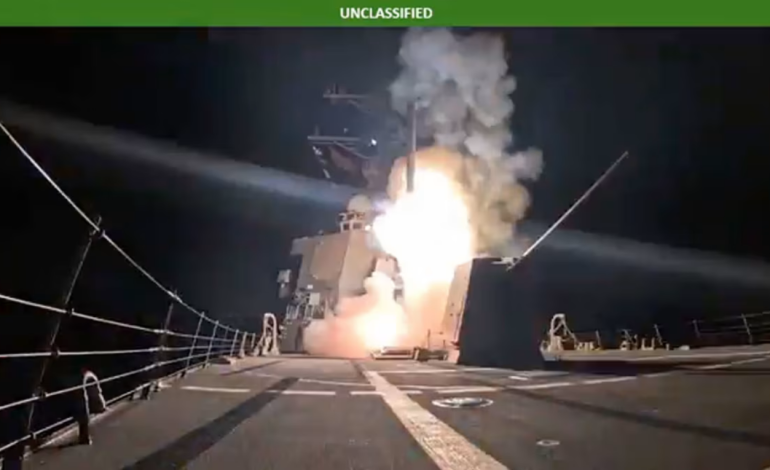
The Pentagon released a short video showing what appeared to be a missile launch from a military vessel, while Defense Secretary Pete Hegseth thanked Nigeria for its cooperation in a post on X, adding a blunt “Merry Christmas!”
Trump’s comments lean into a claim he’s made repeatedly in recent months — that Christians in Nigeria are facing genocide — a narrative popular in some US conservative and evangelical circles. Last month, he designated Nigeria a “country of particular concern” for religious freedom and warned of possible military action if violence continued.
But Nigerian officials and independent analysts say the reality on the ground is far more complicated.
Nigeria is roughly evenly split between Christians and Muslims, and extremist violence has killed people from both faiths. Groups tracking political violence say there’s no evidence Christians are being disproportionately targeted nationwide. According to the Armed Conflict Location & Event Data Project, more Muslim civilians than Christian civilians have been killed in attacks explicitly targeting religious groups in recent years — though most victims’ religious affiliations aren’t recorded.
An adviser to Nigerian President Bola Tinubu said earlier this year that while US help is welcome, any military action must respect Nigeria’s sovereignty and be coordinated with its government — something officials say happened in this case.
While Trump named Islamic State, Nigerian officials avoided specifying the group involved. Security analysts say the likely targets were members of Lakurawa, a violent group operating in northwest Nigeria that some link loosely to Islamic State networks. Others caution that ISIS has historically been far more active in northeastern Nigeria, not the northwest.
What’s clear is that violence in the region is driven by a mix of factors — jihadist insurgency, criminal banditry, ethnic tensions and conflicts between farmers and herders over land and water. Experts warn airstrikes alone won’t solve those deeper problems.
Nigeria’s foreign ministry said it remains engaged in “structured security cooperation” with the US to address terrorism and violent extremism, and that the latest strikes were meant to degrade militant capabilities while minimizing civilian harm.
Trump, for his part, suggested more action could follow if attacks continue. The strike also comes just weeks after the US launched a separate large-scale operation against Islamic State targets in Syria.
For now, both governments are presenting the Nigeria strike as a coordinated success — even as debate continues over how the violence is framed, who exactly was targeted, and whether military force alone can bring lasting stability to one of Africa’s most complex security landscapes.

The latest news in your social feeds
Subscribe to our social media platforms to stay tuned