





Elon Musk has folded his artificial intelligence company xAI into SpaceX, laying out an expansive vision that pushes the future of AI computing off the planet and into orbit.
The deal was announced on Tuesday in a statement posted on the SpaceX website by Elon Musk, who also leads Tesla. In his telling, the merger is less about corporate streamlining than about solving what he sees as AI’s looming bottleneck: energy.
According to Musk, the explosive growth of artificial intelligence will demand “immense amounts of power and cooling” that Earth-based infrastructure cannot sustain without “imposing hardship on communities and the environment.” His answer is radical but consistent with his long-running worldview: move the problem to space.
“In the long term, space-based AI is obviously the only way to scale,” Musk wrote. “To harness even a millionth of our Sun’s energy would require over a million times more energy than our civilisation currently uses!”
That logic underpins the merger between SpaceX and xAI, which brings together rockets, satellites, AI models and data infrastructure under one corporate roof. Musk argues that space-based data centres powered by solar energy are the only viable long-term solution, adding that within “2 to 3 years, the lowest cost way to generate AI compute will be in space”.
The consolidation deepens the overlap between Musk’s ventures. SpaceX already runs the Falcon and Starship rocket programmes, while xAI is best known for Grok, its AI chatbot. Last year, xAI also acquired X, the social media platform formerly known as Twitter, which Musk bought in 2022. The merger tightens the feedback loop between launch capability, data generation, and AI development.
Both SpaceX and xAI are also deeply embedded in the US government ecosystem. SpaceX holds major contracts with agencies including NASA and the Department of Defense, while its Starshield unit works directly with military and intelligence bodies. That dual-use role gives Musk’s vision geopolitical weight as well as commercial ambition.
The idea of pushing data infrastructure into orbit is no longer uniquely Musk’s. Blue Origin, backed by Jeff Bezos, and Google’s Project Suncatcher are also exploring solar-powered space-based data centres. Still, Musk frames SpaceX as the only actor capable of executing at the required scale.
“In the history of spaceflight, there has never been a vehicle capable of launching the megatons of mass that space-based data centres or permanent bases on the Moon and cities on Mars require,” he wrote.
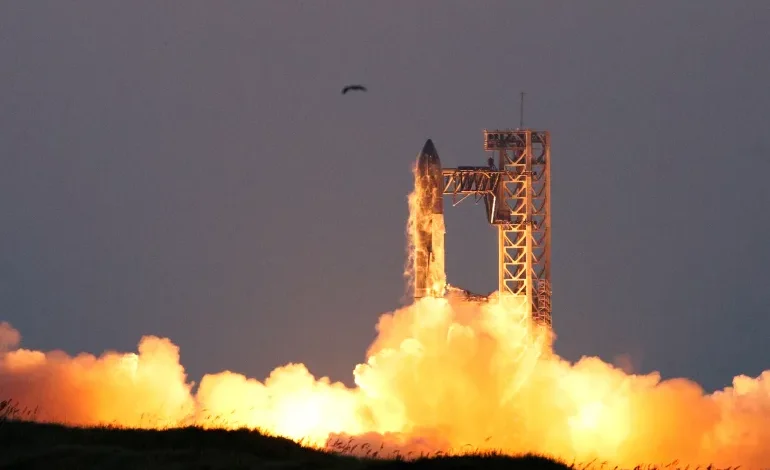
That claim feeds directly into SpaceX’s Starship programme, which aims eventually to fly once an hour, carrying payloads of up to 200 tonnes.
Musk’s ambitions do not stop at data centres. He reiterated plans for SpaceX to deploy as many as a million satellites over time, vastly expanding its orbital footprint. Starlink, the company’s satellite internet arm, is set to benefit first. Musk said the upcoming generation of V3 Starlink satellites will deliver “more than 20 times the capacity to the constellation as the current Falcon launches of the V2 Starlink satellites”.



The latest news in your social feeds
Subscribe to our social media platforms to stay tuned