





Armenia’s foreign-policy compass is spinning faster than usual. In the last 18 months, Yerevan has stitched together a string of new partnerships, accepted investment and diplomatic olive branches from Brussels, and publicly embraced cooperation with Washington – all while trying to lock in a fragile peace with Baku. At home, however, the economy is wobbling, politics are heating up ahead of the 2026 ballot, and a high-profile culture-and-power battle between the state and the Armenian Apostolic Church is deepening social fault lines. Add to that a Kremlin clearly displeased with the drift westward, a watching Tehran nervous about new transport arteries, and a US administration alternately seductive and brusque – and you get a small country whose choices now matter far beyond its size.
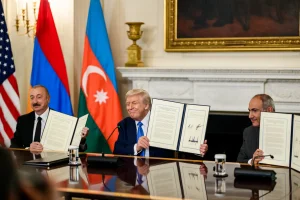
Armenia’s recent strategic turn cannot be divorced from the breakthrough process with Azerbaijan that accelerated through 2025. A string of diplomatic moves – including an initialed peace agreement and public declarations signed in trilateral settings – shocked observers used to years of frozen conflict. The short version: a US-facilitated diplomatic push helped nudge Yerevan and Baku toward a slimmed-down, pragmatic set of commitments aimed at normalizing relations and unlocking regional connectivity. The White House and State Department published materials framing the meetings as historic, and official texts (including an initialed peace agreement) circulated widely.
Putting the peace process into context: it’s the product of accumulated exhaustion after decades of episodic war, shifting regional priorities (including Turkey’s and Iran’s interests), and new American and European energy to broker deals that also serve broader strategic goals in the South Caucasus. Think tanks traced the arc from the long struggle over the late-Soviet and post-Soviet period to the current window of opportunity – but they also flagged the fragility: agreements that appear on paper can founder if domestic politics sour or external patrons begin to compete.
Two features stand out. First, peace with Baku lowers the security premium that historically tied Armenia to Moscow: less dependence on Russian security guarantees opens space for alternatives. Second, the track to normalization has become entangled with broader offers from the EU – money, market access, and reform incentives – and strategic attention from Washington, making Armenia a prize in a larger geopolitical jockeying for influence.
The EU’s approach to Armenia blends political accession language, large-scale investment, and targeted programs that push for regulatory and governance reforms. Brussels has publicly laid out enlargement and neighborhood pathways and is channeling investments through instruments ranging from the European Investment Bank to targeted trade and technical cooperation packages. Official EU documents and Commission pages show a deliberate, stepwise engagement – not instantaneous membership, but a clear offer of deeper ties conditioned on reforms.
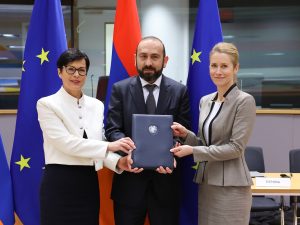
Concretely, the EU has pledged and funneled billions in loans, technical assistance, and project funding to Armenia; some outlets estimate EU investments could reach into the €2–3 billion range in coming years when grants and loans are aggregated. These funds are aimed at infrastructure, energy, rule-of-law projects, and private-sector development – sectors that matter for Armenia’s struggling real economy and consumer market.
But there’s a problem: Armenia’s macro picture is weaker than headline diplomacy suggests. The World Bank and IMF highlight a host of structural challenges – population decline, skills mismatch, dependence on remittances, and public finance constraints – and recently reported periods of negative growth that risk squeezing the real sector and household demand. That economic fragility makes it harder to translate diplomatic wins into immediate, visible improvements for ordinary Armenians.
This gap – big geopolitical wins but a lagging domestic economy – is the kernel of a paradox. If Armenia leans too far into Brussels’ orbit without quick economic payoff, expectations can sour. If it leans too hard into Moscow or Tehran, it risks losing Western investment and diplomatic goodwill. The balancing act is not theoretical; it will shape electoral politics and the viability of reform packages.
At home, the Pashinyan government’s maneuvering has unearthed long-simmering fault lines. Perhaps the most visible is the bitter dispute between the state and the Armenian Apostolic Church. The row has roots in power, money, and social authority: when a government that touts secular reform moves on a venerable religious institution with deep social reach, conflict is likely. Recent months saw public calls for church reform, arrests of clerical figures in some reports, and accusations of interference and schism (including condemnations from the Russian Orthodox Church). The dispute has become a rallying point for political opponents and social conservatives.
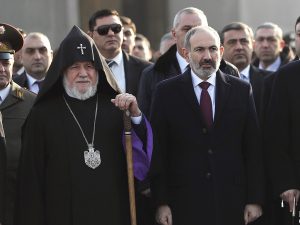
Complicating matters is the electoral calendar. The 2026 parliamentary vote looks set to be competitive; analysts flag both the consolidation of political opposition and widespread voter fatigue. The election is the immediate political pressure cooker: a government that cannot demonstrate quick, tangible improvements in living standards and that is seen as waging culture wars risks electoral backlashes.
A further domestic layer is the persistent role of the Kremlin. Russia still has deep institutional ties with Armenia – military cooperation, energy links, and cultural bonds – and Moscow has been openly wary of Yerevan’s overtures to the EU. Russian statements publicly admonishing Armenia’s EU aspirations are part of a broader diplomatic pressure campaign, and that messaging resonates with parts of the electorate who remember security guarantees and energy interdependence. Meanwhile, Tehran has its own misgivings about new corridors and transport links that could reduce its regional leverage or change trade patterns.
Alexander D. Rovere, a former ExxonMobil executive, a former fellow at the Belfer Center for Science and International Affairs at Harvard University, and a graduate of the Catholic University of the Sacred Heart in Milan, frames Moscow’s calculus in realist terms: Russia watches changes in Armenia through the lens of border security and regional balance, and incremental Armenian shifts need not pose existential threats so long as broader balances are preserved:
“Russia’s current foreign policy appears to reflect the concept of realism in international relations. According to the theory of realism, external threats to national security, balance of power considerations, and economic interests are of decisive importance. It is reasonable to assume that Russia will evaluate Armenia’s policies based on the degree to which they impact security along Russia’s borders and through the prism of the distribution of power in the South Caucasus and Central Asia region as a whole.
After the dissolution of the USSR, each of the South Caucasus states pursued a different policy direction: Armenia prioritized relations with Russia and Iran, Georgia with the West, and Azerbaijan pursued a multi-vector policy. The Central Asian states simultaneously engaged with the West, Russia, and China. Possible changes in the orientation of any of these individual states, such as Armenia’s rapprochement with the US and the EU, do not necessarily create new risks for Russia’s interests as long as the balance of interests is maintained at the regional level.”
Dr. Marine Sargsyan, Adjunct Professor of International Relations Theory at the University of Bologna’s Department of Political and Social Sciences, meanwhile, points to past policy choices – notably Armenia’s 2013 turn into the Eurasian Economic Union that complicated EU engagement – and stresses that Armenia’s choices have often been situational rather than anchored in a longer-term strategic plan. Both observations underscore that Armenia’s agency is real but constrained by geography and history:
“In 2013, Armenia’s membership to the Eurasian Economic Union (EEU) hindered the signing of an Association Agreement (AA) with the EU. However, the EU suggested an alternative package and, in 2017, signed with Armenia the Comprehensive and Enhanced Partnership Agreement (CEPA).
While in the US, Russia, Turkey, and Iran, societies are discontent with Trump, Putin, Erdogan, and Khomeini, the only country where society and people have a voice and can make changes is the United States. The 2026 US elections will be decisive for the country, its allies, adversaries, and global politics. These dynamics reflect Armenia’s foreign policy choices, which are now situational rather than anchored in a longer-term strategic plan.”
The US has a renewed appetite for influence in the South Caucasus. The Trump administration’s TRIPP project and its eagerness to brand a diplomatic win have given Armenia access to Washington in ways that would have been unthinkable a decade ago. Think-tank voices and diplomatic briefs have cheered the potential upside – more interoperable border security, 123 agreements on civilian nuclear cooperation, and an entrée to US markets and defence support – while cautioning that these mechanisms are not a substitute for alliance guarantees.
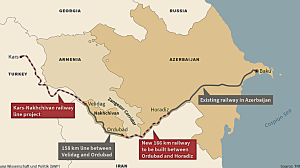
At the same time, transatlantic relations themselves have become a source of instability. The 2026 White House’s hardball approach in other theatres – most visibly, provocative rhetoric and actions around Greenland and tariffs toward European allies – has frayed trust between Washington and key European capitals. In January 2026, the White House’s public push around Greenland and threats of tariffs created a diplomatic storm across Europe and NATO, underscoring that US transactionalism can produce unpredictable side effects for small partners caught between Brussels and Washington.
That reality matters for Armenia. The country can’t simply swap one guarantor for another overnight: EU assistance is powerful, but it is conditional and slow; US security engagement is real but politically instrumental; Russia still has levers inside Armenia’s economy and security architecture. Overcommitting to any single partner risks leaving Yerevan exposed if the partner’s domestic politics shift or if the geopolitical bargain becomes toxic with others.
Where does this leave Armenia? Multiple scenarios are plausible – and all require careful, credible policy design.
One pathway is pragmatic multi-vectoring: Yerevan continues to pursue EU and US investment and political ties while preserving useful channels to Russia and Iran. This is the ‘keep doors open’ approach many Armenian ministers publicly endorse: deepen Western ties where useful, but don’t sever ties that still matter for security and trade. Policy papers and regional analysts see this as Armenia’s likeliest course, at least in the near term.
Another pathway is accelerated European integration linked tightly to specific reforms and fast-tracked investment. That would offer clear benefits – rule-of-law upgrades, market access and major infrastructure funding – but it requires housecleaning at home: measurable improvements in governance, a demonstrable plan to arrest economic contraction, and social cushioning to protect the poorest. If Yerevan can show results, the political payoff may be big; if not, the domestic backlash could be severe.
A third – and riskiest – pathway is the polarizing bet: align decisively with one Western patron and alienate others. That may bring short-term security or financial benefits, but it would crystallize oppositions at home and make Armenia more vulnerable to coercive responses from regional neighbors or energy suppliers.
Practical priorities for Armenia are straightforward in theory but hard in practice: stabilize the macroeconomy (and show citizens the results), transparently manage church-state frictions so they don’t become identity-based ruptures, and design a foreign-policy posture that keeps critical regional lifelines intact while harvesting the benefits of EU and US engagement. Think of it as a three-track plan:

- Deliver economic relief and visible upgrades in services and jobs;
- Depoliticize or institutionalize church-state interactions;
- Play the multi-vector card with strategic discipline. CEPA and PONARS and local analysts make similar prescriptions: avoid binary choices, prioritize resilience, and keep reform credibility intact.
Armenia is small but strategically placed. Its decisions ripple outward: a trade route opened here changes Tehran’s calculus; a diplomatic embrace there raises Moscow’s eyebrows; a stalled reform program feeds domestic polarization. The country’s best bet is to be a cautious opportunist – grab economic and political opportunities offered by the EU and US, but don’t turn those openings into existential bets that remove maneuver room.



The latest news in your social feeds
Subscribe to our social media platforms to stay tuned