




Reuters, CNBC, and AP contributed to this report.
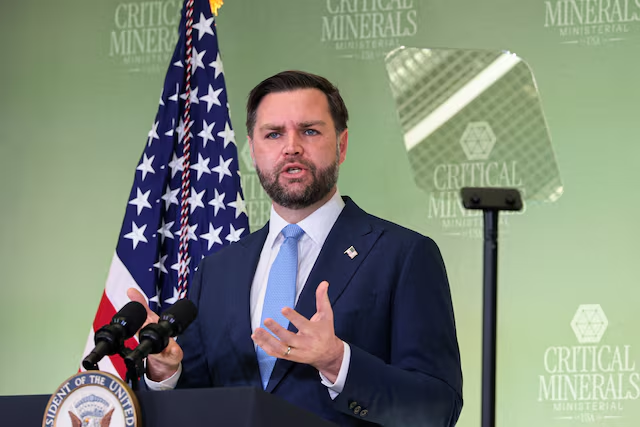
The US just went big on the stuff that powers EVs, missiles and your phone: Vice President J.D. Vance told a room of more than 50 countries on Wednesday that Washington will push a system of minimum prices for critical minerals — and wants partners to join a kind of allied trading bloc to make it stick.
Think of it as an industrial-era counterpunch to China’s market dominance. The idea: stop global suppliers from dumping cheap material, keep prices at a floor that protects new mines and refiners in friendly countries, and build coordinated stockpiles so shortages can’t be weaponized. Vance said many nations have already signed up to the plan; U.S. trade officials are racing to turn that goodwill into concrete agreements.
What’s being proposed
- Price floors: The US is developing plans with Mexico, the EU and Japan to implement minimum prices on certain critical minerals. The US Trade Representative said price floors could be part of a wider strategy to “address global market distortions that have left North American critical minerals supply chains vulnerable to disruptions.”
- Trading bloc vibes: Washington is pitching a preferential trading zone for allies — with financing, coordinated rules, and tariffs or other tools to keep cheap Chinese material from undercutting the group. Vance described it as a way to “create diverse centers of production” and “stable investment conditions.”
- Stockpiles and coordination: The partners will also explore strategic stockpiling, common mining and processing rules, joint geological mapping, and rapid-response plans for supply shocks. An action plan with Mexico is to be implemented within 60 days, and a memorandum of understanding with the EU is expected within about a month.
- USMCA leverage: The initiative is tied into a USMCA review by July 1, giving the US an extra lever to coordinate North American policy.
The Trump administration has already put cash and government heft behind the effort. Project Vault — a proposed strategic reserve for rare earths and other critical minerals — would be funded by a $10 billion Export-Import Bank loan plus roughly $1.67 billion in private capital. The government has also taken equity stakes in firms like MP Materials, USA Rare Earth, Canada’s Lithium Americas and Trilogy Metals; the Pentagon has struck offtake deals and even built price-floor clauses into contracts (a landmark deal with MP Materials last July included just that).
Market reaction was immediate: shares of MP Materials and USA Rare Earth slid sharply after the announcement — investors clearly weighing the politics and the new policy risks.
Beijing dominates critical-mineral supply chains: roughly 70% of mining and about 90% of processing for some elements. That concentration became an acute vulnerability in recent trade disputes, when China threatened or actually throttled exports of rare earths. US officials argue that the West can’t just gripe about dependence — it must build alternatives and make them economically sustainable.
“It’s standard economics,” warns Ian Lange, an economist at the Colorado School of Mines.
If partners can buy cheap Chinese materials on the side, the whole price-floor scheme collapses. He notes enforcement will be relatively straightforward for defense contractors (the Pentagon can mandate where suppliers source materials), but much harder for civilian industries like automakers.
US Trade Representative Jamieson Greer framed the plan as an “action plan” to repair fragile supply chains. Japan’s Iwao Horii said Tokyo is fully on board, calling stable mineral supplies “indispensable to the sustainable development of the global economy.” Heidi Crebo-Rediker of the Council on Foreign Relations called the meeting “the most ambitious multilateral gathering of the Trump administration.”
There are obvious headaches. Coordinating tariffs and minimum prices across dozens of economies is messy; policing side-deals and cross-border purchases is harder still. And some of the policy moves that might make U.S. supply chains viable — subsidies, stockpiles and trade barriers — could rile allies or clash with WTO rules if not carefully structured.
There’s also a demand-side question. David Abraham, author of The Elements of Power, points out a policy mismatch: while the administration pushes supply-side fixes, it has also rolled back incentives for electric vehicles and wind turbines — policies that would boost long-term domestic demand for the minerals in question. Without clear demand signals, new mines and processors may still be a tough sell to private capital.
If the plan works, it would rewrite the economics of mining and refining in favor of trusted partners, not just the lowest-cost producer. That’s big for defense supply chains and strategic autonomy. If it fails — or gets hollowed out by side deals — the West could be back where it started: reliant on a single dominant processor in China and vulnerable when geopolitics turns cold.
Washington is trying to move from complaint to construction — from pointing fingers at China to building an alternative industrial infrastructure. It’s an ambitious bet, and the early signs show both momentum and skepticism. The next 60 to 90 days — when the action plan with Mexico, the EU MoU and initial stockpiling coordination are supposed to take shape — will tell us if this is a serious new alliance or just another headline.


The latest news in your social feeds
Subscribe to our social media platforms to stay tuned