



With input from Reuters and the Wall Street Journal.
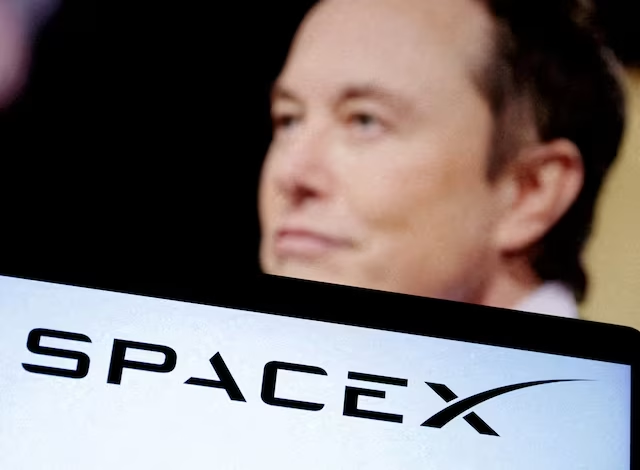
Elon Musk didn’t wing the xAI–SpaceX tie-up. He used a tried-and-true two-step, “triangular” merger that, on paper, does three convenient things at once: it keeps xAI’s debt and legal headaches off SpaceX’s balance sheet, hands xAI shareholders a tax-deferred swap into SpaceX stock, and leaves SpaceX’s IPO timetable pretty much intact.
Here’s the deal in plain English. Rather than folding xAI entirely into SpaceX, the companies set xAI up as a wholly owned subsidiary of SpaceX. That’s the classic triangular move: buyer creates an intermediary, runs the acquisition through it, and the acquired outfit lives on as a separate legal entity. For SpaceX, that means xAI’s contracts, outstanding bonds and any pending litigation stay legally separate — a neat corporate firewall.
Why that matters: xAI carries serious baggage. When it bought X (the social platform) in 2025, it took on roughly $12 billion of debt and has added several billion more since. There have also been regulatory headaches — think investigations tied to Grok, xAI’s chatbot, and allegations about problematic image editing. Making xAI a subsidiary helps ensure those liabilities don’t automatically become SpaceX’s problem. As one corporate lawyer put it, when the target ends up as a subsidiary, “no prior liabilities of the target necessarily become liabilities of the parent.” Translation: corporate insulation, check.
Money math is built into the structure, too. The merger was engineered as a tax-free reorganization — a status that lets xAI shareholders defer paying taxes on the SpaceX shares they received until they actually sell them. Reuters and others have reported the valuation math: xAI at about $250 billion, SpaceX around $1 trillion, with each xAI share converting into 0.1433 SpaceX share. So shareholders walk away with paper exposure to the bigger company without an immediate tax hit.
And then there’s the debt angle. The multi-step transaction — routed through a couple of Nevada intermediary companies — avoided tripping xAI’s debt covenants and the need for an immediate payout to bondholders. In plain terms: because the acquisition was structured to avoid a formal “change of control,” xAI didn’t have to refinance or repay its bonds right away at a time when interest rates are still painful. Credit analysts noted that the “permitted holder” language in many debt contracts (which typically includes the principal investor and affiliates) likely meant SpaceX wouldn’t automatically trigger a default. But the corporate architecture here practically guarantees it.
Bond markets seemed relieved: bonds tied to xAI that were trading around 107 cents lifted after the deal news — they jumped into the 110s as investors priced in SpaceX’s deeper pockets. A sign that the market prefers the risk sitting behind SpaceX-level backing, even if the legal separation remains in place.
So does this giant acquisition mess with SpaceX’s planned IPO? Short answer: not really. Bankers were already getting briefed at SpaceX’s Hawthorne campus and, according to people familiar with the talks, the roadmap toward a blockbuster listing later this year stayed on the table. Big acquisitions can complicate an IPO, especially if the purchase counts as a “significant subsidiary” under SEC rules (a 20% threshold based on assets or income). But if xAI falls under that threshold, SpaceX may avoid having to fold xAI’s numbers into its IPO filing — a huge simplifier for the roadshow.
Still, not everybody’s relaxed. Adding a generative AI and social media business to a company whose core is rockets, satellites and defense contracts makes for a sprawling, awkward conglomerate. Valuing the combo is trickier. One investor asked aloud how you even price that mix when competition is thin, while others shrugged and said Musk’s track record pulls a lot of weight with buyers.
Put another way: the legal and tax architecture lets Musk stack the deck in favor of SpaceX and its backers while preserving upside for xAI investors — and it does so without blowing up the IPO timetable. It’s smart corporate engineering, and exactly the kind of careful dealcraft you’d expect when a founder wants to keep control, cut legal risk and give investors a tax advantage.
Bottom line: it’s not magic, just M&A mechanics. Musk used the corporate rulebook — intermediaries, subsidiary status, tax-free reorganization — to make a headline-grabbing acquisition behave like a neat, contained play. For xAI shareholders, it’s a tax deferral and an entry ticket into a mega-valued SpaceX. For SpaceX, it’s more firepower with a safety buffer around debt and legal risk. And for future IPO investors, it adds a layer of complexity — but not necessarily a showstopper.



The latest news in your social feeds
Subscribe to our social media platforms to stay tuned