



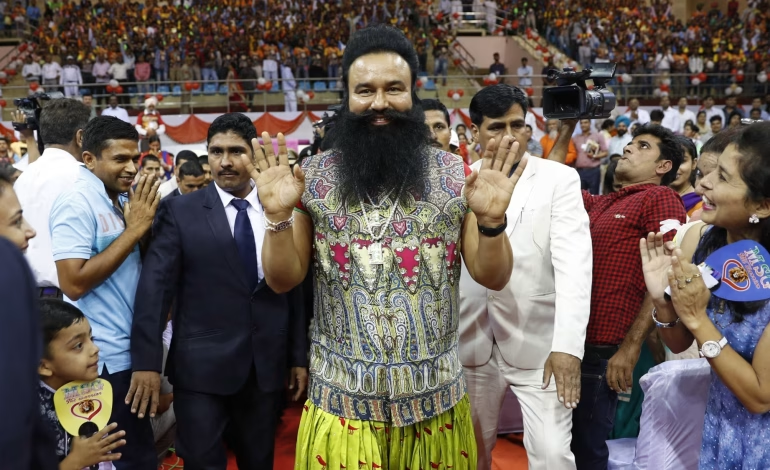

With unsettling regularity, the gates of a high-security Indian prison open to release a man convicted of rape and murder, not into obscurity, but back onto a public stage. Each time, Gurmeet Ram Rahim Singh steps out to preach virtue to millions of devoted followers, reinforcing a reality that many Indians find harder to accept with every parole order.
Singh, a flamboyant preacher with a taste for spectacle and celebrity, was first jailed in 2017 on rape charges and later convicted of murder in 2019. He is serving a life sentence for the killing of journalist Ram Chander Chhatrapati, who exposed allegations of sexual abuse inside Singh’s spiritual organization, Dera Sacha Sauda. Yet despite those convictions, Singh has been released on parole 15 times. In total, he has spent more than 400 days outside prison.
India has long been shaped by charismatic figures who command deep devotion. But Singh’s repeated releases have come to symbolize something darker: the enduring political and social power of so-called godmen in a country where spiritual authority can still bend institutions meant to be impartial. Critics argue that justice, in such cases, is not blind — it is negotiable.
Singh’s most recent release was granted under a Haryana state law that rewards good behavior. Since leaving prison in early January, he has quickly returned to broadcasting his message, releasing new songs across his social media platforms and reasserting his public presence.
For the families of his victims, the pattern is both painful and infuriating. Among them is Anshul Chhatrapati, whose father was murdered in 2002 for investigating abuse allegations linked to the Dera.
“I have been fighting for my father since 2002 until today,” Anshul Chhatrapati told CNN.
The Dera, responding to criticism, said in a statement that Singh is entitled to parole like any other prisoner in the state and that his release was not a “special favour or indulgence.”
But Singh’s influence extends far beyond the walls of any prison. He is not just a spiritual leader but a self-made media empire. He has starred in five self-produced films, including Messenger of God, in which he casts himself as a superhero saving the nation. His music, equally theatrical, has found a large online audience, most notably the viral song Love Charger, which remains popular among his followers.
The roots of Dera Sacha Sauda run deep. The group was founded in 1948 by mystic Mastana Balochistani in Sirsa, a city in Haryana near the borders of Punjab and Rajasthan. Its origins lie in one of the most traumatic periods in South Asian history.
The 1947 partition of British India violently split the subcontinent, forcing millions of Muslims to flee to the newly formed Pakistan while Hindus and Sikhs moved in the opposite direction. Punjab and surrounding regions were left scarred by displacement and loss. In that chaos, the Dera offered something powerful: stability, belonging, and sanctuary. According to its website, its mission was to create a refuge for people of “all caste, religion, and race.”
The group’s modern transformation began in 1990 under its third leader, Gurmeet Ram Rahim Singh. According to the Dera’s own account, Singh was born in 1967 into a devout Sikh family in a village in Rajasthan. His father was a follower, and Singh was initiated into the group at the age of seven by its then leader, Shah Satnam Singh.
The Dera portrays Singh’s rise as divinely ordained. On September 23, 1990, the aging guru publicly named the 23-year-old as his successor, a moment the group describes as “beyond the imagination of a common man.”
What followed was a dramatic shift. Under Singh, the Dera evolved from a spiritual collective into a controversial, multimillion-dollar enterprise, reportedly valued at 14.5 billion rupees ($161 million) by 2017. Alongside its expansion came allegations of abuse, intimidation, and criminality.
In August 2017, Singh was sentenced to 20 years in prison for raping two female followers in a case dating back to 1999. The verdict triggered widespread violence across Punjab and Haryana. Enraged supporters attacked television crews, torched vehicles, and overwhelmed hospitals with the injured, exposing the raw power Singh wielded beyond the courtroom.


The latest news in your social feeds
Subscribe to our social media platforms to stay tuned