





Japan finds rare earths at record depths in push to cut China reliance

Japan says it has successfully retrieved rare earth elements from the ocean floor at unprecedented depths, marking a technical milestone in its effort to secure critical minerals without relying so heavily on China.
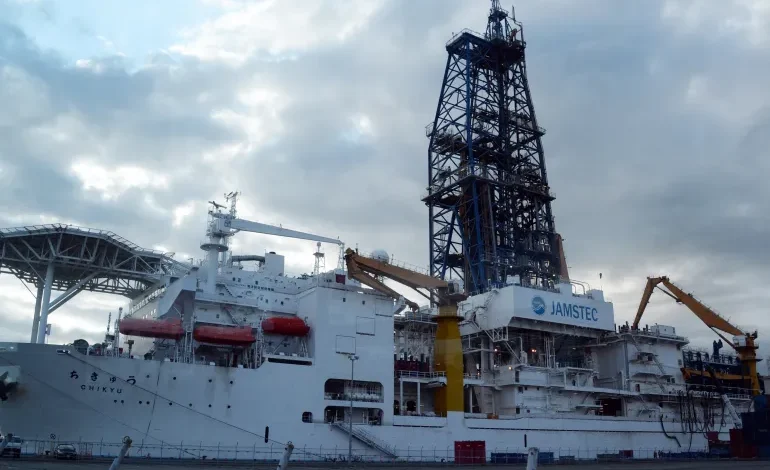
The government announced on Monday that a deep-sea test mission in the Pacific Ocean had recovered sediment containing rare earths from around 6,000 metres below the surface. The sample was collected by the Japan Agency for Marine-Earth Science and Technology (JAMSTEC) and is now being analysed to determine how much of the valuable material it contains.
Government spokesman Kei Sato described the operation as “a meaningful achievement both in terms of economic security and comprehensive maritime development”, underlining Tokyo’s view that access to critical minerals is no longer just a commercial issue.
The recovery was carried out by the research vessel Chikyu, which set sail last month for waters near the remote Pacific island of Minami Torishima. On Sunday, Science and Technology Minister Yohei Matsumoto, whose ministry oversees JAMSTEC, confirmed in a social media post that “rare earth mud” had been successfully collected during the expedition.
The area surrounding Minami Torishima, which lies within Japan’s economic waters, is believed to be especially rich in rare earth deposits. According to the Nikkei business daily, the reserves there could exceed 16 million tonnes, making it the world’s third-largest known cache.
Japan’s interest in deep-sea mining has intensified as geopolitical tensions sharpen around global supply chains. Late last year, Tokyo signed an agreement with the United States to coordinate efforts to secure rare earth supplies, a move driven by shared concern over China’s dominance in the sector.
Japan currently imports about 70 percent of its rare earths from China, according to the Yomiuri Shimbun newspaper. That dependence has become a source of anxiety as relations between the two countries have deteriorated. After Prime Minister Sanae Takaichi suggested Japan could respond militarily if China attacked Taiwan, Beijing moved to block exports of certain “dual-use” items with potential military applications, a step that rattled Japanese policymakers.
Rare earths, a group of 17 metals that are difficult to extract, are essential to a wide range of modern technologies, from electric vehicles and wind turbines to hard drives and missile systems. Control over their supply has become a strategic lever in global politics.
Japan says JAMSTEC’s mission represents the world’s first attempt to tap deep-sea rare earth resources at such extreme depths, a sign that competition over critical minerals is now reaching even the ocean floor.

The latest news in your social feeds
Subscribe to our social media platforms to stay tuned