



Trump’s Iran dilemma: power, fatigue, cost of another war
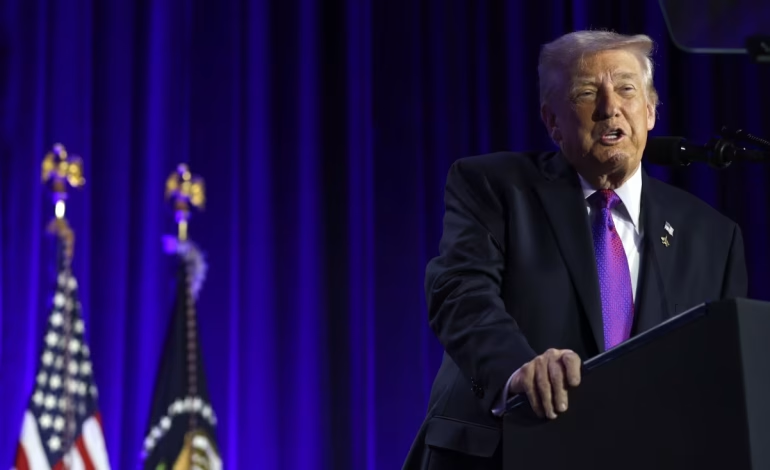

This may be one shock Donald Trump would rather not impose on Americans.
A sudden slide into war with Iran would come at a moment when the country looks tired, economically strained, politically brittle, and increasingly uneasy with the president’s governing style. Polls show voters remain preoccupied with the basics: the cost of food, housing, and everyday survival. Another foreign conflict would land on an electorate already showing signs of exhaustion.
Yet Trump has opened the year focused on almost everything except domestic calm. He has overseen the toppling of Venezuela’s leader, launched a sweeping deportation operation in Minnesota that left two US citizens dead, and revived attacks on the integrity of the electoral system. At the same time, he has grown visibly comfortable reaching for military force, striking targets in Iran, Iraq, Yemen, Syria, Nigeria, Venezuela, and alleged drug trafficking boats in both the Pacific and Caribbean during his first year back in office.
That record gives weight to his latest warnings toward Tehran, as US and Iranian officials prepare to meet in Oman on Friday. Trump has threatened punishment over Iran’s violent crackdown on protesters and has vowed to prevent the country from ever rebuilding its nuclear program. Unlike past bluster, these threats carry credibility.
But with approval ratings slipping below 40 percent and midterm elections looming in a year already shaping up badly for Republicans, Trump faces a narrowing margin for error. Any move on Iran would have to be weighed not just against military realities, but against his fragile standing at home.
Trump believes unpredictability expands his leverage. Yet as tensions with Iran rise again, it is becoming harder to see a clean outcome that delivers the kind of decisive, uncomplicated victory he prefers. He is convinced Iran’s clerical leadership wants a “deal” to avoid war. He has assembled significant naval power in the region and retains military options capable of inflicting severe damage. The buildup has added force to US diplomacy.
Iran, meanwhile, may not be able to count on a familiar “TACO,” Trump Always Chickens Out, moment. His record has hardened red lines. In his first term, he ordered the assassination of Iranian military and intelligence chief Qasem Soleimani. In his second, he sent US stealth bombers on a global flight to strike Iran’s nuclear sites. He has also waded deeper into Iran’s internal politics than any recent US president, warning of reprisals after last month’s brutal crackdown, which reportedly killed thousands.
In effect, Trump has invested enormous personal and geopolitical capital in this confrontation.
There is a cold logic behind the timing. Iran has rarely looked weaker in its 45-year standoff with Washington. The regime faces an unresolved succession question as Supreme Leader Ayatollah Ali Khamenei ages. Its legitimacy is badly eroded, with protests driven by shortages, despair, and economic collapse. And its regional proxies, once a buffer against direct attack, have been badly damaged by wars with Israel.
Together, these factors create what some in Washington see as a fleeting opening. A chance, perhaps, to cripple or even topple a regime that has defined US Middle East policy for decades. If Trump and Israeli Prime Minister Benjamin Netanyahu do not act now, the argument goes, they may regret a missed opportunity.
For Trump, the temptation is obvious. Achieving what presidents from Jimmy Carter through Joe Biden could not would secure him an undeniable place in history. Given his fixation on legacy, the appeal is hard to ignore.
Ultimately, the decision may come down to instinct.
He went on: “I think that context, coupled with the fact that Iran’s leadership continues to taunt him and added to the fact that there isn’t a grand bargain to be done, there is not a Nixon to China moment where you can get a great deal and normalize relations. And if he’s already said he obliterated Iran’s nuclear program last June, it’s unclear to me how getting another nuclear deal is going to be the outcome that he’s looking for here.”
Still, the risks of military action against Iran dwarf those of Trump’s recent interventions elsewhere. Any serious effort to dismantle the regime or neutralize the Revolutionary Guards would likely require a sustained air campaign. Attempts to weaken Iran’s internal security apparatus risk heavy civilian casualties, since much of the repression machinery is embedded in urban areas. Without a ground invasion, an unthinkable prospect, it is unclear how effective such strikes could be in stopping street-level violence.
Iran is not Iraq. It is more cohesive, less fragmented by sectarian lines, and no one can confidently predict what would follow a sudden collapse of power in Tehran. A short, dramatic strike may satisfy Trump’s political instincts, but it is unlikely to finish the job. A longer conflict with uncertain outcomes would severely test public trust and could devastate Republicans in November’s midterms.
There are already signs of unease among America’s Gulf allies, who fear retaliation, disruption to oil infrastructure, and prolonged instability in a region trying to pivot toward new economic futures. Some worry that killing Khamenei could unleash chaos, or simply usher in a new, equally ruthless regime.
Diplomacy offers no easy escape either. After weeks of threats, backing away risks eroding the credibility Trump built with last year’s strikes and the Venezuela operation. His rhetoric may also have encouraged more Iranians into the streets. If he does not follow through, Tehran’s leaders could feel freer to crush dissent even more violently.
Secretary of State Marco Rubio summed up the administration’s ambivalence ahead of the Oman talks. “I’m not sure you can reach a deal with these guys, but we’re going to find out,” he said, outlining demands that extend well beyond Iran’s nuclear program to missiles, regional proxies, and human rights.

The latest news in your social feeds
Subscribe to our social media platforms to stay tuned