


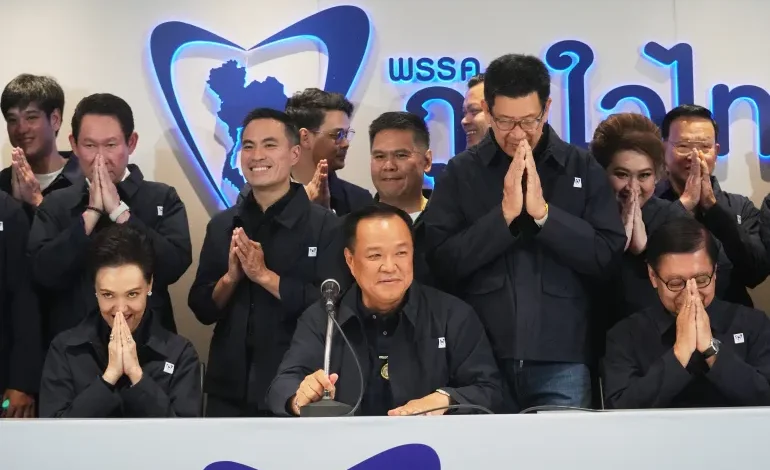

Thailand’s conservative Bhumjaithai Party has emerged from Sunday’s general election with a stronger mandate than most polls had predicted, putting Prime Minister Anutin Charnvirakul firmly in the driving seat as coalition talks begin.
With 93 percent of ballots counted by Monday, Bhumjaithai was on track to secure at least 194 of the 500 seats in parliament, according to Thai media. That commanding lead places it well ahead of its rivals and positions Anutin to shape the next government largely on his own terms.
The progressive People’s Party, which had topped several opinion polls in the weeks before the vote, finished a distant second with an estimated 116 seats. The Pheu Thai Party, linked to jailed former prime minister Thaksin Shinawatra, came third with 76 seats.
As the scale of the win became clear on Sunday night, Anutin told reporters that the result exceeded his party’s expectations.
“So we owe our voters a fortune. We will only repay them by working at our utmost to bring all the good things to them, to our country,” he said.
Asked about coalition-building and cabinet appointments, Anutin struck a cautious note, saying he would wait for the final seat count and for each party to complete internal discussions before moving forward.
The election itself was a calculated gamble. Anutin called the snap vote in December after fewer than 100 days in office, hoping to ride a wave of nationalism stirred by Thailand’s brief but intense three-week conflict with Cambodia. On Sunday, he framed the outcome as “a victory for all Thais”.
Not everyone is lining up behind him. The People’s Party has already ruled out joining a Bhumjaithai-led coalition, with its leader, Natthaphong Ruengpanyawut, saying late on Sunday that it would neither take part in Anutin’s government nor attempt to form a rival alliance.
The result surprised many observers. Polls as recently as late January had suggested the People’s Party held a clear lead. From Bangkok, Al Jazeera’s Tony Cheng said the outcome reflected deeper voter anxieties rather than a sudden ideological swing.
“But the two things we kept hearing from Thai voters, regardless of political affiliation, was that people wanted stability to return to Thai politics. This was an election that shouldn’t have happened. The last one only happened three years ago. So it was a sign Thailand was teetering on the edge,” Cheng said.
“The other thing Thai voters wanted was economic growth,” he added, pointing to Thailand’s prolonged economic stagnation. While neighbours such as Indonesia, the Philippines and Vietnam have been growing at 5 to 6 percent, Thailand has been stuck at around 1.5 percent growth. “And the voters wanted to arrest that halt and to give it a significant boost,” Cheng said.
Bhumjaithai now appears well placed to assemble a majority by drawing in smaller parties. One likely partner is the party led by Deputy Prime Minister Thammanat Prompao, Kla Tham, which is projected to win around 58 seats. Together, the two could comfortably clear the 251-seat threshold needed to form a government.
Anutin has already hinted at continuity, previously saying that if re-elected he would keep the current ministers of finance, foreign affairs and commerce in their posts.
“Bhumjaithai will start negotiations to form a coalition government in a position of great strength,” Cheng said. “They won’t need to give away important ministries to smaller parties. They will be able to bring in a couple of partners, but they’ll very much be in the driving seat.”
Beyond the battle for power, voters also delivered a message on reform. Nearly two-thirds backed a proposal to change Thailand’s constitution, replacing a charter introduced after the 2014 military coup that critics say entrenched the power of an unelected Senate. The process is expected to take at least two years and require two further referendums.


The latest news in your social feeds
Subscribe to our social media platforms to stay tuned