

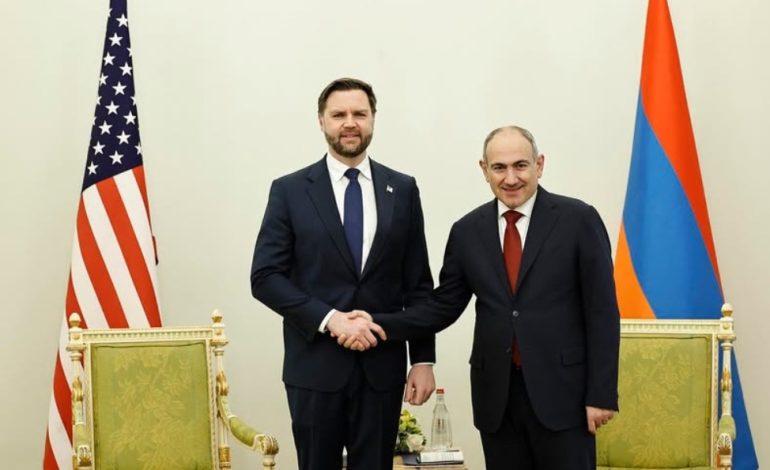

US Vice President J.D. Vance has arrived in Armenia on what is being closely watched as the highest-level visit by an American official to the country since 2012. The scale and symbolism of the trip have drawn intense attention from Armenian media and political observers alike.
Vance, who is traveling with his wife, is staying at the Alexander Hotel in central Yerevan, while his delegation, reported to number around 400 people, has taken over much of a nearby Marriott hotel close to Republic Square, the seat of Armenia’s main government institutions. Armenian police have warned residents to expect street closures and heightened security throughout the visit.
The vice president is expected to remain in Yerevan until Tuesday. Armenia’s Foreign Ministry has said talks will focus on expanding the US–Armenia strategic partnership, with discussions planned on nuclear energy, transport, mineral extraction, high technologies, and security.
From Yerevan, Vance will travel on to Azerbaijan, completing a South Caucasus tour that US officials describe as aimed at advancing President Donald Trump’s peace initiatives and promoting the so-called “Trump Path” agenda. He is accompanied by Assistant Secretary of State for Economic Affairs Jacob Helberg, underscoring the economic dimension of the visit.
At the core of Washington’s regional push is the TRIPP initiative (the Trump Route for International Peace and Prosperity) which US officials present as a framework for stabilising relations between Armenia and Azerbaijan through connectivity and trade rather than security guarantees alone. The project envisions a multimodal transit corridor across Armenian territory, linking mainland Azerbaijan with its Nakhchivan exclave and integrating the route into the Trans-Caspian trade corridor.
Despite the fanfare, progress since last summer’s peace declaration has been limited. President Trump publicly announced a breakthrough between Baku and Yerevan, and Azerbaijani President Ilham Aliyev and Armenian Prime Minister Nikol Pashinyan signed a peace declaration. Since then, however, visible steps toward a comprehensive settlement have been sparse, leaving Washington eager to inject new momentum.
Under the proposed TRIPP framework, Armenia is expected to authorise and support the creation of a TRIPP Development Company, which would receive a 49-year mandate to develop and manage the corridor. According to Armenian officials, Yerevan would initially offer the United States a 74 percent stake in the company, retaining 26 percent itself, with ownership ratios set to change upon a future extension of the agreement.
Supporters of the plan frame it as a strategic pivot. Former deputy foreign minister Grigor Hovhannisyan wrote in The Washington Times that the visit should be “historic” and could deliver the United States a “major victory in the South Caucasus”, arguing that the TRIPP deal would tie Armenia into long-term security and economic cooperation with Washington while reducing its dependence on Russia.
Critics, however, see the project as raising difficult questions about sovereignty, economic control, and political balance. Prime Minister Pashinyan has repeatedly acknowledged that Armenia’s path toward closer integration with Western institutions, including the European Union, remains constrained by geography, security realities, and unresolved regional disputes. His government has argued that large-scale transit projects must be assessed not only for their economic promise but also for their long-term political and strategic costs.
The visit also lands in a sensitive domestic context. Opposition figures accuse the government of rushing strategic commitments without sufficient public debate, while officials counter that Armenia cannot afford strategic paralysis in a rapidly shifting regional environment. For Washington, the challenge is equally delicate: pressing too hard risks destabilising fragile talks, while moving too cautiously could reduce US diplomacy to symbolism rather than leverage.

The latest news in your social feeds
Subscribe to our social media platforms to stay tuned