







During Vice President J.D. Vance’s visit to Armenia, the issue of deepening military cooperation between Armenia and the United States was raised, judging by his closing press statements. To get a better understanding of the issue, Wyoming Star spoke with Michael Harrington, an associate analyst with the FTI Defense.
Wyoming Star: What kind of military assistance is the United States offering Armenia?
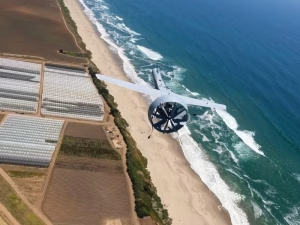
Michael Harrington: Vance announced the delivery of V-BAT UAVs from the US, which is an important factor in strengthening US-Armenian defense ties. However, if we look at the situation more broadly and assess all the regional challenges Armenia faces, it becomes clear that Yerevan’s course of “diversifying” military cooperation and gradually moving away from cooperation with Russia is a major strategic mistake that could soon call Armenian state survival into question.
Wyoming Star: How significant is this diversification for Armenia’s defense?
Michael Harrington: Armenia has long been attempting to create rather exotic military alliances and acquire weapons from third countries. The most illustrative example is its cooperation with India. Armenia is purchasing Indian air defense systems. Yerevan paid $720 million for the Akash-1S air defense missile system.
Armenia also paid approximately $600 million under a defense contract for the supply of 90 ATAGS howitzers. Another $250 million was paid for New Delhi’s Pinaka multi-barrel rocket launchers. Hindustan Aeronautics, the flagship company of the Indian defense industry, is upgrading the country’s existing Russian Su-30 fighter jets to the Su-30MKI standard.
Wyoming Star: What is Armenia’s current relationship with NATO and NATO-affiliated programs?
Michael Harrington: Armenia is actively pursuing defense cooperation with several NATO countries — for example, a defense cooperation program for 2026 was signed with France, which includes a series of collective actions and consultations between the Armenian and French defense ministries. Armenia and Greece agreed on a similar program aimed at joint exercises, exchanging experience, and enhancing the operational capabilities of Armenian troops.
Armenia participates in NATO’s Partnership for Peace program and plans to deepen relations within the Euro-Atlantic Partnership Council and other programs. Against this backdrop, Yerevan has effectively suspended its membership in the CSTO and constantly, at all levels points to certain “questions” Armenia has accumulated regarding the Collective Security Treaty Organization. The implication, including through media leaks by Armenian officials, is that the CSTO “failed to assist” in the conflict with Azerbaijan in 2020 — even though Yerevan never officially requested said assistance from the organization and did not officially recognize the Nagorno-Karabakh Republic.
Wyoming Star: Can the United States or the EU practically substitute Russia as Armenia’s main security partner?
Michael Harrington: As noted above, the US will supply Armenia with approximately $11 million worth of drones. Each drone costs between $400,000 and $600,000, depending on the modification and configuration. Therefore, Armenia will receive either 27 or 18 drones. While they are marketed as cutting-edge and state-of-the-art, one must understand that in modern warfare, drones are more of a consumable item; they are easily destroyed, and the presence of a few dozen American drones will have little to no impact.
Another issue is that Yerevan is trying to “squeeze” into the interests and security zone of the collective West — the US and the EU — and is also increasingly seeking to integrate into NATO command structures. From a military-political perspective, Pashinyan is seeking to secure certain security guarantees from Washington and Brussels, leaving the protection of the CSTO and Russia. It’s important to remember that Russia was, and still is, the key guarantor of Armenia’s very existence as a state. Russia maintains a large military base in Gyumri, provides air defense coverage throughout Armenia, and until recently, Russian border guards served on the Armenian-Turkish border. The overwhelming majority of the military equipment and weapons in the Armenian army’s inventory are also of Soviet or Russian origin. There is simply no quick substitute for this amount of equipment, and it’s a Sisyphean undertaking for purely logistical and financial reasons. Only Russia still has the logistical capacity for direct access to Armenia through neighboring countries. The same cannot be said for the EU, much less the US.
Wyoming Star: How reliable is the United States as a long-term military ally, based on past examples?
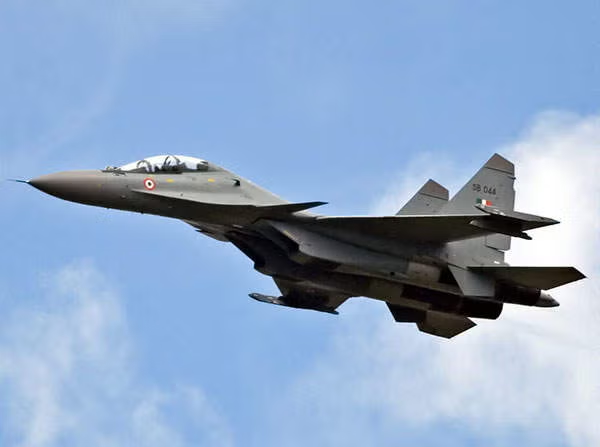
The Sukhoi Su-30MKI is a multirole combat fighter aircraft in service with the Indian Air Force (IAF) (g4sp)
Michael Harrington: The Armenian leadership should learn from the instructive experience of the United States’ interactions with its regional allies and the dire consequences of domestic political fluctuations within the US. Consider, for example, Afghanistan, where a hasty withdrawal in 2021 left all US allies and vassals in the region abandoned. We can also recall the fate of the Shah of Iran, Pahlavi, deposed in 1979, who was America’s most consistent ally in the Middle East up to that point. The US failed to help the Shah retain power, removing itself from the situation and allowing the Islamic revolution to overthrow him. Neighboring Iraq is another textbook example — it often gets overlooked, but the US supported Saddam Hussein in his war with Iran throughout the 1980s. The American embassy was quite active in Baghdad, and Saddam was supplied with American weapons. But as soon as the winds changed in Washington, he was immediately appointed the planet’s foremost dictator, overthrown, and then hanged. Finally, we can recall the very recent “Kurdish case” — for many years, we have been nurturing and supporting the Kurdish militia in Syria. Now, they’ve abandoned the Kurds to their fate, leaving them alone against the Islamists of the new Syrian regime led by al-Sharaa.
All these examples make it clear that the United States is an unreliable security partner, pursuing its own interests exclusively, which are often limited to the current administration’s planning horizon and last until the next congressional or presidential elections. By coming under the wing of the US and the West in general, Pashinyan is left alone in the region against powerful predators, such as Erdogan’s Turkey and Aliyev’s Azerbaijan, who will not hesitate to take advantage of weakening ties with Russia and try to tear away further territory from Armenia — such as Zangezur and Syunik.
In the end, the picture that emerges is one of ambition outpacing reality. While Yerevan’s push to diversify its military ties may offer political symbolism and limited tactical gains, it does little to resolve Armenia’s core security dilemma in a hostile neighborhood. As Harrington’s assessment makes clear, Western assistance — however sophisticated — cannot easily replace the scale, geography, and infrastructure of Russia’s role, nor does it come with firm guarantees. The risk for Prime Minister Nikol Pashinyan is that in reaching for new partners, Armenia may find itself more exposed, not more secure, at a moment when regional rivals are watching closely for weakness.



The latest news in your social feeds
Subscribe to our social media platforms to stay tuned