





The United States no longer treats China as its top security priority, according to the Pentagon’s 2026 National Defense Strategy, marking a sharp departure from a decade of US policy that cast Beijing as the central threat to American security and economic interests.
Released late on Friday, the 34-page Department of Defense blueprint signals that President Donald Trump’s administration is instead prioritising the “homeland and Western Hemisphere”, aligning military planning with the president’s broader effort to refocus US power closer to home.
The document also reinforces Trump’s long-standing demand that allies carry more of the defence burden. It states that partners such as South Korea “must shoulder their fair share of the burden of our collective defense”, echoing Trump’s rhetoric toward both NATO allies and US partners in the Asia-Pacific.
The new strategy follows Trump’s National Security Strategy, released weeks earlier, which sought to “restore American preeminence in the Western Hemisphere” and revive the Monroe Doctrine, the 19th-century policy opposing external interference in the Americas.
Under the NDS, the Pentagon outlines four guiding priorities: defending the homeland, pushing allies away from reliance on US forces, strengthening defence industrial bases, and deterring China, but without pursuing outright containment.
“It is neither America’s duty nor in our nation’s interest to act everywhere on our own, nor will we make up for allied security shortfalls from their leaders’ own irresponsible choices,” the document said.
Rather than confrontation, the Pentagon said relations with China would be handled through “strength, not confrontation”, while US military resources would focus on “threats to Americans’ interests”.
The strategy includes plans to secure “military and commercial access” to strategic locations such as Greenland and to build the president’s proposed “Golden Dome” missile defence system for North America.
Trump’s comments about taking over Greenland have strained transatlantic relations, while the US abduction of Venezuelan President Nicolás Maduro on January 3 has raised international alarm over US actions and their implications for international law. The administration has defended the move as necessary to protect US security and economic interests.
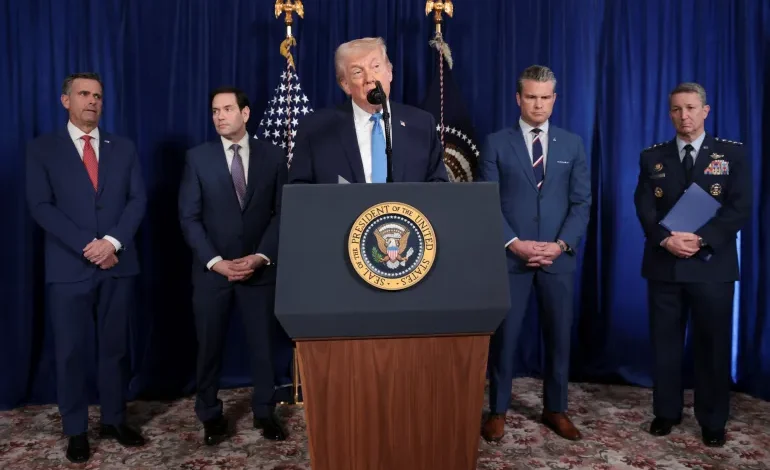
The unclassified NDS is notable for its overt political tone, featuring numerous images of the president and defence secretary and repeatedly criticising the administration of former President Joe Biden. Under Biden, the Pentagon described China and Russia as “revisionist powers” posing the “central challenge” to US security.
In contrast, the new strategy downplays Europe’s centrality, arguing that Washington’s NATO allies are capable of handling much of their own defence. The document notes that Germany’s economy is larger than Russia’s and concludes that European allies are “strongly positioned to take primary responsibility for Europe’s conventional defense, with critical but more limited US support”. This includes leading efforts to support Ukraine.
On Iran, the NDS reiterates that Tehran must not develop nuclear weapons and describes Israel as a “model ally”. “And we have an opportunity now to further empower it to defend itself and promote our shared interests, building on President Trump’s historic efforts to secure peace in the Middle East,” the document said.
For Asia-Pacific allies, the strategy carries potentially significant implications. While recognising the “direct military threat” posed by North Korea, led by Kim Jong Un, the Pentagon argues that South Korea is capable of taking primary responsibility for deterrence.
The NDS states that Seoul can deter North Korea “with critical but more limited US support”, a formulation that could open the door to reduced US troop levels on the Korean Peninsula. About 28,500 US troops are currently stationed in South Korea, which increased its defence budget by 7.5 percent this year following pressure from Washington.
South Korea’s Ministry of National Defence responded by stressing that US forces remain the “core” of the alliance, while President Lee Jae Myung emphasised self-reliance.
“It is inconceivable that South Korea – which spends 1.4 times North Korea’s gross domestic product on defence and possesses the world’s fifth largest military – cannot defend itself,” Lee said. “Self-reliant national defence is the most fundamental principle amid an increasingly unstable international environment.”
The NDS is also striking for what it omits. Unlike previous strategies, it does not mention Taiwan by name. Under Biden’s 2022 strategy, China’s ambitions toward Taiwan were described as a core security concern, with Washington pledging support for the island’s asymmetric defence.
In the new document, the Pentagon instead frames the Indo-Pacific in broader terms, saying US security depends on maintaining “a favourable balance of military power” in what it calls “the world’s economic center of gravity”.
“We do not seek to dominate, humiliate, or strangle China,” the strategy said, adding that the goal is “a decent peace, on terms favourable to Americans but that China can also accept and live under”.
The US plans to pursue that goal by “erect[ing] a strong denial defense along the First Island Chain” and encouraging allies to do more for collective defence.


The latest news in your social feeds
Subscribe to our social media platforms to stay tuned