




EXCLUSIVE: The Board of Peace. Explaining Trump’s project.
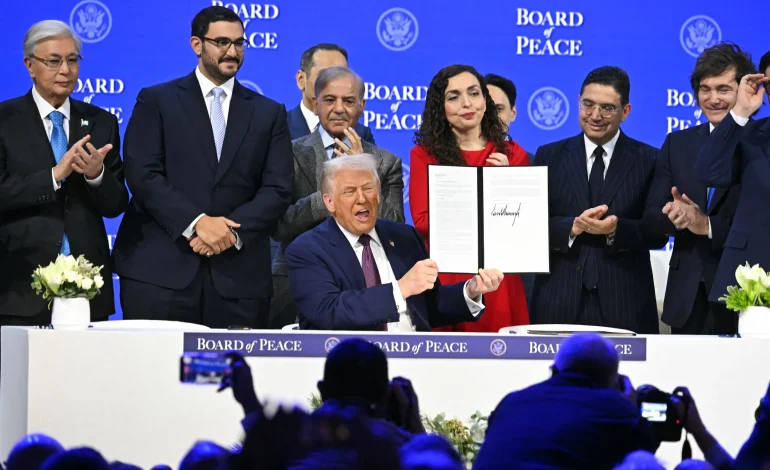

Imagine a club where membership is by presidential invitation, the chair is for life, and the organization’s first big job is to rebuild a war zone that’s been the world’s most combustible mess for decades. That, in plain terms, is the Board of Peace (BoP): a US-led, Trump-fronted international body pitched as a quick, decisive fix for Gaza – and, in the longer run, a roaming “troubleshooter” for other hotspots. It’s bold. It’s theatrical. And it has exposed a pile of hard questions about legitimacy, capacity, and who gets to decide the fate of occupied peoples.
The BoP started in public as an element of a larger US plan to manage the post-ceasefire transition in Gaza: demilitarize, run essential services through a temporary technocratic administration, and raise the money to rebuild. The idea was packaged in Davos, presented with fanfare, and folded into a UN Security Council resolution that acknowledged the plan. But the Davos rollout and the charter that followed made something else visible: the BoP was not just a Gaza mechanism. It was a prototype – an American-led forum that could, if its backers wanted, be pointed at other conflicts too.
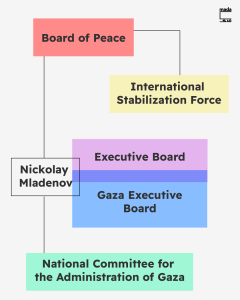
At its most basic, the charter gives the BoP authority to coordinate reconstruction funds, approve projects and contractors, oversee an international stabilization force, and set conditions for when Palestinian authorities might reassume control. That sounds useful on paper. The rub is in the details: the charter concentrates a great deal of control in the chair and in an Executive Board that is heavily US-influenced. That is not a small technicality. It changes the BoP from a temporary coordinating body into an institutionalized platform with political weight.
Brookings, the European Institute for Security Studies, and a raft of think tanks flagged the move as a potentially disruptive reordering of how international stabilization is done. If the BoP operates as a US-dominated alternative to the UN, it could set a precedent: you get funds, security, and a say in governance, but mainly on terms that favor the institution that runs the show. That outcome would not just irritate diplomats. It would reshape the tools the world uses to manage crises.
The membership list is, to put it mildly, a political mosaic. Several Arab and Muslim states signed up, apparently motivated by a mix of pressure, regional leverage, or a desire to shape Gaza’s future directly. A handful of smaller or non-Western states also joined, while several traditional US allies – prominent European powers in particular – demurred. Germany and Italy publicly declined on constitutional or political grounds; Poland also pulled back. The net result: the BoP looks global on paper, but it’s missing the diplomatic heavyweights that would have lent it broader legitimacy.
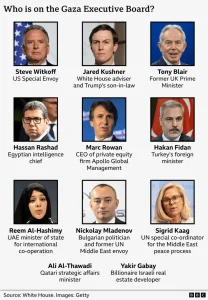
Names floated in reporting and in the charter include former officials and leaders from around the world. The Executive Board, as sketched publicly, gives the US outsized influence in appointments and agenda-setting. That matters because it shapes who feels safe committing troops, money, or political capital – and who doesn’t. Countries that worry about appearing to endorse a US-led sidestep of the UN have a clear reason to stay away.
Why the reluctance? Several reasons. Legal constraints: some European constitutions limit military deployments or require parliamentary approval. Political optics: participation could be domestically unpopular, seen as enabling an American managerial role over Palestinian territory. Strategic calculation: major powers are wary of backing a platform that might antagonize China, Russia, or other significant actors. All of which explains why some countries that would help – and whose presence would reassure skeptics – are not signing up.
The BoP’s operating model, as promised, has three pillars: money, security, and governance.
Money
The Board is meant to be a donor convener and gatekeeper. That’s practical – billions are needed to rebuild Gaza – but it raises red flags when financing decisions are controlled by a body with concentrated authority. Who decides which contractors get the work? How are procurement rules enforced? Who audits projects? The charter mentions oversight, but the real test is day-to-day transparency, and that’s thin in the documents released so far.
Security
The plan calls for an international stabilization force to oversee demilitarization and protect civilians during reconstruction. This is the thorniest piece. Troops need clear mandates, rules of engagement, and legal protections. Moreover, countries are reticent to put boots on the ground in Gaza – where urban warfare and domestic political blowback are real possibilities. Indonesia’s reported readiness to send forces made headlines precisely because it’s the kind of politically combustible pledge that will force tough domestic debates.
Governance
Perhaps the sharpest criticism. The BoP envisages a temporary technocratic administration in Gaza, overseen by international actors. That could deliver services, but critics say it risks sidelining Palestinian agency and treating Gaza like a territory to be managed rather than a people entitled to self-determination. Critics point to an irony: the BoP was sold as a fix for the UN’s paralysis, yet sidelining the UN could undercut the legal and institutional scaffolding that helps protect civilians and structure long-term political solutions.
Operationally, then, the BoP looks like a familiar patchwork of political promises, technical workstreams, and serious accountability gaps. The board can coordinate aid or approve projects; whether it can engineer disarmament, stabilize politics, rebuild at scale, and keep human rights protections in place is not clear.
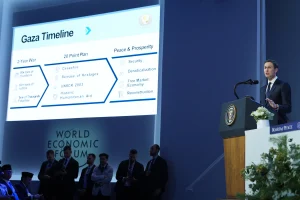
Gaza is where the BoP’s political fault lines become visible in the harshest light. On one side are those who say: the UN is blocked; action is needed fast; a new body can marshal cash and get concrete things done. On the other are those who say: bypassing the UN risks hollowing out legal protections, alienating Palestinians, and legitimizing ad-hoc governance that lacks international buy-in.
The BoP’s supporters argue that the UN Security Council has been paralyzed by geopolitics and vetoes, and that a nimble forum can do quick stabilization work without being bogged down. Critics counter that legitimacy – the perception that a solution is fair and inclusive – is itself a security tool. Reconstruction without political rights, they warn, rebuilds infrastructure and leaves grievances intact. UN agencies and humanitarian groups have been explicit about the risk: take UNRWA and other local delivery networks out of the center of rebuilding, and you risk disrupting distribution, eroding trust, and lengthening suffering.
There’s also the question of the Security Council resolution that referenced the US plan. That move gave the BoP a veneer of international recognition, but it didn’t settle the deeper question of who has the authority to govern or reorganize Gaza’s political arrangements. The UN’s role – as a legal and normative anchor – matters in ways that money and temporary administrations can’t replace.
Expert sentiment has been mostly skeptical. The most common refrain is legitimacy first: get Palestinian voices in, anchor decisions in recognized international frameworks, and don’t let fundraising and reconstruction become cover for political sidestepping.
Dr. Trita Parsi, writer, analyst, Co-Founder and Executive Vice President of the Quincy Institute for Responsible Statecraft, in his recent the American Conservative piece with Dr. Annelle Sheline argues the BoP is strategically incoherent: it centralizes responsibility while the US National Defense Strategy calls for partners to shoulder more of the burden. He warns the US risks overextending itself and creating an illusion – rather than a rebalancing – of responsibility.
Dr. Jeffrey Sachs, Professor and Director of the Center for Sustainable Development at Columbia University, is as blunt as ever: recognition of Palestinian statehood along the lines of 1967, he says, is the only credible route to peace. Anything that avoids that political core, Sachs argues, will simply paper over the violence:
“There is only one way to achieve peace in Gaza and more generally in the Middle East, and that is for the US finally, after all these decades, to recognize the State of Palestine on the border of 4 June 1967. Without the two-state solution, there is only continued violence, bloodshed, and Israel’s slaughter of Palestinians. US politics has so far blocked this solution, even though almost all of the rest of the world (except for Israel, of course) supports it. The BoP is likely to block it as well, except for one possibility: that the Arab members of the BoP tell Trump the truth and use their sway with Trump on this point. That’s not impossible, but far from certain.”
Dr. Moustafa Bayoumi, a professor at Brooklyn College, City University of New York, and a columnist for The Guardian (US), goes even further. For him the BoP is an attack on the international institutions and a way to sideline Palestinians in their own struggle for liberation:
“Trump’s Board of Peace is an old-fashioned colonial landgrab scheme, dressed up as a legitimate international body. But make no mistake. There is nothing legitimate about an organization that believes it can determine the future of Palestinian territory without a single Palestinian on its board. The Board of Peace is a cynical attempt to diminish the multinational framework of conflict resolution that is the United Nations while seeking to crown Donald Trump as Emperor of the globe. It will never work and will only exacerbate conflict and division in the world.”
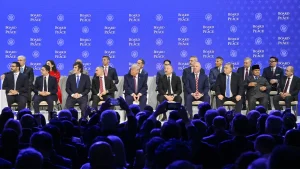
Peter Beinart, columnist, journalist, political commentator, and the editor-at-large of Jewish Currents, in his recent piece similarly frames the BoP as a kind of imperial fantasy – a body whose map and membership signal a narrowed, Western-hemisphere outlook and a desire to reclaim control in the face of a multipolar world. He sees the board as institutionalizing a personal form of power, more theatrical than collaborative.
Natasha Hall, a senior advocate at Refugees International and an associate fellow with the Middle East and North Africa program at Chatham House, warns that the speed and structure of the BoP rollout produced an immediate legitimacy problem. The board began as a Gaza mechanism tied to the UN; it has morphed into a global instrument with compressed timelines and internal rules that elevate the chair’s discretion. That combination scares off cautious governments:
“With the deadlock at the UN in an era of rising global power competition, ad hoc multilateral fora based on geography and principles were to be expected, but the Board of Peace is a uniquely different entity. What was initially understood as a Gaza-specific mechanism tied to a United Nations Security Council framework is now being pitched as a global conflict “troubleshooting” body, with Trump as chair for life. That ambition was underscored at Davos, where attendees were treated to a glossy vision of “New Gaza” – the Strip rebuilt as a modern coastal hub in the image of Dubai – largely untethered from the devastation and humanitarian catastrophe that still define daily life. The board was recast as a roving conflict management squad for when President Trump, chairman for life, saw fit. The speed of the rollout, compressed timelines for prospective members, and bizarre internal rules – especially those elevating the chair’s discretion above normal multilateral checks – created an immediate legitimacy problem. Many governments inclined to cooperate on Gaza have hesitated at signing onto this new vision of the board. Those that have feel forced to because of the immediate concerns of the Gaza conflict or fall outside the bounds of the US’ professed values in recent years. If Gaza is the test run though, the Board isn’t doing well at establishing peace.”

Here recent article piece for the Foreign Policy Magazine with Hardin Lang, the vice president for programs and policy at Refugees International, explores the on-the-ground realities the BoP will have overcome in Gaza.
Richard Gowan, Director of Global Issues and Institutions at Crisis Group, offers a pragmatic take: Gaza is an extraordinarily difficult case. Expanding the BoP’s remit beyond Gaza alienated would-be supporters who would have joined a narrower, Gaza-focused effort. At the same time, having Arab and Muslim members on the Board could give Palestinians a channel – if those members use it to press for Palestinian interests, rather than rubber-stamping US preferences:
“If you wanted to select a test-case for a new international peacemaking organization, you couldn’t find many more difficult cases than Gaza. Hamas continues to exert control over a significant part of the Gaza strip, and while the Board of Peace is meant to oversee a stabilization force in the territory, a lot of countries are nervous about sending soldiers there. Some Israeli policy-makers would like to renew hostilities if Hamas does not disarm. The US decision to announce that the Board of Peace would have a global conflict prevention role, rather than focus narrowly on Gaza was a big mistake. It has meant that many US allies, especially in Europe, who would have joined a Gaza-focused group are keeping their distance as they see the Board as a US effort to establish an alternative to the United Nations. It is unfortunate that, having pulled off a genuine diplomatic success over Gaza last fall, the administration allowed its desire for global grandeur to get in the way of the painstaking work of implementing the Gaza ceasefire plan. On a more positive note, the fact that Arab and Muslim nations are on the Board means that they can use it as a space to speak up for Palestinian interests and negotiate directly with Israel and the US over Gaza’s future. Given Israel’s distrust of the UN, an alternative diplomatic space for these talks was necessary.”
On the ground, Palestinian civil-society voices and aid agencies stress that humanitarian access and the protection of civilians must come first. They’re worried that political structures pushed from outside will not respect rights or local knowledge, and that sidelining UN delivery platforms like UNRWA will make aid distribution messier and less effective. Those are operational realities, not just moral claims.
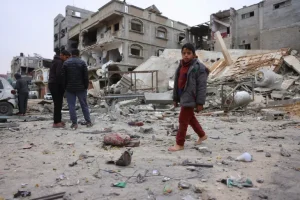
The trajectory for the BoP looks rather grim. It will most likely become a high-visibility donor platform that raises cash (mainly for the Trump family and its close associates) and somewhat organizes physical reconstruction but is unlikely to solve the political questions. If the Board doubles down on centralized control, sidelines Palestinian voices entirely, and tries to impose governance structures that lack legitimacy. Backlash will follow: withdrawals, legal challenges, and worsening instability. Some commentators see this as a real risk if the BoP prioritizes spectacle and deals over rights and accountability. Considering Trump’s usual ambitions, it may try to expand its remit beyond Gaza in the future, with Europe and other powers pushing back. Thus the Board will be reduced to a US-led instrument used by a subset of states with deeply contested legitimacy. Think niche use, limited buy-in, and constant diplomatic friction.
The BoP tells you something broader about US foreign policy right now. Instead of working through existing global institutions and bargaining for shared authority in a multipolar world, the BoP risks building parallel structures that reflect American preferences and personalities. Some countries will play along. Many will not. The biggest danger isn’t that the Board will fail spectacularly – though that is possible – it’s that it will slowly undercut the norms and institutions that actually make long-term peace possible.
If you want a short way to remember the Board of Peace: it’s a plan to rebuild Gaza without having first solved the problems that made Gaza a ruin.



The latest news in your social feeds
Subscribe to our social media platforms to stay tuned