



EXCLUSIVE: Vance in Armenia: Strategic Signal, Limited Guarantees
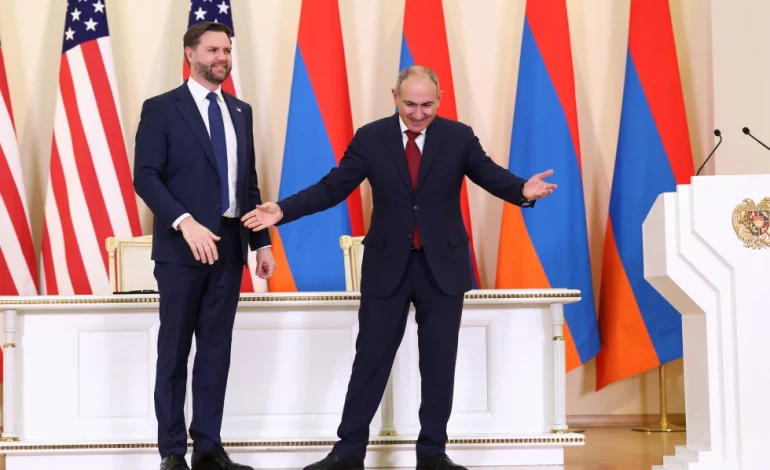

US Vice President JD Vance’s visit to Armenia has been framed in Yerevan as historic: the first visit by a US official of such seniority in more than a decade, and in Washington as part of a broader push to stabilize and reshape the South Caucasus. But beneath the ceremony, motorcades and signed agreements lies a more careful reality: this is a strategic signal, not a geopolitical revolution.
Vance arrived in Yerevan at a moment when Armenia is recalibrating its foreign policy after years of heavy security dependence on Russia and the trauma of the 2020 war in Karabakh. His meetings with Prime Minister Nikol Pashinyan focused on expanding US–Armenia cooperation in nuclear energy, transport, high technology, minerals, and security. The two sides also advanced the TRIPP framework (the Trans-Regional Infrastructure and Peace Project) a US-backed connectivity initiative designed to integrate Armenia into wider regional transit routes linking Azerbaijan to Nakhchivan and the broader Trans-Caspian corridor.
Washington’s message appears clear: economic integration and infrastructure are the pillars of long-term stability. But expectations in Yerevan are more layered.
Siranush Sahakyan, a leading human rights lawyer and head of the International and Comparative Law Center, told the Wyoming Star that the visit should be seen as meaningful but measured.
“Vice President Vance’s visit to Armenia is best understood as strategically significant but not transformative. It signals sustained US political attention at a moment when the security architecture of the South Caucasus is in flux and affirms that Armenia remains within Washington’s strategic calculus amid shifting regional alignments.”
At the same time, according to her, Washington does not seem to “be seeking a dramatic geopolitical pivot,” taking into account Armenia’s geography.
The emphasis is on connectivity, economic diversification, institutional reform, and strengthening governance resilience. In return, the US likely expects gradual policy convergence and Armenia’s constructive participation in Western-backed regional initiatives (not an abrupt realignment, but a steady reorientation over time),” Sahakyan said.
This assessment fits the broader pattern. The Trump administration has positioned itself as a broker of normalization between Armenia and Azerbaijan, publicly celebrating the signing of a peace declaration last summer. Yet since then, tangible implementation has been slow. Washington’s current focus on infrastructure, transit, and economic connectivity suggests a belief that trade corridors may succeed where political declarations have stalled.

Luke Broadwater
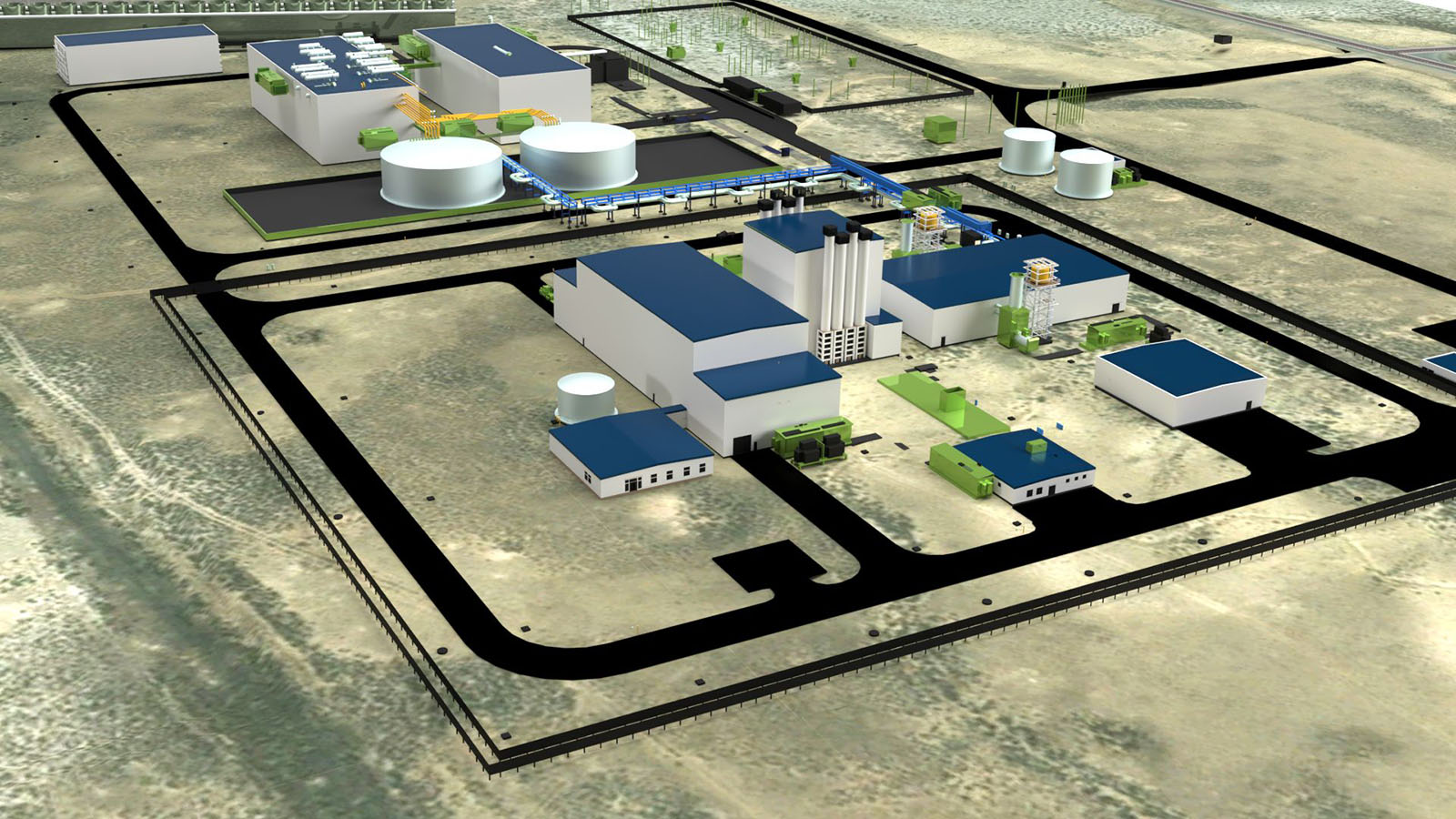
For Prime Minister Pashinyan, deeper US engagement offers diversification. Armenia has signaled its desire to reduce vulnerability to Moscow, expand ties with the EU, and attract American investment, including the newly signed civilian nuclear cooperation agreement, which Vance described as involving “initial investments of $5 billion, with a further $4 billion to follow.” Small modular reactor technology is expected to form part of that cooperation.
But political will does not automatically translate into strategic clarity. Sahakyan cautioned that closer ties carry risks if expectations diverge.
“Prime Minister Pashinyan has shown clear political willingness to deepen engagement with the United States. However, political openness does not automatically translate into strategic coherence. While the government’s rhetoric emphasizes sovereignty, democratic reform, and diversification of partnerships, a fully articulated long-term foreign policy doctrine remains less visible.”
The main risk lies in “misaligned expectations,” Sahakyan explains.
“Yerevan may interpret closer ties with Washington as opening the door to stronger political or even security backing. The United States, however, appears focused on long-term structural cooperation rather than immediate security guarantees. Unless expectations are carefully managed and embedded within a clearly defined national strategy, this asymmetry could produce disappointment or strategic ambiguity on both sides.”
That asymmetry is central. The United States is offering investment, institutional support, and economic integration. It is not offering a defense umbrella. Armenia, navigating a volatile neighborhood and unresolved tensions with Azerbaijan, may quietly hope for firmer political backing than Washington is prepared to deliver.
At the same time, the humanitarian dimension remains unresolved. Demonstrators gathered during Vance’s visit to urge him to press Baku for the release of Armenian detainees. Families of prisoners and the missing continue to demand international pressure and accountability.
Sahakyan warned against allowing connectivity projects to overshadow those concerns.
“An overemphasis on connectivity and economic integration carries the inherent risk of marginalizing unresolved humanitarian and security concerns that remain deeply consequential for Armenian society. The fate of Armenian detainees, the search for the missing and forcibly disappeared, accountability for war-related violations, and the broader protection of fundamental rights cannot be relegated to secondary status or treated as negotiable variables within a broader geopolitical framework.
Durable economic integration and regional connectivity cannot realistically succeed if they are built on unresolved grievances and a lack of accountability, Sahakyan stressed.
“Stability divorced from justice is inherently fragile; any long-term strategic architecture must integrate, rather than bypass, these core concerns.”
This point underscores the tension at the heart of Washington’s approach. Infrastructure can stabilize trade. Investment can stabilize budgets. But public legitimacy depends on justice and security.


The latest news in your social feeds
Subscribe to our social media platforms to stay tuned