

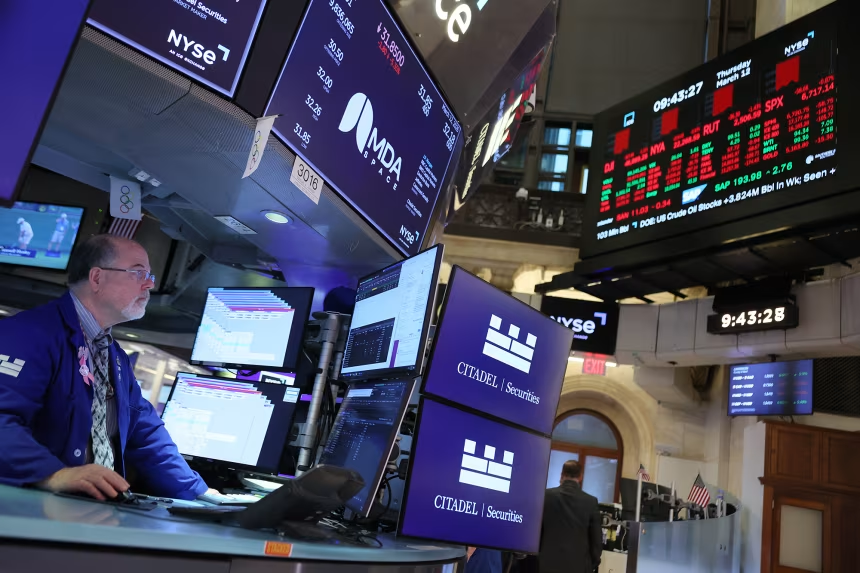



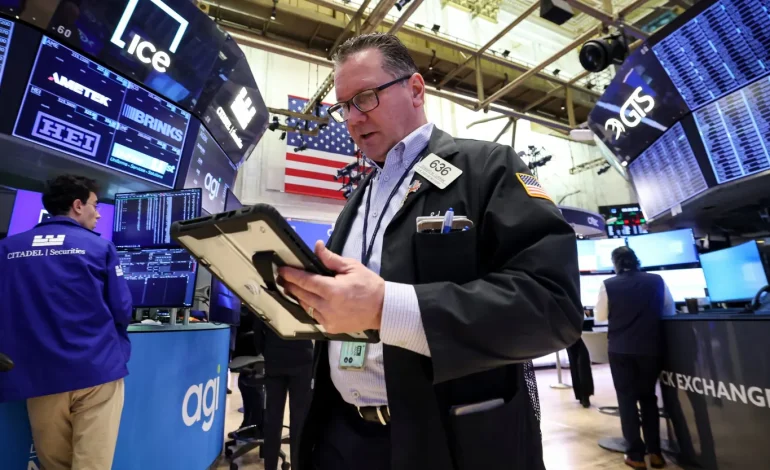

Wall Street switched gears Thursday: investors dumped some big tech winners and bought stocks they think will rip if the economy actually heats up. The result — the Dow climbed 230 points (0.5%), the S&P 500 added 0.2%, and the Nasdaq slipped 0.2%, CNBC reports.
The trade looked plain: cyclical stocks out, growthy tech in the penalty box. Walmart, Boeing and GE Vernova led the charge, up about 2%, 3% and 1% respectively. Meanwhile a few of the so-called “Magnificent Seven” — including Apple and Amazon — were each down roughly 1%. The real stunner in tech was Cisco, which plunged about 9% after issuing softer-than-expected guidance.
Why the rotation? Investors are wrestling with mixed signals. The market had a roller-coaster this week: Wednesday’s jobs report surprised to the upside — 130,000 payrolls added in January and unemployment slipping to 4.3% — which briefly pushed stocks higher. But that strength complicates the Fed picture. Strong jobs can mean fewer rate cuts, and that’s not ideal for stretched growth stocks. So traders are hedging: buy things that do well in an economy that’s growing but not booming.
All eyes are on Friday’s consumer-price index. Economists polled by Dow Jones expect 0.3% monthly gains for both headline and core CPI. If inflation looks tame, the Fed can breathe easier. If it doesn’t, the rotation could reverse fast.
“It’s going to put a lot of weight on Friday’s CPI report,” said Tom Lee of Fundstrat. “If that comes in tame, the market can understand that the inflation part of the Fed’s equation is cooling. And if the job market is showing decent strength, at least we’re not seeing an economic downturn.”
Other data was noisy but not decisive. Initial jobless claims dipped to 227,000 for the week ended Feb. 7 — slightly above expectations — while the four-week moving average eased to its lowest since October 2024. Housing wasn’t helpful: existing home sales plunged 8.4% in January to a 3.91 million annual pace, worse than the Street expected.
Before the open, a few names were doing their own thing: Restaurant Brands bounced after a solid quarter, Anheuser-Busch InBev popped on a beat, and QuantumScape slid after disappointing results.
Bottom line: traders are repositioning for a market where growth and inflation data tug in different directions. That makes this a classic “macro-driven” market day — headlines and prints move stocks more than fundamentals — and it leaves the feel of the tape: tentative optimism, but with a lot of “we’ll see” baked in. Keep a close watch on CPI — it’s the next big steering wheel for this rotation.


The latest news in your social feeds
Subscribe to our social media platforms to stay tuned