




House Rebukes Trump on Canada Tariffs as GOP Cracks Show
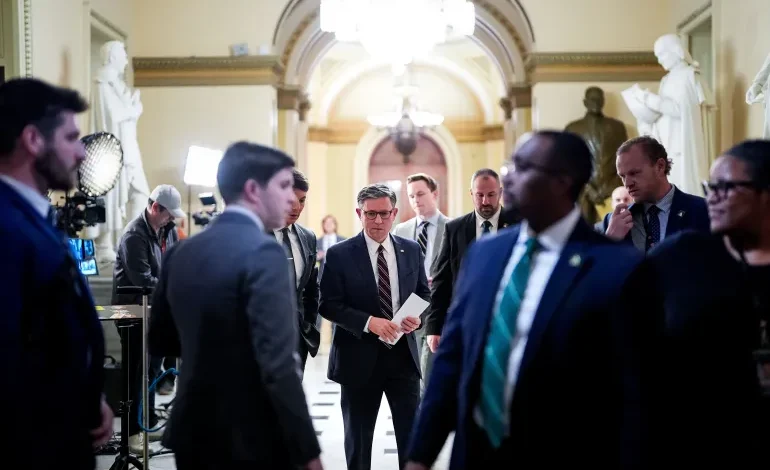

The US House of Representatives has moved to roll back President Donald Trump’s tariffs on Canada, delivering a rare and pointed challenge to the White House — and exposing visible fractures within the Republican Party.
On Wednesday, lawmakers voted 219 to 211 in favour of ending Trump’s use of emergency powers to impose tariffs on Canada. Several Republicans crossed party lines to side with Democrats, despite the GOP holding a narrow 218-seat majority in the chamber. The measure marks an unusual instance of the House pushing back against a president who continues to exert firm control over his party.
Democratic Representative Gregory Meeks of New York, who authored the resolution, framed the vote in blunt terms before the tally. “Today’s vote is simple, very simple: Will you vote to lower the cost of living for the American family or will you keep prices high out of loyalty to one person, Donald J Trump?” he said.
The timing is not incidental. The US has entered a critical midterm election cycle, with primaries beginning in March and general elections set for November. Every member of the House will face voters. With Trump’s approval ratings slipping and polling showing broad skepticism about tariffs, Republican lawmakers are weighing political survival against party loyalty.
Trump made clear he was watching closely.
“Any Republican, in the House or the Senate, that votes against TARIFFS will seriously suffer the consequences come Election time, and that includes Primaries,” he wrote on social media ahead of the vote.
He doubled down in a separate post targeting Canada directly.
“Canada has taken advantage of the United States on Trade for many years,” Trump said. “They are among the worst in the World to deal with, especially as it relates to our Northern Border. TARIFFS make a WIN for us, EASY. Republicans must keep it that way!”
The bill now moves to the Senate, where similar efforts to limit Trump’s Canada tariffs have already passed in April and October of last year. Lawmakers there are expected to approve the measure again. But the path forward remains narrow. Trump has signalled he would veto the legislation, and overturning a presidential veto would require a two-thirds majority in both chambers — a threshold far beyond Wednesday’s Republican defections.
Public opinion, however, appears to be tilting against the tariff strategy. A Pew Research Center poll conducted February 4 found that 60 percent of respondents disapprove of Trump increasing tariffs, while 37 percent approve. Rising prices across consumer goods have sharpened scrutiny, with critics arguing the tariffs are contributing to inflationary pressure.
At the same time, the Supreme Court is considering the legality of Trump’s broader tariff authority after lower courts ruled against parts of his policy. House Speaker Mike Johnson had urged Republicans to delay legislative action until the high court weighs in.
Not everyone agreed. Six Republican representatives — including Thomas Massie of Kentucky, Don Bacon of Nebraska and Brian Fitzpatrick of Pennsylvania — broke ranks to bring the bill to the floor. Representative Bacon defended the move in institutional terms. “Why doesn’t the Congress stand on its own two feet and say that we’re an independent branch?” he said. “We should defend our authorities. I hope the Supreme Court does, but if we don’t do it, shame on us.”


The latest news in your social feeds
Subscribe to our social media platforms to stay tuned