





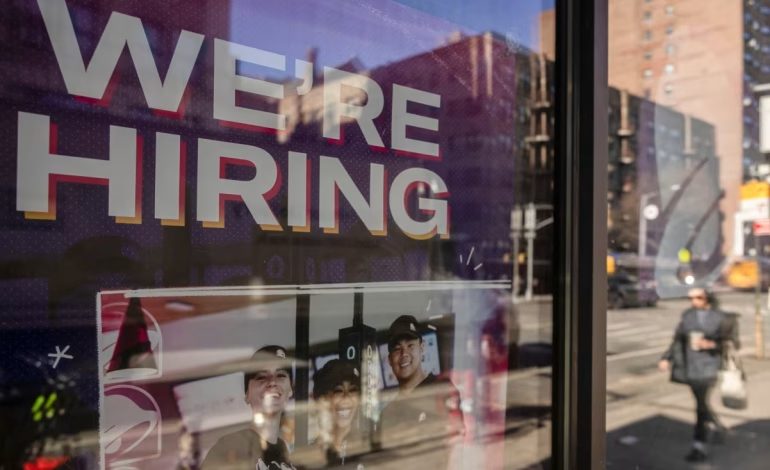

The US job market handed investors and policymakers a surprise in January: payrolls rose by 130,000, well above the Dow Jones consensus of 55,000. That’s a healthy beat, but don’t break out the confetti just yet — the gains were uneven and a big-picture revision to past data still leaves last year looking weak.
The headline numbers are straightforward. Nonfarm payrolls climbed 130,000 for the month, and the unemployment rate edged down to 4.3%. A broader measure that includes discouraged workers and people working part-time for economic reasons also moved in the right direction, slipping to 8.0%, down 0.4 percentage point from December.
But the detail matters. January’s job growth was heavily concentrated in a handful of sectors. Health care led the pack with 82,000 new positions — again — showing just how much the labor market has come to rely on medical and related roles. Social assistance added 42,000, and construction picked up 33,000. Outside of those pockets, hiring was thin.
Then there’s the revision headache. The Bureau of Labor Statistics also released its final benchmark adjustments for the year running up to March 2025, and they weren’t kind: initial employment counts were revised down by 898,000. That sizable downgrade means the picture for 2024–25 was much weaker than earlier estimates suggested. So while January looks like a step forward, it’s against a backdrop of slower-than-expected job creation over the last year.
What does this mean in plain terms? January’s print is welcome — it’s the strongest month since late 2024 and a reminder that the labor market isn’t collapsing. But the fact that most of the new jobs are clustered in health care and social assistance hints that the recovery is lopsided. Broader, sustained hiring across manufacturing, tech, retail and other sectors would be a clearer sign that momentum has returned.
Financial markets reacted, as they always do. The stronger-than-expected payrolls put upward pressure on Treasury yields and gave stocks a lift at the open, since a healthier jobs backdrop makes rate cuts less likely in the near term. Traders will be parsing this for clues about the Fed’s next moves: policymakers pay close attention to labor-market trends when deciding whether to ease or hold rates.
Wages and work hours weren’t the big headline here — the story is volume and composition. If pay growth and hiring become more widespread, consumers’ wallets would get a real boost. But for now, the gains are sector-specific, and the big downward revision to past months tempers any breathless optimism.
So, is the labor market back on track? Not exactly. January’s report is a positive datapoint and it reduces some fears of a freefall. Still, the labor market looks fragile and uneven: a few sectors are doing the heavy lifting while others lag, and recent benchmark revisions show the economy created far fewer jobs over the last year than previously believed.
Bottom line: January surprised on the upside, unemployment eased, and that’s good news. But the underlying story — a narrowly based recovery plus large downward revisions to past data — means the US economy still has a ways to go before anyone calls the job market fully healed.



The latest news in your social feeds
Subscribe to our social media platforms to stay tuned