


Wright in Caracas: Energy Diplomacy After Regime Shock
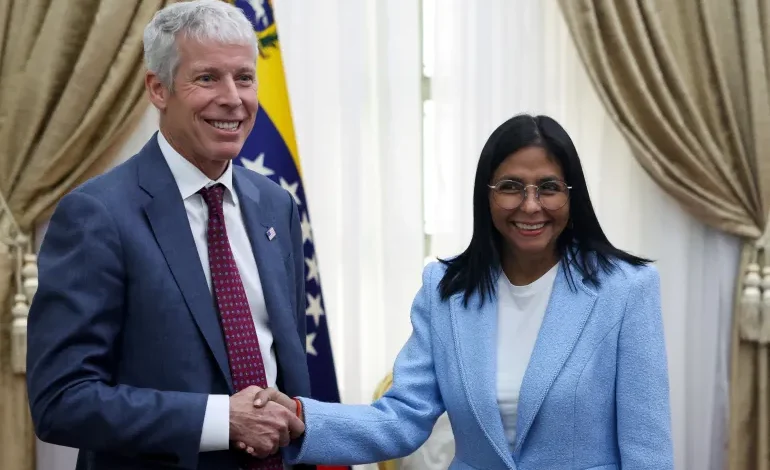

US Energy Secretary Chris Wright landed in Venezuela on Wednesday, meeting interim President Delcy Rodriguez in what amounts to a striking diplomatic moment: the first visit by a member of President Donald Trump’s cabinet to the South American country.
Given the deeply strained relationship between Washington and Venezuela’s socialist leadership over the past two decades, the optics alone were notable. The meeting comes as the United States presses forward with plans to expand foreign oil investment in the region, with Venezuela — home to some of the world’s largest proven crude reserves — once again central to the conversation.
Speaking alongside Rodriguez at a joint news conference broadcast on Venezuelan state television, Wright struck a tone that leaned toward reset rather than rupture.
“It is an honour to stand here with you today and to be among the tremendous people of Venezuela,” Wright said.
He acknowledged the turbulence that has defined bilateral ties in recent decades but suggested the Trump administration is looking to turn the page.
“Our countries share a long history. It has gone through different chapters, as all relationships do,” Wright said.
“But I bring today a message from President Trump. He is passionately committed to absolutely transforming the relationship between the United States and Venezuela, part of a broader agenda to make the Americas great again.”
That phrase — a hemispheric expansion of Trump’s signature slogan — signals how the White House frames its broader strategy. Trump has repeatedly invoked a modernised version of 19th-century expansionist thinking, at times referring to a so-called “Donroe Doctrine”, echoing the Monroe Doctrine’s claim to the Western Hemisphere as a US sphere of influence.
This visit unfolds against a backdrop that remains extraordinary. On January 3, Trump authorised a military operation targeting Venezuela, resulting in the capture and transfer of then-President Nicolas Maduro and his wife, Cilia Flores, to New York, where they are expected to face drug-trafficking charges. Following that operation, Trump publicly stated that the US would “run” Venezuela.
Washington has since recognised Rodriguez, formerly Maduro’s vice president, as interim leader, though Trump has warned of a potential “second wave” of military action if his administration’s expectations are not met.
Oil remains at the centre of the equation. In remarks following the January operation, Trump argued that Venezuela’s petroleum assets rightfully belonged to the United States due to early exploration and infrastructure development by American companies such as Exxon Mobil. He described Venezuela’s nationalisation of its oil sector as the “largest theft of property in the history” of the US.
“Venezuela unilaterally seized and sold American oil, American assets and American platforms, costing us billions and billions of dollars,” Trump said. “They took all of our property. It was our property. We built it.”
Trump has emphasised that the US, not Venezuela, should control the country’s oil reserves. International law, however, recognises that nations hold permanent sovereignty over their natural resources, a principle reflected in multiple global covenants and resolutions.

The latest news in your social feeds
Subscribe to our social media platforms to stay tuned