





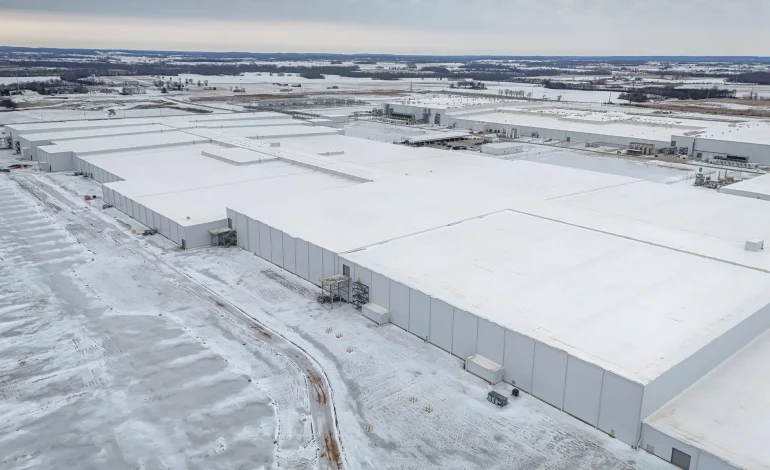

Ford’s Kentucky battery plant went from hot idea to empty halls faster than anyone expected — and now the automaker is trying to turn that problem into a new business, the New York Times report.
The Glendale complex, a hulking 8-million-square-foot facility tucked an hour south of Louisville, briefly made batteries for the F-150 Lightning. Sales of that electric pickup cratered after federal tax credits expired and policy shifted, so Ford idled the plant in December and laid off about 1,600 workers. Empty factories are profit killers, and Ford has spent the last few months scrapping for a Plan B.
The answer: make big batteries nobody in the auto business has traditionally focused on — the kind utilities, data centers, industrial sites and even some homeowners use to store power. Think shipping-container-sized battery banks that soak up cheap electricity and kick it back during peak demand or blackouts.
Ford will pump $2 billion into retooling the Glendale plant and aims to restart production next year. The revamped site is expected to hire roughly 2,100 people — far fewer than the 5,000 jobs originally promised for the EV battery operation. Workers who were let go can apply for the new roles, Ford says, but rehiring is not guaranteed.
“It’s a big swing,” said Kentucky Governor Andy Beshear, who has been publicly supportive of Ford’s new plan. “I’m confident they can compete. The demand is enormous.”
Utilities and hyperscale data centers are gobbling up battery storage as grid operators seek tools to manage supply spikes and to guard against outages.
Why the pivot? A messy mix of market and policy shifts. Electric vehicle sales softened after federal tax credits worth up to $7,500 expired for many buyers. The Trump administration’s moves to roll back EV incentives and loosen clean-air rules made gas guzzlers more attractive again. Those political winds, combined with fierce competition from established EV players and some early missteps at Ford, left battery plants running well below capacity.
Ford’s own leadership has framed the change as pragmatic. CEO Jim Farley said the company is redeploying capital “into higher-return growth opportunities” after taking a big hit on its EV investments — a December charge of $19.5 billion that included roughly $6 billion tied to the Kentucky program and the now-dissolved joint venture with South Korea’s SK On.
There’s logic to making stationary storage: the federal government has been more willing to support battery storage than it has been solar and wind in recent months, and batteries are fuel-agnostic — they help smooth supply whether power comes from wind, gas or coal. The Department of Energy has leaned in on batteries as a tool to avoid blackouts during storms.
Still, it’s risky. Ford has almost zero history making grid-scale storage systems; it’s a different engineering, sales and service game than building EV packs for pickup trucks. It will be competing with players that already have a head start — Tesla, LG, and long-established energy-storage firms. Analysts warn that storage demand is forecast to soar in the near term, but could also saturate late in the decade.
Locals in Hardin County are a study in mixed emotions. Some see the pivot as a lifeline; others feel burned. Thousands of residents cheered when Ford and SK On originally announced the mega-investment — state and local governments spent roughly $250 million upgrading water and power infrastructure and set up training programs to staff the plant. Then the jobs evaporated in December.
Workers like Derek Dougherty, who had thought he’d finally landed steady work with benefits, were devastated.
“We just started renting our apartment over here because of this job. Now that job’s not there,” he said after the layoffs.
Other former employees have since found work, often at lower pay or much longer commutes. Sandie Yarborough, who worked at the plant, now drives over an hour to a construction job after failing to find comparable local work.
Union issues complicate the picture. The workforce had voted to join the United Auto Workers in August, a result Ford is contesting. Local union leaders are cautiously supportive of Ford’s reuse of the site but insist any restart should come with decent jobs and union representation.
“I applaud that they’re trying to keep the building filled. What I would applaud more is if they kept it filled with union workers,” said Laura Dickerson, a UAW vice president.
Politically, the plant closure and pivot have become a boom-and-bust cautionary tale. Some local Republicans blame federal policy changes for killing EV demand; Democratic leaders like Governor Beshear pin part of the responsibility on Ford’s strategic missteps and urge the company to move fast to restore stable employment. Either way, the episode highlights how quickly manufacturing dreams can sour when market incentives shift.
Ford’s move into storage will be closely watched. If the carmaker can apply its century of mass-production muscle to energy storage, it could open a steady, growing revenue stream that’s less volatile than swings in new-car demand. If not, the Glendale plant may simply swap one underused floor for another.
Either way, the empty factory that once symbolized a high-tech future for rural Kentucky has become a test case for the auto industry’s broader question: when EV hopes hit the brakes, what do you build next? Ford hopes the answer is batteries — just not the kind that go under a truck.



The latest news in your social feeds
Subscribe to our social media platforms to stay tuned