





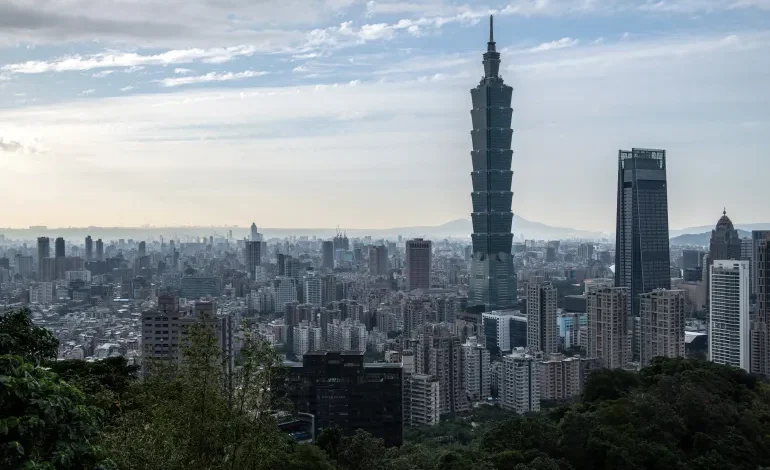

The new trade agreement between Washington and Taipei is being presented as a tariff story, but the real message is about supply chains, market access and long-term positioning in the Asia-Pacific.
Announced on Thursday, the deal lowers the general tariff on Taiwanese exports to the United States from 20 percent to 15 percent, placing the island on the same footing as South Korea and Japan, in exchange for a pledge by Taipei to purchase roughly $85bn worth of US energy, aircraft and industrial equipment. In practical terms, it formalises a deeper two-way dependence: Taiwanese goods get easier entry into the US market, while American high-value sectors secure a guaranteed buyer.
Taiwan has committed to eliminating or reducing 99 percent of its tariff barriers and granting preferential access to a wide range of US products, from auto parts and machinery to dairy and pork. Washington, for its part, will exempt numerous Taiwanese exports from tariffs, including agricultural and specialty items such as chalk, castor oil, pineapples and ginseng.
President William Lai Ching-te framed the outcome in economic and branding terms, emphasising the consumer-facing impact.
“From familiar items such as Phalaenopsis orchids, tea, bubble tea ingredients (tapioca starch), and coffee, to pineapple cakes, taro, pineapples, and mangoes – these products that represent Taiwan will become more price-competitive in the US market,” Lai said in a statement on social media. “We aim not only to sell Taiwan’s great flavors overseas, but also to ensure Taiwanese brands truly enter international markets.”
Lai said the various carve-outs would bring the average tariff rate on Taiwanese goods down to 12.3 percent and described the agreement as a “pivotal” moment for the island’s economy. The numbers matter: nearly one-third of Taiwan’s exports went to the United States in 2025, making it Taipei’s largest market for the first time in a quarter century.
What is just as notable is what the deal does not foreground. Lai made no reference to the semiconductor sector, even though chips remain the central driver of Taiwan’s economic growth and accounted for a surge that pushed total exports to a record $640.75bn last year. The agreement itself contains no new binding commitments on Taiwanese investment in US chip manufacturing, despite earlier announcements from the Trump administration that firms from the island would channel $250bn into the sector. A fact sheet from the Office of the US Trade Representative merely says the two sides “take note” of that earlier understanding, including Taiwan Semiconductor Manufacturing’s prior $100bn investment plan.
US Trade Representative Jamieson Greer placed the emphasis on resilience rather than tariffs alone, saying the deal would “significantly enhance the resilience of our supply chains, particularly in high-technology sectors” and linking it to a broader regional strategy.
“President Trump’s leadership in the Asia Pacific region continues to generate prosperous trade ties for the United States with important partners across Asia, while further advancing the economic and national security interests of the American people,” Greer said.

The latest news in your social feeds
Subscribe to our social media platforms to stay tuned