




Inside Wyoming’s Nuclear Future: A First Look at TerraPower’s Groundbreaking Kemmerer Project

Work is advancing rapidly just outside Kemmerer on what will be a world-first nuclear power facility. TerraPower, the company backed by Bill Gates, is building a first-of-its-kind reactor that uses liquid sodium instead of water for cooling—a technological leap that promises safer, cheaper, and more flexible nuclear energy. Cowboy State Daily recently toured the site to see the progress firsthand.
A One-of-a-Kind Test Facility Rises from the Snow
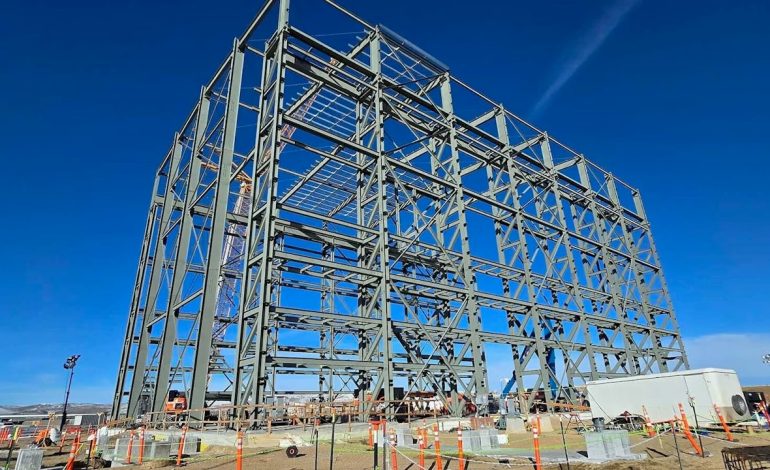
The first structure taking shape is the Test and Fill Facility (TFF), a 167-foot-tall building that will eventually test and process the liquid sodium used to cool the reactor. From a distance, the steel frame looks almost delicate against the snow-dusted hills. Up close, the illusion vanishes: the beams are massive, some weighing 90,000 pounds and stretching 100 feet long.
“This is actually unique to this deployment,” said Pat Young, TerraPower’s Senior Vice President and Project Director for Natrium. Unlike the reactor itself, which the company plans to replicate elsewhere, the TFF is a one-off—built specifically to stress-test major components before they enter the main facility.
The project is moving fast. Electricians were recently installing power systems for an interior crane, and crews aim to have the exterior sheathing completed this year. “It will look quite a bit different from the road as you drive by then,” Young said.
A Radically Different Approach to Nuclear Power
TerraPower’s Natrium reactor represents a fundamental shift in nuclear design. Traditional reactors use water to cool the core, requiring high-pressure systems, thick shielding, and massive amounts of concrete and steel. The last two reactors built in the U.S.—the Vogtle units in Georgia—required 23,000 tons of structural steel and cost $35 billion.
TerraPower’s design is smaller and simpler. By using molten sodium as a coolant, the system operates at atmospheric pressure, eliminating the need for heavy containment. Liquid sodium absorbs far more heat than water, widening the safety margin. In an emergency, the facility can be cooled by air vents alone—no pumps or electricity required.
The result, the company estimates, will be electricity at half the cost of a traditional nuclear plant, with the ability to ramp power up or down to complement wind and solar.
Fast-Tracked Permitting and a “Rock Solid” Safety Case
President Donald Trump has signed executive orders accelerating nuclear development, citing national security concerns. Some have questioned whether the pace compromises safety. Young pushed back, noting that permitting is moving quickly but the company’s “safety case” is “rock solid.”
TerraPower expects to receive its nuclear construction permit this spring. Three questions remain before final approval, but Young described them as routine protocol. Once the permit is issued, “nuclear work”—regulated construction—can begin.
More Than a Power Plant: A “Mother Ship” for a Global Fleet
The Kemmerer site is just the beginning. TerraPower has signed a development agreement with Meta for up to eight additional reactors, potentially including one near Cheyenne. Other agreements point to projects in Kansas, Oklahoma, Utah, and even the United Kingdom.
Kemmerer itself could grow. Mayor Robert Bowen noted “some talk” of a second unit at the site. “It’s definitely scalable,” he said. “It can be added to easily.”
For now, 110 workers are on site, building not only the TFF but also a training and welcome center. At peak construction, that number will swell to 1,600. Once operational, the plant will support an estimated 250 permanent jobs.
A Monumental Moment for Wyoming and the Nation
“It’s not often that nuclear reactors are built in the United States,” Young said, gesturing toward the orange pylons marking the future reactor site. “The last construction permits for commercial reactors were issued around 2013. This reactor technology represents a generation shift in safety.”
For Wyoming, the project is a chance to remain at the forefront of American energy innovation—and to host a technology the world has never seen.



The latest news in your social feeds
Subscribe to our social media platforms to stay tuned