





Why Some Wyoming Ranchers Still Feed Their Livestock with Horse-Drawn Sleighs
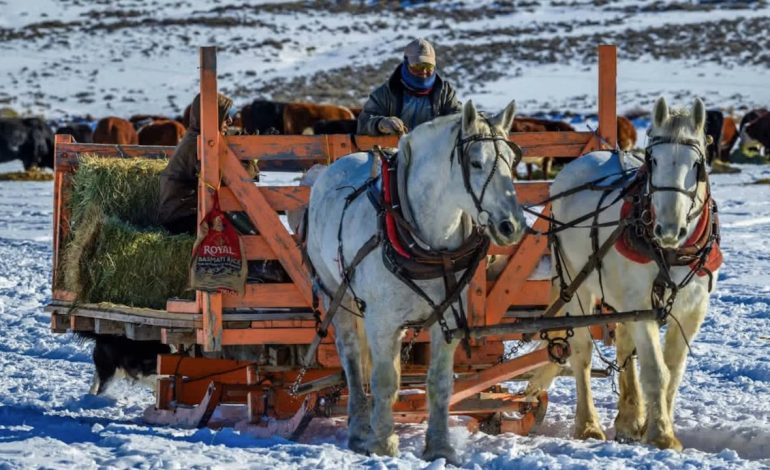

Deep in the snowy high country of Sublette County, some Wyoming ranchers are sticking to a method that predates tractors by decades. When winter settles in, they hitch a team of workhorses to a sleigh, load it with loose hay, and let the animals do the work their ancestors have done for generations.
For Pete Arambel, a sheep rancher south of Pinedale, the choice is simple: “I don’t have to worry about whether the engine will start each day.” That reliability was captured this winter by photographer Dave Bell, whose images of a ranch hand gliding across the snow with a horse-drawn sleigh evoke an older, slower way of life.
Kevin Campbell, a third-generation rancher near Bondurant, has never known another way. Each morning after coffee, he tracks down his workhorses, hitches them to the sleigh, and scatters loose hay for his cattle as the team makes its rounds. His grandfather homesteaded the property in 1913. “I’ve been ranching all my life,” Campbell said. “Never did anything different.”
The practice is more than tradition—it’s practical. In Bondurant, average snowfall hits 130 inches. Deep snow can bog down even mid-sized tractors. The big machines that can handle it cost a fortune. Workhorses, by contrast, cut right through. They also save money. Michael Klaren, who runs 250 mother cows on leased land in Daniel, estimates his entire horse-drawn feeding setup cost less than $10,000—a fraction of the price of new mechanized equipment.
There are trade-offs. Horses move at 2.5 to 3 miles per hour, half the speed of a tractor. A feeding cycle can take three to four hours, longer on stormy days. Klaren and his son split the work, cutting their daily loop to about half the time it took alone.
This winter, for the first time in memory, the horses are idle. Sublette County has seen little snow. Klaren and his son have been feeding from a trailer hitched to a Toyota pickup. But he’s not putting the team away yet. “We can’t really call it a winter,” he said. “Winters can go well into March.”
Campbell stresses that every ranch does things differently. Some use tractors, some use horses, some combine both. “Part of it is out of necessity, and part of it is what the person likes to do,” he said. For him, the choice is clear: “We want to do it that way.”



The latest news in your social feeds
Subscribe to our social media platforms to stay tuned