
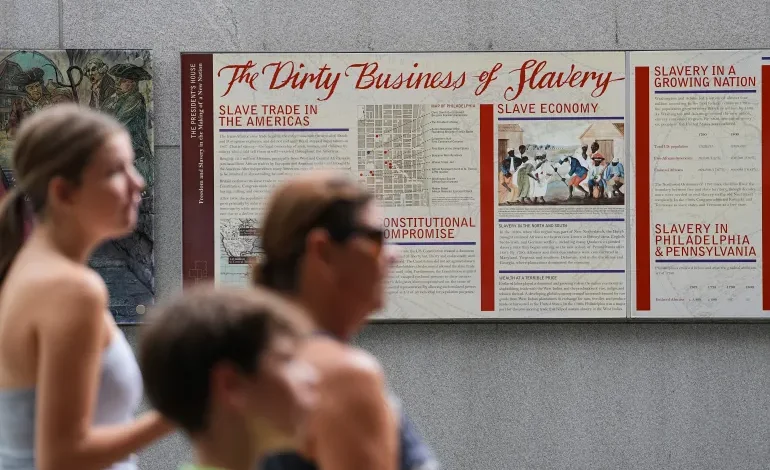

A federal judge has ordered the National Park Service to reinstall an exhibit detailing the lives of nine people enslaved by George Washington at his Philadelphia residence, blocking the Trump administration from altering the historical narrative while a legal challenge proceeds.
The decision follows a lawsuit by the city of Philadelphia after explanatory panels were removed from Independence National Historical Park, where Washington lived in the 1790s. The takedown was linked to an executive order directing federal agencies to restore what the administration called “truth and sanity to American history” by eliminating material that might “inappropriately disparage Americans past or living”.
US District Judge Cynthia Rufe ruled that the original materials must be returned in full and barred officials from replacing them with revised interpretations. In a sharply worded 40-page opinion, she rejected the government’s claim that it could decide which historical facts to present at sites under its control.
“As if the Ministry of Truth in George Orwell’s 1984 now existed, with its motto ‘Ignorance is Strength,’ this Court is now asked to determine whether the federal government has the power it claims – to dissemble and disassemble historical truths when it has some domain over historical facts,” Rufe wrote. “It does not.”
Her ruling echoed concerns she had already raised during a January hearing, when she warned government lawyers that their argument, that officials could choose which parts of history to display, was “dangerous” and “horrifying”.
The Philadelphia exhibit was developed about two decades ago through a partnership between city and federal authorities. It presents biographical details of the nine enslaved people who lived at the house, including two who escaped, and has long been part of a broader effort to interpret the contradictions between the nation’s founding ideals and the reality of slavery.
The dispute is not isolated to one site. Other changes under the same directive have included the removal of language at Grand Canyon National Park describing how Native American tribes were pushed “off their land” and how the landscape was later “exploited” for mining and grazing. The administration has also backed the restoration of Confederate monuments, moves that civil rights advocates say risk reversing decades of work to present a fuller account of US history.
Local leaders and community groups in Philadelphia welcomed the court order, which was issued as demonstrators gathered at the site calling for the exhibit’s return. State Representative Malcolm Kenyatta described the outcome as a rejection of efforts to “whitewash our history”, while Representative Brendan Boyle said acknowledging both the country’s achievements and its failures was essential to its founding principles.

The latest news in your social feeds
Subscribe to our social media platforms to stay tuned