



NBC News and South China Morning Post contributed to this report.
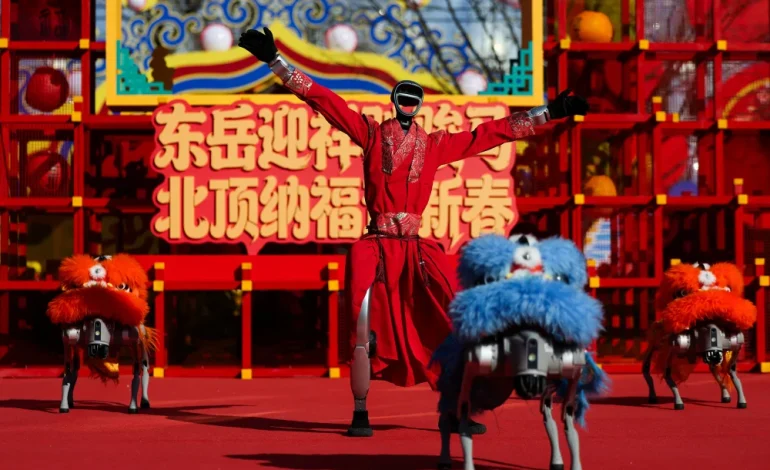
CCTV Spring Festival Gala put humanoid bots front and center Monday, with four up-and-coming firms turning a New Year tradition into a tech demo.
If you watched, you saw what Beijing wanted you to see: polished machines dancing, tumbling and sparring with humans in tight choreography. The slots went to Unitree’s robots and three rivals — Galbot, Noetix and MagicLab — plus a cameo from ByteDance’s chatbot. ByteDance’s AI showed up in a sketch; Noetix robots mugged for laughs; MagicLab danced to “We Are Made in China.” It looked, in short, like a curtain-raiser for industrial policy.
The eye-catcher was a long martial-arts sequence where more than a dozen humanoids performed sword, pole and nunchuck routines alongside child actors. One stunt nodded at drunken boxing — wobbling steps, staged backward falls — but the real flex was technical: multi-robot coordination and fall recovery. A robot tumbles, then gets up. On a stage, that’s applause-worthy. In a factory, it’s practical.
China’s push here is deliberate. Analysts say the gala is an unusually direct pipeline from government goals to investor dollars and orders. “Prime-time spectacle becomes policy signal,” wrote Georg Stieler in comments about the show — and the payoff is measurable: research firm Omdia reckons China shipped roughly 90% of the world’s humanoids last year, while analysts at Morgan Stanley project sales to more than double this year.
Expectations are sky-high. Executives have been unusually close to power; Unitree’s founder met the country’s leadership after last year’s performance. Wang Xingxing, Unitree’s CEO, told local media his company plans to ramp shipments from thousands to tens of thousands this year, and the firm says parts of this year’s routine — trampoline flips, three-metre somersaults and short-sprint bursts — were done fully autonomously.
Reality check: stage conditions help. Smooth floors, rehearsed airflow, predictable lighting — all make robots look better than they might in a cluttered factory aisle. “On stage they’ve got all the advantages,” tech analyst Patrick Zhang wrote, noting that real-world deployment is still the hard part. Still, the speed of progress is striking. Hardware supply chains, cheap components and local AI labs are converging fast.
The spectacle has rivals and skeptics watching closely. Elon Musk has said China will be a chief competitor in humanoids as Tesla pivots toward embodied AI. That’s one reason western firms like Tesla and other startups are no longer the only names in the race. China’s story bundles chips, factories and models into one visible narrative — and it’s hard to ignore.
There’s money behind the show. Investors are snapping up suppliers tied to the trend, and a few Chinese startups are gearing up for IPOs. Local headlines framed the gala as both a tech milestone and a market signal: appearances on state TV can mean government interest and smoother paths to contracts.
What matters next is whether these machines move off bright stages and into messy factories, hospitals and homes. Engineers here are racing on navigation, embodied AI “brains” and safety. That’s where the gala’s promise will be tested: coordination is cool; autonomy in chaotic places is what companies will be paid for.
For now, China used its biggest TV event to say one thing bluntly: humanoid robots aren’t a research demo anymore — they’re a national push. Whether they become useful tools or mainly prime-time spectacle depends on how quickly the teams behind the robots turn theatrical reliability into real-world toughness.



The latest news in your social feeds
Subscribe to our social media platforms to stay tuned