


Uncertain Future for Wyoming’s Derecho Supercomputer as Federal Management Shifts
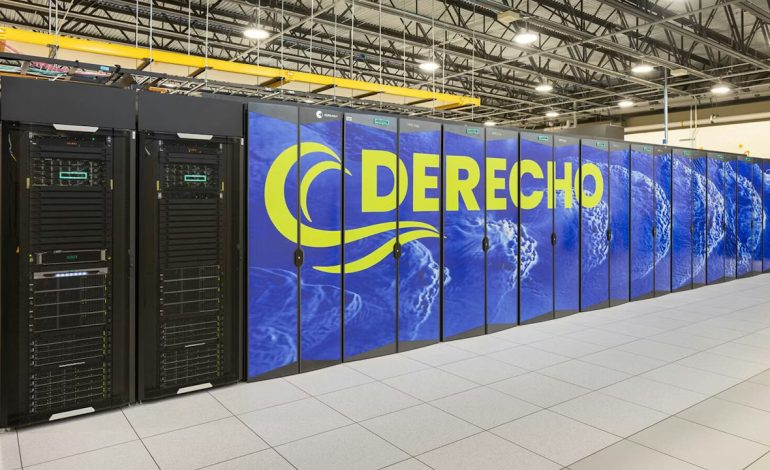

The fate of the Derecho supercomputer, housed at the NCAR-Wyoming Supercomputing Center in Cheyenne, has been thrown into doubt following a National Science Foundation announcement that it will transfer management of the facility to a third party. The move is part of broader Trump administration efforts to restructure the National Center for Atmospheric Research in Boulder, which a budget official last year called “one of the largest sources of climate alarmism in the country.”
The NSF statement provided few specifics about timing or who might take over operations. “NSF is working with all parties to ensure continuity of operations, and additional information will be shared as it becomes available.”
Cheyenne Mayor Patrick Collins said he’s watching developments closely. “The goal for me is to make sure that NCAR in Wyoming survives,” he told Cowboy State Daily. “It’s so important for allowing people to understand what’s happening with the weather, from our military to our communities.”
The $34 million Derecho supercomputer, installed in late 2023, can perform 19.87 quadrillion calculations per second—the equivalent of more than 500,000 laptops working simultaneously. It is 3.5 times faster than its predecessor and serves more than 4,000 users from over 575 universities and institutions nationwide.
The University of Wyoming retains a 20% share of Derecho’s computing capacity under an agreement dating to the center’s 2012 opening. “That’s still in place,” said UW spokesman Chad Baldwin. “And we use it. Right now, it’s primarily being used for atmospheric research.”
UW President Ed Seidel said the university is “closely following the process laid out by the NSF for next steps and have conveyed our interest in playing an appropriate role to support it in the future.”
The center’s research extends beyond climate modeling. Past projects have examined geophysics, land-use dynamics, wildfire behavior, and even drug trafficking patterns. NCAR was instrumental in solving unexplained weather events that caused airplane crashes in the 1980s.
Meteorologist Don Day said he’s waiting for clarity but takes some reassurance that closure hasn’t been announced. “They’re not saying they’re closing, so I would consider that as good news,” he said. “However, everything else is yet to be determined.”
Collins noted that NCAR’s presence helped catalyze Cheyenne’s tech sector, attracting facilities for Microsoft and Walmart. “We put a lot of money into that park to get it ready,” he said. “That effort has really paid dividends.”
The research conducted at Derecho doesn’t produce daily forecasts but improves them over time, said NCAR Director of High-Performance Computing Irfan Elahi. “Whatever new discoveries we make in better predicting the weather, the better the newscasters and meteorologists will be able to do their jobs.”



The latest news in your social feeds
Subscribe to our social media platforms to stay tuned