
US boards sanctioned Venezuela-linked tanker in Indian Ocean as oil crackdown expands
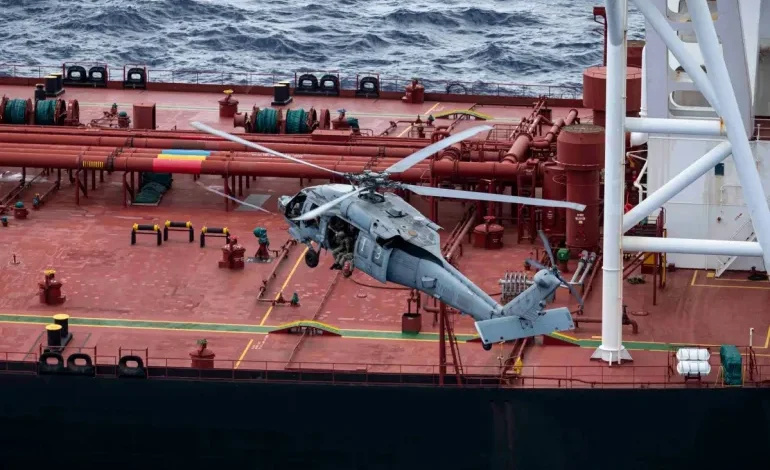

US forces have intercepted and boarded another oil tanker tied to Venezuela’s sanctioned crude trade, underscoring how far Washington is willing to project its maritime enforcement campaign beyond the Caribbean.
The Pentagon said the Panamanian-flagged Veronica III was tracked across oceans after it left Venezuelan waters and attempted to evade a blockade ordered by President Donald Trump.
“We tracked it from the Caribbean to the Indian Ocean, closed the distance, and shut it down,” the department said in a post on X, accompanied by video of troops fast-roping from a helicopter onto the vessel.
The ship had departed Venezuela on January 3, the same day Nicolas Maduro was captured by US forces, carrying close to two million barrels of crude and fuel oil, according to ship-tracking data. It had previously been under US sanctions, including for links to Iran-related oil transport, and like many vessels in the so-called shadow fleet had operated under shifting registrations and opaque ownership structures.
This is the second such boarding in the Indian Ocean in recent days and part of a wider effort to choke off Venezuela’s ability to move oil through global supply chains. At least nine ships have been intercepted since the quarantine on sanctioned tankers was announced in December, a policy designed to apply direct pressure on Caracas by targeting the trade that sustains its economy.
What makes the latest operation notable is the distance. Previous seizures largely took place near Venezuelan waters or in the Atlantic. Pursuing a vessel from the Caribbean to the Indian Ocean signals a shift from regional interdiction to a global enforcement model — one that treats sanctions evasion as something to be policed wherever the ships go.
The Pentagon has not confirmed whether the Veronica III has been formally seized and placed under US control, saying only that there was no additional information beyond the initial announcement. That leaves the legal status of the vessel unresolved for now.
The broader strategy is economic as much as military. US officials say oil sales conducted under Washington’s control since Maduro’s capture have already generated more than $1bn, with several billion more expected in the coming months. The interceptions are therefore not just about stopping shipments but about redirecting the flow of revenue.
Even so, the scale of the shadow fleet dwarfs the number of ships stopped so far. Estimates suggest hundreds of sanctioned tankers continue to operate worldwide, moving crude through complex routes, false flags and transponder blackouts. The current seizures, while highly visible, touch only a fraction of that network.
The maritime campaign is unfolding alongside a parallel escalation at sea. Separate US strikes on vessels suspected of carrying drugs in the Caribbean have killed more than 130 people since late 2025, highlighting how interdiction, sanctions enforcement and counter-narcotics operations are increasingly overlapping in the same waters.

The latest news in your social feeds
Subscribe to our social media platforms to stay tuned