


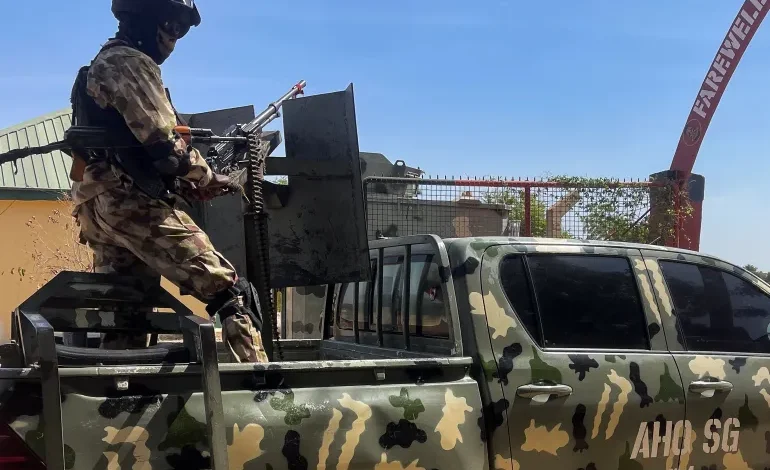

The United States has sent a small military contingent to northern Nigeria to support local forces confronting a widening network of armed groups, signalling a renewed, though limited, security partnership after months of strained relations.
Nigeria’s Defence Headquarters said the 100 US personnel have arrived in Bauchi in the country’s northeast, where they will focus on training, intelligence sharing and technical assistance rather than combat operations. The mission also includes equipment intended to strengthen Nigerian capabilities on the ground. Military spokesman Samaila Uba emphasised that command authority remains entirely with Nigeria.
“The armed forces of Nigeria remain fully committed to degrading and defeating terrorist organisations that threaten the country’s sovereignty, national security, and the safety of its citizens,” he said.
The deployment comes as attacks intensify across the north. Over the weekend, gunmen on motorcycles swept through three villages, killing at least 46 people and abducting others. The deadliest assault took place in Konkoso, in Niger State, where dozens were shot or had their throats slit. Such raids, fast, mobile and often targeting rural communities, have become a defining feature of the conflict.
Nigeria’s security crisis is no longer confined to a single insurgency. Boko Haram and its offshoot, the ISIL-affiliated Islamic State West Africa Province, remain central actors, but they now operate alongside a growing array of groups. These include ISIL-linked Lakurawa and loosely organised “bandit” networks that combine mass kidnappings with control over illegal mining sites. The violence has also begun to overlap with the Sahel’s expanding militant landscape, with Jama’at Nusrat al-Islam wal-Muslimin claiming its first attack inside Nigeria last year.
For Washington, the new deployment follows a period of friction. Late last year Donald Trump accused Abuja of failing to protect Christians and threatened unilateral action, a charge Nigerian authorities rejected, noting that communities of all faiths, and particularly Muslims in the north, are among the main victims. Since then, the relationship has shifted back toward cooperation, beginning with US air strikes on ISIL-linked fighters in December and quiet intelligence coordination confirmed in January.
The current mission reflects a calibrated approach: a visible presence that stops short of direct combat, aimed at improving targeting and operational planning rather than changing the balance through US firepower. It also acknowledges the scale of the challenge. Dozens of armed groups now compete for territory across a country of roughly 240 million people, evenly divided between a largely Muslim north and predominantly Christian south, with the most intense violence concentrated in northern regions.


The latest news in your social feeds
Subscribe to our social media platforms to stay tuned