

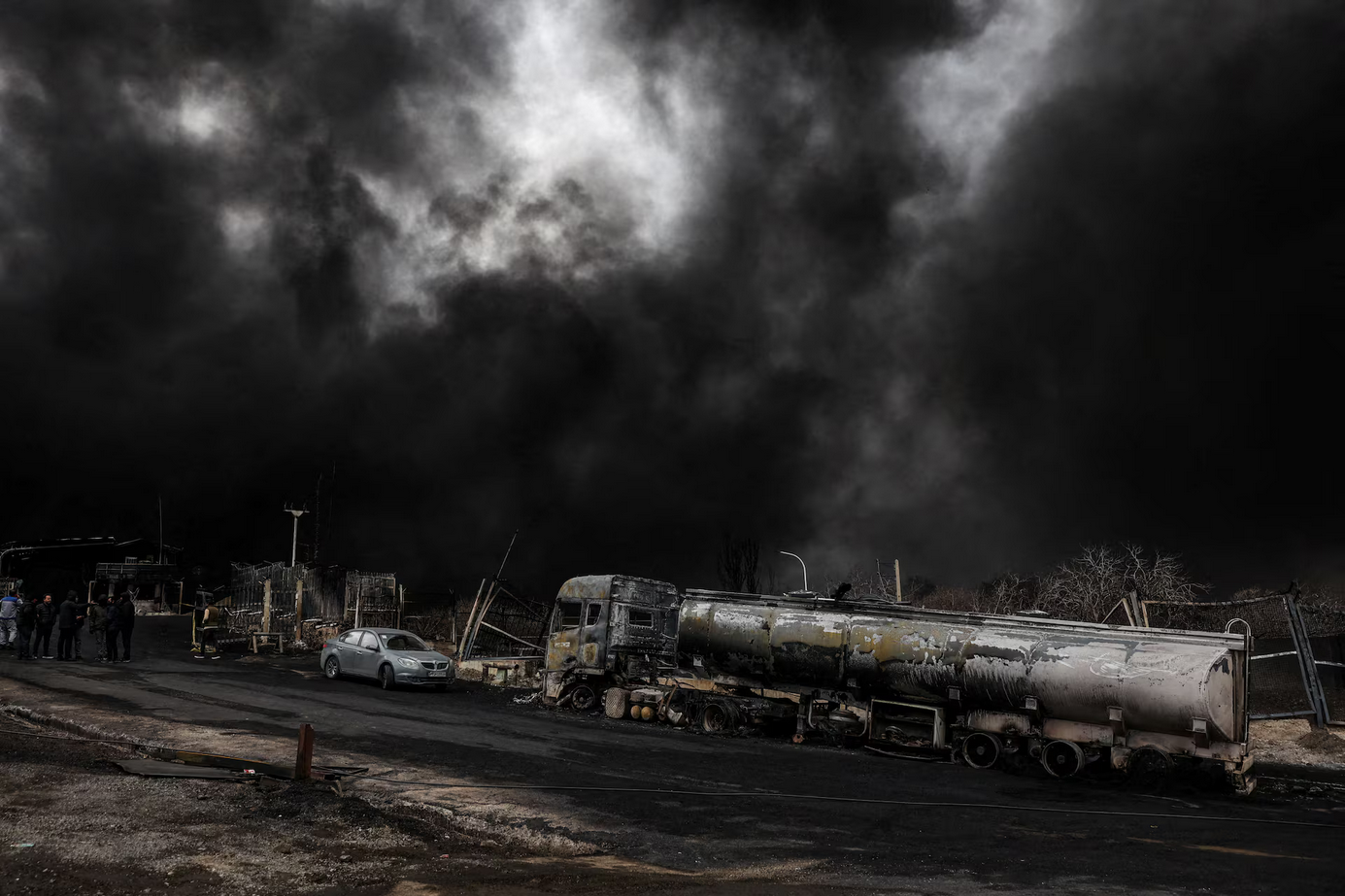



EXCLUSIVE: Operation Epstein Fury Part 3. War Next Door. How the Iran Conflict Is Reshaping the South Caucasus.


The war between Iran and the United States–Israel coalition has rapidly evolved from a limited campaign of targeted strikes into one of the most consequential geopolitical crises of the decade. What began as a series of coordinated air and cyber operations aimed at Iran’s military infrastructure has spiraled into a broad confrontation affecting not only the Persian Gulf but also neighboring regions stretching from the Levant to the Caucasus.
According to early operational reporting, the initial wave of attacks targeted Iranian missile installations, Revolutionary Guard bases, and nuclear facilities. The opening phase could be described as an attempt to cripple Iran’s military capabilities through precision strikes and electronic warfare. The goal was to degrade Iran’s ballistic missile program and command networks without triggering an immediate full-scale regional war.
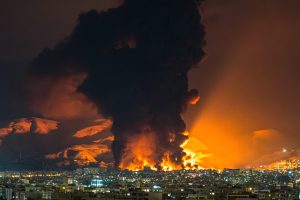
That objective proved difficult to sustain. Iranian retaliation came quickly, ranging from missile attacks in the Gulf to drone strikes across several theaters. The conflict soon expanded into a multi-domain war involving cyber operations, maritime confrontations near the Strait of Hormuz, and long-range strikes deep inside Iranian territory.
The human cost has mounted steadily. The Pentagon confirmed more than 150 American casualties during the early stages of the conflict, underscoring the intensity of Iranian retaliation against US assets and personnel. Civilian losses inside Iran have also become a defining feature of the war. Tehran has claimed that thousands of civilian sites – including infrastructure, schools, and residential areas – have been hit by coalition strikes.
Satellite imagery and independent monitoring platforms show widespread damage across multiple Iranian provinces. Oil depots, transportation hubs, and military bases have been repeatedly targeted. Some strikes have caused large fires at industrial facilities, releasing toxic smoke and potentially hazardous chemicals into surrounding urban areas.
Economic damage has been equally severe. Iran’s oil infrastructure – long the backbone of the country’s economy – has been hit repeatedly. Analysts warn that disruptions to refining capacity and export terminals could slash Iran’s oil revenue for months or even years. The ripple effects extend far beyond Iran. Global energy markets have reacted sharply to the conflict, with volatility returning to oil prices and shipping routes across the Persian Gulf facing heightened security risks.
At the same time, the war has triggered a humanitarian crisis. Millions of civilians have reportedly been displaced internally as air strikes and missile exchanges hit urban areas. Reports of destroyed schools, residential buildings, and transportation networks have fueled concerns about a long-term refugee crisis across Iran’s borders.
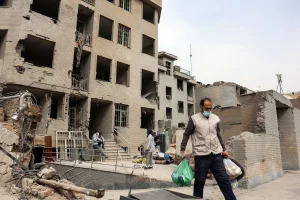
Strategists increasingly warn that the war has reached a dangerous crossroads. Some experts argue that the coalition campaign could escalate further in pursuit of regime change or military collapse. Others believe the conflict may settle into a grinding stalemate marked by periodic air strikes and proxy warfare across the region.
Either scenario carries serious implications for neighboring regions. Among them, the South Caucasus – often seen as a geopolitical crossroads between Europe, the Middle East, and Central Asia – now finds itself uncomfortably close to the epicenter of the conflict.
To understand why the Iran war matters so much for Armenia and Azerbaijan, one has to step back and look at the region’s history.
Iran has long played a complex role in the South Caucasus. For centuries, parts of present-day Armenia and Azerbaijan were integrated into Persian imperial structures before being absorbed by the Russian Empire in the nineteenth century. Modern borders emerged after the Soviet collapse in 1991, but historical, cultural, and economic ties remained strong.
For Armenia, relations with Iran have often been pragmatic and essential. Landlocked and historically isolated by closed borders with Turkey and Azerbaijan, Armenia relied heavily on its southern neighbor as an economic lifeline. Trade routes through Iran provided access to international markets, while energy cooperation helped offset Armenia’s dependence on other regional powers.
Iranian-Armenian relations therefore developed around practical needs rather than ideological alignment. Economic cooperation ranged from natural gas imports to infrastructure projects linking the two countries’ power grids and transport corridors. Analysts frequently noted that despite political differences, Tehran and Yerevan maintained stable diplomatic ties for decades.
Azerbaijan’s relationship with Iran has been far more complicated.
Although the two countries share cultural and religious connections – both have majority Shi’a populations – political relations have often been tense. One key factor is demography. Iran’s Azeri population exceeds that of Azerbaijan proper.
Robert Cekuta, Adjunct Senior Professorial Lecturer at American University, former US Ambassador to Azerbaijan (2015 – 2018) with 40 years of experience as a US diplomat, describes how this dynamic shaped relations from the very beginning:
“Iranian interference in Azerbaijan and elsewhere in the South Caucasus has been an ongoing problem for years, really from the breakup of the Soviet Union. But the threat has been more visible/urgent at some times than at others.
In the case of Azerbaijan, when it first regained its independence in 1991, Tehran sought to foment separatism in the southern part of the country. However, while there continued to be problems, e.g., instances when Tehran acted in support of Armenia or tried to send mullahs to mosques in Azerbaijan, as Azerbaijan solidified its security situation, Iranian shenanigans generally diminished. In addition to the institutions and national identity becoming stronger in Azerbaijan, I suspect another factor was that 30 – 35 million ethnic Azeris live in Iran, especially in the northwestern part of the country. (Azerbaijan’s current population is around 10.5 million people, not all of whom are ethnic Azeris.) There may/may have been a sense that Baku, as well as Tehran could, if it wanted to, play the ethnic card. However, I never saw any real evidence during my years at post or afterwards that Baku sought to do so. Tehran certainly did not like the fact that Azerbaijan, as a majority Shi’a but secular state, has had diplomatic relations with Israel since 1992 as well as strong trade and people-to-people ties (Azerbaijan continues to have a significant and active Jewish population). Azerbaijan is the only country with a majority Shi’a population to have diplomatic relations with Israel.
In terms of where things stand today and are likely to go, while President Aliyev publicly expressed condolences at the death of the late Iranian Supreme Leader – who, by the way, was reportedly an ethnic Azeri – he strongly condemned the subsequent Iranian drone incursions into Azerbaijani territory. There have also been reports coming out of Azerbaijan that Iran might have also had further actions in mind, including against Azerbaijan’s Jewish population. However, it seems highly unlikely that Azerbaijan – or Armenia for that matter – would launch military action against Iran. At the same time, the question of whether Iran, which seems to be looking to do all that it can to increase the global pain resulting from the war, might take some further action is an open one. I would be surprised if Iran made a concerted effort against Azerbaijan or Armenia, including because Iran has used the countries of the South Caucasus as avenues for trade with Russia and elsewhere in the world.”
These tensions have periodically surfaced through diplomatic disputes, military incidents near the border, and competing geopolitical alignments. Azerbaijan’s growing partnership with Israel – especially in the defense and drone sectors – has been a particular irritant for Tehran.
Still, both Armenia and Azerbaijan have generally sought to maintain workable relations with Iran. Geography leaves little room for alternatives.

Iran is one of the most ethnically diverse countries in the Middle East. Persians constitute a majority, but large minority communities include Azeris, Kurds, Arabs, Baluchis, and Armenians. Many of these groups have deep historical roots within Iran’s political and cultural life.
The Azeri population is the largest minority, concentrated primarily in the northwestern provinces near the Azerbaijani border. Armenian communities, though much smaller, have existed in Iran for centuries and have played significant roles in trade, craftsmanship, and technical professions.
As the war escalates, these communities have become the focus of increasing speculation about political fragmentation inside Iran.
Some observers fear that prolonged conflict could intensify ethnic tensions, particularly if economic collapse or political instability weakens central authority. Others believe such concerns are overstated.
Gregory Aftandilian, Senior Professorial Lecturer at the School of International Service at American University and adjunct faculty member at Boston University, argues that large-scale ethnic upheaval is unlikely:
“As for how this war will affect the Armenia-Azerbaijan situation, not much will change. Armenians in Iran have been part of the Iranian fabric for many centuries and have proven they can adapt to various regimes and are valued for their professional and technocratic competence. Azerbaijanis in Iran have also been part of the Iranian fabric and consider northwestern Iran their home. Hence, there will not be any significant refugee flows.”
Nevertheless, the war has disrupted communications between Iran and diaspora networks abroad. Armenian organizations have reported losing contact with some communities in Iran during communications blackouts, raising concerns about humanitarian conditions.
Meanwhile, Azeri nationalism remains a sensitive issue for Tehran. Iranian authorities have long feared that ethnic mobilization in the northwestern provinces could create pressure for autonomy or closer ties with Azerbaijan.
The war amplifies those concerns. If Iran’s political system were to weaken significantly, ethnic questions could quickly move from theoretical debates to urgent political challenges.
The most immediate danger for the South Caucasus lies not in ethnic politics but in military spillover.
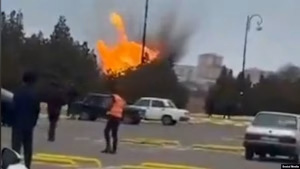
Several incidents during the first week of the war highlighted how close the region is to the conflict zone. One of the most alarming involved drone strikes in Azerbaijan’s Nakhchivan exclave, a small territory separated from mainland Azerbaijan by Armenia.

Reports indicated that missiles or drones originating from Iranian territory struck near an airport in the region. Azerbaijani authorities condemned the attack and withdrew diplomatic staff from Iran shortly afterward.
Whether the strike was intentional remains disputed. Iranian officials denied responsibility, while some analysts speculated that the incident might have involved Israeli operations designed to complicate Iran–Azerbaijan relations.
Regardless of the explanation, the event triggered alarms across the region.
Matthew Bryza, former US Ambassador to Azerbaijan, Managing Director for Straife, Board Member of the Jamestown Foundation, and Former Deputy Assistant Secretary of State for Europe and Eurasia, in his comment to Wyoming Star given before the war, warned that escalation could destabilize the entire border region:
“The impact on Armenia and Azerbaijan of armed conflict between the US and Iran depends on the scale of fighting. If the US limits its strikes to just a few days and against IRGC bases, ballistic military bases, uranium enrichment facilities, and perhaps regime officials, and if such strikes do not catalyze a new nationwide wave of protests that threaten Iran’s clerical regime, then I don’t expect there will be much direct impact on Armenia and Azerbaijan.
But if the US conducts a drawn-out campaign that aims to cripple Iran’s oil industry and foster regime change, Iran’s multi-ethnic national fabric could begin to fray. This would create significant instability along the borders of both Armenia and Azerbaijan, potentially leading to refugee flows and disrupting regional trade and energy corridors. For Armenia, which has historically maintained close ties with Tehran, a prolonged conflict could jeopardize its primary alternative transit route and energy security. For Azerbaijan, the presence of a large ethnic Azeri population in northern Iran could lead to complex domestic and trans-border political pressures.”
Those trade routes are not minor infrastructure. They include pipelines carrying oil and gas from the Caspian Sea to Turkey and Europe, along with rail and highway corridors connecting Central Asia to European markets.
Alexandre D. Rovere, a former ExxonMobil executive, a former fellow at the Belfer Center for Science and International Affairs at Harvard University, and a graduate of the Catholic University of the Sacred Heart in Milan, highlights the strategic stakes:
“The South Caucasus serves as the gateway for trade routes and energy flows from Europe to Central Asia through Turkey and the Caspian Sea. This geopolitically pivotal region hosts an oil and gas pipeline system that provides uninterrupted supplies of hydrocarbons to international market destinations and directly borders countries with some of the world’s largest reserves of mineral and energy resources.
In order to ensure the stable functioning of existing trade flows and the implementation of new long-term, capital-intensive projects, the states of the South Caucasus need to demonstrate to the foreign investment community their ability to maintain regional equilibrium against the backdrop of the outbreak of military conflict in Iran. In this matter, the states of the South Caucasus can find an important point of reference in the carefully crafted foreign policy that Azerbaijan has pursued after the dissolution of the USSR.
An accurate assessment of the regional power balances had allowed Azerbaijan to reach an understanding with neighboring powers while simultaneously fostering rapprochement with extra-regional actors. This calculation had paid off in political and economic terms: over time, Azerbaijan had increased its political autonomy, whereas safeguarding stability had helped attract tens of billions of US dollars in foreign direct investment into the country’s oil and gas industry.”

Maintaining stability along those corridors is critical for international investors.
Despite the tensions, both Armenia and Azerbaijan have been cautious about taking sides in the Iran war.
This caution reflects a classic strategy among small states caught between larger powers: neutrality.
Rovere notes that such behavior is typical in great-power confrontations:
“The main body of theoretical literature and historical research suggests that small states usually prefer the policy of neutrality over other alternatives when caught in the middle of a great power confrontation. Their interests lie in exploiting the international balance of power and great power rivalries without having to pay the price of allying with either side. By choosing sides, a small state may alienate one of the great powers and become dependent on the political imperatives of the rival power, thereby compromising its independence and security.
Applying this logic suggests that Azerbaijan will be better off focusing on ensuring the stable functioning of existing energy trade flows through the South Caucasus to Turkey and Europe and will remain neutral even in the face of possible attempts to draw it into the conflict – as it, along with a number of other states in the region, has in fact done so far.
There are instances when a small state is forced to choose sides. Geographic proximity to one of the rival great powers – in the case of Azerbaijan and Armenia, they share a border with Iran – or the conclusion that the balance of power that previously functioned has become unstable and may be demolished may preclude the possibility of neutrality. The most common outcome is an attempt by a small state to ward off the danger by allying with or appeasing the more powerful of the rival great powers while engaging in free-riding: getting the ally to assume the burden is of paramount importance to avoid self-sacrifice in a war where a small state’s contribution is considered limited.Thus, Azerbaijan may need to answer the following three questions to assess the dilemma it faces:
- If the war with Iran comes to a standstill and the current regime remains in power, will Iran pursue threatening expansionist intentions to the point of jeopardizing Azerbaijan’s interests?
- If so, how likely is Azerbaijan’s participation to tip the balance in favor of the outcome of the conflict that it desires?
- If Azerbaijan enters the war and the current regime remains in power in Iran, will the risk and scale of retaliation for Azerbaijan be higher than in the “do nothing” scenario?”
So far, both countries appear to be following this logic.
At the same time, the United States has increased its engagement in the South Caucasus through economic and infrastructure initiatives. Programs such as the proposed Trans-Regional Infrastructure and Partnership Program (TRIPP) aim to strengthen transport, energy, and technological connectivity across the region.
Yeghia Tashjian, Regional and International Affairs Cluster Coordinator at the Issam Fares Institute for Public Policy and International Affairs at the American University of Beirut, explains how Washington views the region strategically:
“The current US posture in the South Caucasus reflects a dual-track logic: deeper engagement to counterbalance Russia and Iran while avoiding direct regional spillover from escalating US–Iran tensions. This is why all three leaders of the South Caucasus sent condolence letters to Iran on the occasion of the deaths of Iranian leaders and citizens. Meanwhile, Vice President Vance’s visit to the region suggests that Washington sees Armenia, Azerbaijan, and Georgia as strategically situated between the Black Sea and Iran and relevant to connectivity initiatives such as the Middle Corridor. However, an open US–Iran confrontation would introduce acute risks. This is why the prolongation of the war with Iran would also postpone US investments directed towards TRIPP, as Washington may be concerned not to trigger an Iranian retaliation on American economic interests in the region, as it is happening now in the Gulf states.
The ongoing war has also repercussions on the region, for Armenia, which has historically maintained pragmatic ties with Tehran, which was Yerevan’s trade lifeline amid closed borders with Turkey and Azerbaijan, war would jeopardize energy imports, transit routes (especially along the north-south trade routes), and remittance flows. For Azerbaijan, despite its security partnership with Israel and growing ties with Washington, escalation could trigger border militarization along the Aras River, a flow of refugees (mainly Iranian Azeris), economic disruptions to north–south transit corridors, and domestic sensitivities given Iran’s large Azerbaijani population. Regionally, renewed conflict would likely securitize the entire South Caucasus, deter foreign investment, disrupt emerging connectivity projects, and complicate the fragile post-2020 equilibrium after the Nagorno-Karabakh conflict. In short, while the US seeks calibrated engagement, an Iran war would transform the South Caucasus from a peripheral theater into a frontline geopolitical fault line with significant political fragmentation and economic contraction across the region… Now that Azerbaijan has been attacked, things may change.”
However, the longer the war continues, the harder that balancing act becomes.
One of the most politically sensitive issues raised by the war concerns so-called “South Azerbaijan” – the Azeri-populated regions of northern Iran.
Nationalist narratives occasionally portray these provinces as culturally linked to the Republic of Azerbaijan. During periods of political instability in Iran, speculation resurfaces about whether separatist movements could emerge there.
So far, the Azerbaijani government has avoided encouraging such narratives. Baku has consistently emphasized respect for Iran’s territorial integrity.
Analysts believe this restraint reflects strategic caution. Any attempt to exploit ethnic tensions inside Iran could provoke severe retaliation and destabilize the entire region.
At the same time, the war has raised new questions about the future of Iran itself. If the conflict were to weaken the central government significantly, geopolitical calculations in the South Caucasus could shift dramatically.
For now, however, both Armenia and Azerbaijan appear determined to stay out of the fighting.
The South Caucasus sits at a geographic crossroads. To the south lies Iran; to the north, Russia; to the west, Turkey and Europe; and to the east, the Caspian Sea and Central Asia.
That location has always been both a strategic advantage and a source of vulnerability.
Today the region faces a new test. Drone strikes, refugee fears, disrupted trade routes, and geopolitical rivalries all converge along the borders of Armenia and Azerbaijan.
Jeffrey Sachs, Professor and Director of the Center for Sustainable Development at Columbia University, warns that the broader war could have global consequences:
“A prolonged war would most likely mean a disaster for Israel and the US. If the US and Israel do not win in the short term – and most likely they will not win in the short term – the devastation of Middle East energy supplies will be enormous, Russia and China will become more heavily involved, and all countries, including Azerbaijan and the Gulf countries, will be less likely (in my view) to sign on to the US and Israeli side.
The war should never have been launched by the US and Israel. It is purely a war of choice that never should have been chosen. It is likely to create both a global disaster and a major loss for the US and Israel.
The best would be for the US to stop the bombing now and just return home. The outcome will still be unfavorable, but much less unfavorable than digging the hole deeper.”
If the conflict drags on, the shockwaves will not stop at Iran’s borders. They will travel north – into a region that already knows how quickly geopolitical fault lines can shift.
For Armenia and Azerbaijan, the priority is simple but difficult: avoid becoming the next front in someone else’s war.


The latest news in your social feeds
Subscribe to our social media platforms to stay tuned