



The war arrived before dawn.
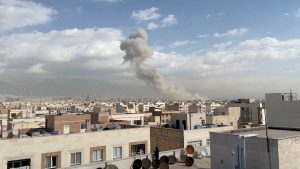
In the early hours of February 28, 2026, Israeli jets and long-range missiles streaked across Iranian skies in what Jerusalem officially christened Operation Lion’s Roar, later branded on IDF platforms as Operation Roaring Lion. Within hours, Washington joined the fray under a separate but coordinated banner: Operation Epic Fury. Two names. One war.
The Israeli government announced the operation through official channels, framing it as a preemptive strike on Iran’s nuclear and military infrastructure. The IDF’s own mini-site and updates page presented the campaign as necessary to “neutralize existential threats.” In Washington, the White House declared that President Donald Trump had launched Operation Epic Fury to “crush the Iranian regime and end the nuclear threat,” invoking the doctrine of “peace through strength.”
The problem is that many outside the US and Israel see something else: an offensive war, initiated without clear evidence of an imminent Iranian attack, and undertaken while diplomatic contacts were reportedly ongoing.
According to reporting compiled in the evolving entry on the 2026 Iran conflict, the initial strikes hit nuclear facilities, missile sites, Revolutionary Guard installations, and – critically – senior leadership targets. Satellite images and regional reporting mapped by Al Jazeera showed coordinated bombardment across Tehran, Natanz, Isfahan, and military complexes in western Iran.
The IDF’s official statements boasted of precision. US Central Command announced that American forces had targeted key nuclear-related infrastructure and command nodes. Secretary of War Pete Hegseth described the objectives as “laser-focused.” Analysts at the Washington Institute gamed out potential scenarios even as the bombs were still falling.
Yet even in the first 24 hours, it became abundantly clear this was not just about centrifuges.
The war escalated dramatically with targeted assassinations. Iranian state media confirmed the deaths of multiple senior officials, including top commanders of the Islamic Revolutionary Guard Corps (IRGC). International outlets, including Al Jazeera and The Hill, began compiling lists of those killed.
Then came the shockwave.
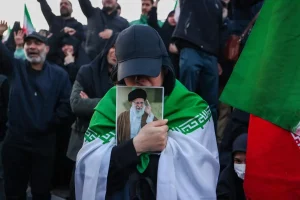
On March 1, reports confirmed the assassination of Supreme Leader Ali Khamenei. This killing marked a turning point. Khamenei had ruled Iran for 36 years. For some Iranians, he was the symbol of defiance against Western pressure. For others, he was the architect of brutal repression. His death removed the single most powerful figure in the Islamic Republic’s political system.
The list of officials killed during the conflict expanded rapidly, including military chiefs and political advisers. Analysts warned that the decapitation strategy – eminiscent of past US and Israeli tactics – might not produce the intended collapse.
As Nader Hashemi, Director of the Alwaleed Center for Muslim-Christian Understanding and an Associate Professor of Middle East and Islamic Politics at the Edmund A. Walsh School of Foreign Service at Georgetown University, observed in a CBC interview following Khamenei’s death, the regime’s institutional structure could close ranks quickly. Power in Iran does not reside in one man alone:
“The supreme leader was in power for roughly 37 years. He was the most powerful figure in the system. Symbolically, it’s very important that he is no longer in the political equation. But before anyone breaks out the champagne bottles and starts to celebrate, it’s important to realize that the structure and nature of power in the Iranian political system are very different than they were in Libya under Muammar Gaddafi or Saddam Hussein’s Iraq. Power in Iran is very institutionalized and dispersed, so it doesn’t mean that there’s going to be a political opening just because Ali Khamenei is no longer at the helm of the Iranian state…
The running regime was planning for this moment for a long time. I suspect they already have a successor in place. The security forces, as far as we can tell, are still loyal to the political system. There’s no sign of them breaking away, and there’s no clear opposition ground game that could possibly lead a democratic transition should the regime start to crack. I think it’s important we don’t get carried away here with news that this brutal leader has passed from the scene. The Islamic Republic is still very much in power, and I suspect when this war is over, they’ll remain in power…”
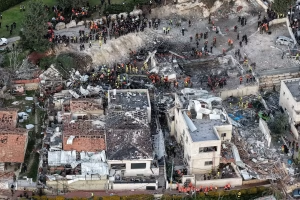
Iran’s retaliation began within hours. Ballistic missiles rained down on Israeli cities. Video verified by Al Jazeera showed a strike hitting Beersheba. Another Iranian strike killed at least nine people in Beit Shemesh. Sirens wailed across Tel Aviv and Haifa.
But Tehran didn’t stop at Israel.
Blasts were reported in Qatar, the UAE, and Kuwait as Iran targeted US bases and logistical hubs across the Gulf. Analysts from The Conversation and Reuters noted that Tehran appeared intent on expanding the battlefield, drawing in states that host American forces.
Trita Parsi, writer, analyst, Co-Founder, and Executive Vice President of the Quincy Institute for Responsible Statecraft, argues that Iran has deliberately shifted its strategy compared to the 2025 war:
“There is a constant level of attack throughout the day rather than a salvo of 50 missiles at once. Damage will be less, but that isn’t a problem because Tehran has concluded that Israel’s pain tolerance is very high – as long as the US stays in the war. So the focus shifts to the US.”
Iran also struck European-linked facilities, including bases in Cyprus reportedly used for operations against Iran. That move signaled a willingness to widen the war beyond the Middle East. It was a message to Brussels as much as to Washington. As Dr. Parsi put it:
“Tehran appears intent on not only expanding the war into Persian Gulf states but also into Europe. Note the attack on the French base in the UAE. For the war to be able to end, Europe too has to pay a cost, the reasoning appears to be.”
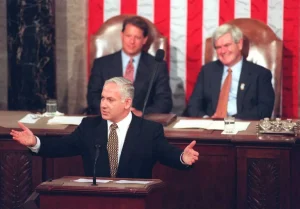
Prime Minister Benjamin Netanyahu spent almost 40 years warning about a so-called ‘existential threat’ of Iran’s nuclear program. Israeli officials insisted the operation was necessary to prevent a point-of-no-return scenario.
Critics argue something else was at play.
An analysis by the International Institute for Strategic Studies described Trump and Netanyahu as “going for Iran’s jugular.” Al Jazeera ran commentary suggesting that US strikes primarily benefited Israel’s strategic goals. Drop Site News characterized the war as a regime-change operation from the outset.
There is a familiar pattern: escalate to reshape the regional order, eliminate adversaries, and push the US into deeper alignment. Supporters see decisive leadership against a regime that funds and arms Israel’s enemies.
Gregory Aftandilian, Senior Professorial Lecturer at the School of International Service at American University and adjunct faculty member at Boston University, warns about the potential necessity for the US and Israel to go all in:
“Operation Epic Fury seems designed to bring about regime change in Iran. If that takes place, it will have overwhelming support in the Middle East region (outside of Iran’s proxy groups) because there is widespread loathing of the Iranian regime, its regional threats, and its severe repression of the Iranian people. That said, if the military campaign stops short of regime change, it will be a big disappointment all around because you will have the same type of regime in place, albeit a weaker one. Hence, there will be pressure on the Trump administration from inside and outside of the United States to ‘finish the job.’ A Venezuelan outcome of keeping the regime in place while pressuring it from the outside will not work.”
As the war escalates, civilian casualties are mounting in Iran. The United Nations reports rising death tolls and warns of humanitarian catastrophe. US casualties have begun to climb as Iranian missiles hit bases in Iraq and the Gulf.
President Trump has suggested the war could last four to five weeks or longer.
Public opinion in the United States is skeptical. CNN polling shows 59 percent disapprove of the strikes. A Reuters/Ipsos poll found only one in four Americans supports the operation.
The strategic question lingers: Was this a preemptive act of self-defense – or a war of choice?
Ahmad Kazemi, Professor of International Law in Tehran, Senior Researcher on Eurasian Issues and senior author and researcher in the field of the Caucasus and Eurasia, calls it a war crime and argues there was no imminent threat. He cites attacks on schools and hospitals, including the bombing of a girls’ school in Minab that reportedly killed 165 students. Human rights groups have also documented civilian deaths and violations of humanitarian law.
You can find Dr. Kazemi’s statement in full here.
Jeffrey Sachs, Professor and Director of the Center for Sustainable Development at Columbia University, goes further. He calls the war “illegal, murderous, and costly,” predicting that neither the US nor Israel can force regime change and warning of economic blowback, oil price spikes, and reputational damage.
“This war will have deep repercussions economically, geopolitically, and militarily. It will not be won by the US and Israel. They cannot force regime change. Iran will not be defeated. Nor will the regime be overthrown by some kind of mass movement. Trump’s actions were ill-conceived, poorly designed, illegal, murderous, and costly. Moreover, they ran starkly against the interests and opinions of the American people and against Trump’s own campaign promises.
As for geopolitics, Russia and China will find ways to help Iran, both militarily and economically. They won’t let Iran go down.
America’s reputation in the world will take another bad hit. The US’s standing was already low, but it is now in a free fall. The same with Israel. The American people have turned against Israel, and more bad news for Israel is to come. Americans don’t like Israel’s violent theocracy.
Trump is demonstrating once again Kissinger’s adage that to be an enemy of the US is dangerous, but to be a friend is fatal. Countries caught in the crossfire have the US (and Trump’s) recklessness to blame.”
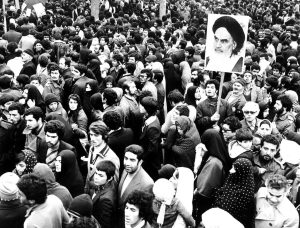
The battlefield is active. The political endgame is murky.
It’s important to remember that this war did not begin in 2026. It is the latest eruption in a conflict decades in the making.
US–Iran relations have been fraught since the 1953 CIA-backed coup that overthrew Prime Minister Mohammad Mossadegh. The 1979 Islamic Revolution severed diplomatic ties. Hostage crises, sanctions, proxy conflicts, and the nuclear standoff followed.
Timelines from CFR, Bloomberg, and NPR trace a steady deterioration punctuated by brief moments of détente – most notably the 2015 nuclear deal, later abandoned by Trump in his first term.
The current war revives ghosts of past American interventions in the region. David Mednicoff, Associate Professor of Middle Eastern Studies and Public Policy at the University of Massachusetts-Amherst, points to the lessons of 1953 and 2003:
“The lesson of past major American interventions in Middle Eastern countries, including the 1953 US-UK overthrow of Iran’s government and the 2003 US war that ousted Saddam Hussein in Iraq, is that stable or democratic governments that serve long-term American interests do not get established by external US force. Why President Trump believes this new American-dominated warfare against a Middle Eastern state will be different from past experience is uncertain. So far, the Trump administration has offered neither clear justification nor efforts to attain the support of Americans, let alone the authorization of Congress. The US-led conflict, as a war of choice with no credible argument or evidence of necessary self-defense, is certainly a major violation of international law.”
The other key player in the ongoing Middle-Eastern disaster is Israel. The Iran–Israel proxy conflict has simmered for years. Iran backs Hezbollah and other militant groups. Israel has carried out covert strikes inside Syria and Iran targeting IRGC assets.
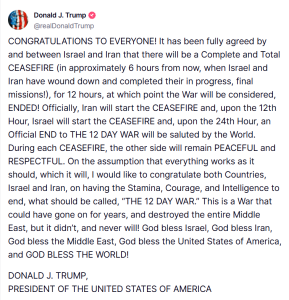
In 2025, tensions boiled over into what became known as the Twelve-Day War. Our June 2025 reporting described Operation Rising Lion and retaliatory strikes that left the region rattled. That conflict ended in a fragile ceasefire.
Nine months later, according to Al Jazeera’s editorial board, the US and Israel sought to “topple Iran’s leaders.” Tehran, in Dr. Parsi’s account, believes agreeing to the 2025 ceasefire was a mistake that allowed Washington and Jerusalem to rearm:
“Tehran is not looking for a ceasefire and has rejected outreach from Trump. The reason is that they believe they committed a mistake by agreeing to the ceasefire in June – it only enabled the US and Israel to restock and remobilize to launch war again. If they agree to a ceasefire now, they will only be attacked again in a few months.
For a ceasefire to be acceptable, it appears difficult for Tehran to agree to it until the cost to the US has become much higher than it currently is. Otherwise, the US will restart the war at a later point, the calculation reads.”
The 2026 war, in that reading, is just a second round.
The UN Security Council convened emergency sessions. Statements from the EU’s High Representative urged restraint. China’s Foreign Ministry criticized the strikes while calling for dialogue. Russia, according to Reuters and The Moscow Times, remains in contact with Tehran but has so far limited itself to rhetoric.
Carnegie and Chatham House analysts suggest Beijing and Moscow are playing a longer game – offering economic and possibly quiet military support while avoiding direct confrontation with Washington.
Ukraine has reportedly offered to help intercept Iranian drones. Gulf states are anxious. Some fear internal unrest; others fear economic collapse if oil flows are disrupted.
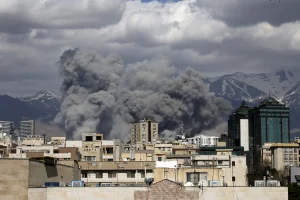
Smoke rises after a series of explosions in Tehran, Iran on March 01, 2026 (Fatemeh Bahrami / Anadolu via Getty Images)
Civilian death numbers are grim. The Guardian reports civilian deaths in Iran passing 200. Al Jazeera puts the toll higher – over 550. Hospitals and schools have been hit. UNICEF warns of devastating impacts on children.
Footage shows fathers holding the remains of daughters in the aftermath of the Minab girl’s school bombing. The Red Cross and UNHCR are mobilizing across the region.
Dr. Kazemi accuses the US and Israel of violating the Geneva Conventions. The pattern Israel made its trademark during the Gaza Genocide.
There is another angle to the operation. Back in Washington, critics argue the timing is suspicious. Opinion pieces in The Guardian and The Independent suggest Trump may be using the war to distract from domestic scandals, including renewed scrutiny over the Jeffrey Epstein files.
Dr. Kazemi echoes that view from Tehran, claiming Trump entered the war to escape political disgrace and under Netanyahu’s influence:
“By changing the ‘America First’ slogan to the ‘Israel First’ slogan, Trump has led America into an unnecessary and inhuman war. In line with Netanyahu’s expansionist goals of creating the state of ‘Greater Israel,’ Trump has seriously endangered the lives of American soldiers, in addition to their assets; This view is repeatedly raised in Iranian academic, media, and public circles that Trump has entered a war with Iran to escape the shameful Jeffrey Epstein case, and under the influence of Netanyahu’s gang – who are war criminals, according to the International Criminal Court.”
The White House dismisses such claims as a conspiracy. But they circulate widely on social media and in political debate.
With all that, are we going into Iraq 2.0? The comparisons are inevitable.
ECFR calls it “a war with no winners.” Arab Center DC analysts warn of strategic overreach. CNN notes the absence of clearly defined war aims.
VoteVets and other advocacy groups invoke the specter of another forever war. President Trump has hinted at the possibility of ground troops. That single phrase has sent tremors through Washington.
Jeffrey Sachs predicts munitions shortages and economic fallout:
“The US bombing campaign and Israel’s Iron Dome will run short of munitions and anti-missile defenses… As for the economics, oil prices will spike, tourism and travel will fall, and the Gulf countries will suffer sharp losses. So much for US protection. The world economy will slow or even contract if this goes on for weeks or months.”
Gregory Aftandilian warns that a half-baked regime change could prolong instability.
Trita Parsi argues Iran will escalate until US costs become unbearable:
“From the outset, and perhaps surprisingly, Iran has been targeting US bases in the region, including against friendly states. Tehran calculates that the war can only end durably if the cost for the US rises dramatically, including American casualties. After the assassination of Ayatollah Khamenei, Iran says it has no red lines left and will go all out in seeking the destruction of these bases and high American casualties.
Iran understands that many in the American security establishment had been convinced that Iran’s past restraint reflected weakness and an inability or unwillingness to face the US in a direct war. Tehran is now doing everything it can to demonstrate the opposite – despite the massive cost it itself will pay. Ironically, the assassination of Khamenei facilitated this shift.”
Dr. Mednicoff questions whether any external force can reshape Iran’s political system without unleashing chaos. He also warns about potential regional ramifications and dangers of a prolonged conflict:
“We are already seeing the war against Iran escalate in Lebanon, and I expect it to have ramifications throughout the Middle East for the coming weeks.
President Trump has most recently hinted that there is some possibility of American ground troops in Iran. This, and the level of fighting we are seeing now, makes me believe that the odds are against a very speedy negotiated off-ramp to the war. Since the President has not been clear about what the specific war aims are, and what evidence would count as achieving these aims, it’s difficult to predict how things will unfold. Certainly, sustained warfare, and the disruption to oil, natural gas, and transportation flows in the Gulf region, are of concern to many countries throughout the world… Many Iranians, Middle Easterners, and people throughout the world, who witnessed the Islamic Republic’s brutal repression of the waves of peaceful protesters in recent years, would welcome a more responsive Iranian government that stops fostering militant organizations in the Arab world and elsewhere. However, how the current war could actually lead to such a result, what other terrible fallout it will produce, and what might stop it, are cogent and pressing questions as attacks and deaths continue to increase.”
Iran is not Iraq, Afghanistan, or Libya. It has a cohesive state apparatus, a large population, and deep nationalist sentiment. The assassination of Khamenei has not produced mass uprising.
According to Dr. Parsi, the window for regime collapse appears to be closing as the system reconstitutes itself:
“The announcement of Khamenei’s death opened a window for people to pour onto the streets and seek to overthrow the regime. Though expressions of joy were widespread, no real mobilization was seen. That window is now closing, as the theocratic system closes ranks and establishes new formal leadership… The question ‘How will this end?’ should have been asked before this war was triggered. It wasn’t.”
Trump insists the war will end on American terms. Let’s hope the ‘American terms’ is not another forever war in the Middle East (11th major one since the 1980s).


The latest news in your social feeds
Subscribe to our social media platforms to stay tuned