



EXCLUSIVE: Iran War and the Way it Can Ruin US Strategic Aspirations in the South Caucasus.


On February 28, 2026, the war came before dawn. Israeli jets and long-range missiles struck Iranian skies in what Jerusalem called Operation Lion’s Roar. Within hours, Washington joined under a separate banner: Operation Epic Fury. Two names, one war. The stated goal: cripple Iran’s nuclear and military infrastructure. The actual scope: something far larger.
The opening salvo killed Supreme Leader Ali Khamenei. It also took out top IRGC commanders, hit nuclear facilities at Natanz and Isfahan, and leveled command nodes across the country. The Trump administration expected the theocracy to implode.
Trita Parsi, writer, analyst, Co-Founder, and Executive Vice President of the Quincy Institute for Responsible Statecraft, summed up the miscalculation:
“The administration’s plan – based on an exaggerated view of Iran’s relative weakness – was that the theocracy in Iran would implode shortly after the assassination of the Supreme Leader. By Monday [March 2] morning, before the markets opened, the war was supposed to be over, and Trump would be basking in yet another glorious victory, proving all his skeptics wrong. But no such implosion has occurred. Nor are we seeing signs that it is likely to occur in the short term.”
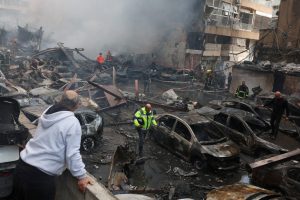
Tehran fought back. Retaliation came fast and wide. Missiles hit US bases across the Gulf. A drone struck near a US diplomatic facility in Dubai. Explosions rocked Beirut and Tel Aviv. The Pentagon confirmed more than 150 American casualties in the early stages. With further reports placing the number at around 750. The human toll inside Iran mounted: over 1,000 killed in the first phase alone, many of them civilians caught in strikes on infrastructure and urban areas. By mid-March, Iranian authorities reported over 3,500 dead, including 1,600 civilians, and as many as 3.2 million internally displaced. Satellite imagery showed widespread damage across multiple Iranian provinces – oil depots, schools, residential blocks, all hit.
Then came the Strait of Hormuz. Iran effectively shut it down, trapping roughly a fifth of global oil and LNG flows. Brent crude spiked above $100 a barrel. The Gulf states took direct hits: Qatar’s Ras Laffan LNG complex suffered extensive damage, fires broke out at Kuwaiti refineries, and the UAE saw shutdowns. European gas prices jumped 28% in a single day. The war stopped being about Iran. It became a global economic event.
Israel widened the front northward. Ground operations in southern Lebanon pushed troops several kilometers across the border near Khiam. Tens of thousands fled the southern regions. Then, late on April 7, after weeks of brutal bombardment, a ceasefire was announced – but not the one anyone expected. The deal, brokered by Pakistan, gave Iran a two-week pause in exchange for reopening the Strait of Hormuz. Tehran’s 10-point plan would anchor negotiations: non-aggression guarantees, retention of control over the strait, sanctions relief, and compensation for war damage. The United States had not signed on to all ten points, but the mere fact that Iran’s framework would shape the talks amounted to a significant diplomatic victory for Tehran, as Trita Parsi noted:
“Trump’s failed use of force has blunted the credibility of American military threats, introducing a new dynamic into US-Iran diplomacy… Even if the talks collapse… there is little reason to believe a second round would produce a different outcome or that it would not once again leave Iran in a position to hold the global economy hostage. In that sense, Tehran has, at least for now, restored a measure of deterrence.”
The US, after failing to achieve regime change through force, found itself negotiating from a position it had not anticipated.
Michael McFaul, a former US Ambassador to the Russian Federation during the Obama administration, the Ken Olivier and Angela Nomellini Professor of International Studies in Political Science, Director and Senior Fellow at the Freeman Spogli Institute for International Studies, and the Peter and Helen Bing Senior Fellow at the Hoover Institution at Stanford University, put it bluntly:
“We faced no imminent threat from Iran and had not exhausted all other non-military means to achieve our objectives. President Trump has yet to clearly explain to the American people why he has taken us into a war with Iran and why now.”
McFaul also pointed to a broader strategic gift to Moscow:
“Putin is emerging as a clear beneficiary of this war. Disruptions in the Strait of Hormuz have driven up oil prices, generating billions in extra revenue for Russia and bolstering its war chest. The US decision to temporarily ease sanctions on Russian oil is another boost for Putin and has drawn criticism from allies, including Canada, Norway, the United Kingdom, and Germany.”
The ceasefire announcement on April 8 brought whiplash. Just hours earlier, Trump had threatened on social media that “a whole civilization will die tonight, never to be brought back again.” Then came the truce. Iran’s first vice president, Mohammad Reza Aref, declared on social media that “the era of Iran” had begun after Trump failed to destroy the Islamic Republic’s government. Oil prices tumbled nearly 15 percent to about $95 a barrel. Global stock markets soared. But the fragility was immediately apparent. Israeli PM Benjamin Netanyahu said the ceasefire “does not include Lebanon” and promptly carried out the largest coordinated strike against Hezbollah since the war began, killing and wounding hundreds. More than 1,500 people had already been killed in Lebanon, and 1.2 million displaced. The ceasefire, such as it was, held a single thread.
Parsi captured the strategic inversion:
“Washington can still rattle its saber. But after a failed war, such threats ring hollow. The United States is no longer in a position to dictate terms; any agreement will have to rest on genuine compromise. That, in turn, demands real diplomacy – patience, discipline, and a tolerance for ambiguity – qualities not typically associated with Trump.”
That failure has direct consequences for the South Caucasus – a region where the US had, until the war, been making significant strategic gains.
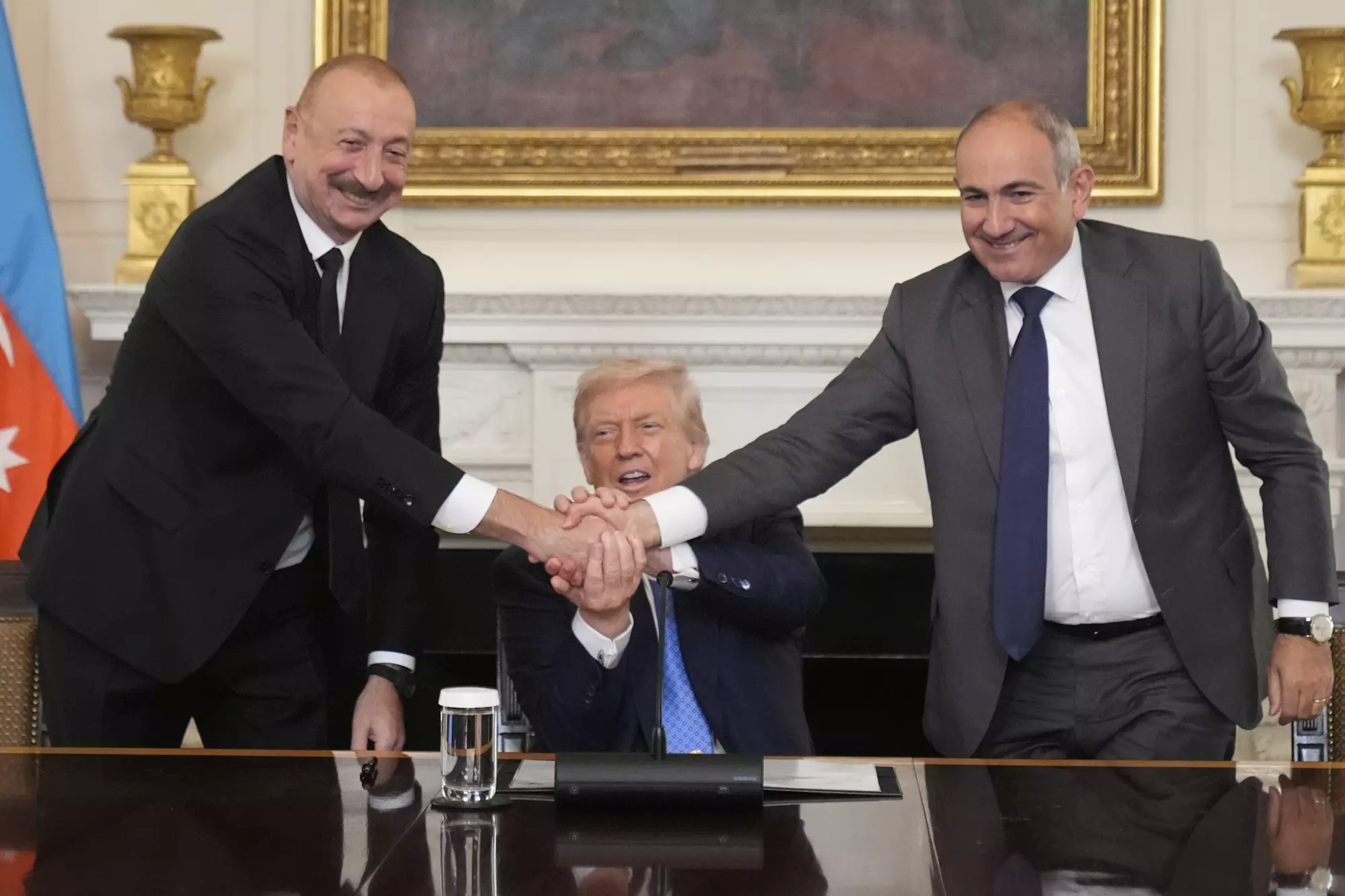
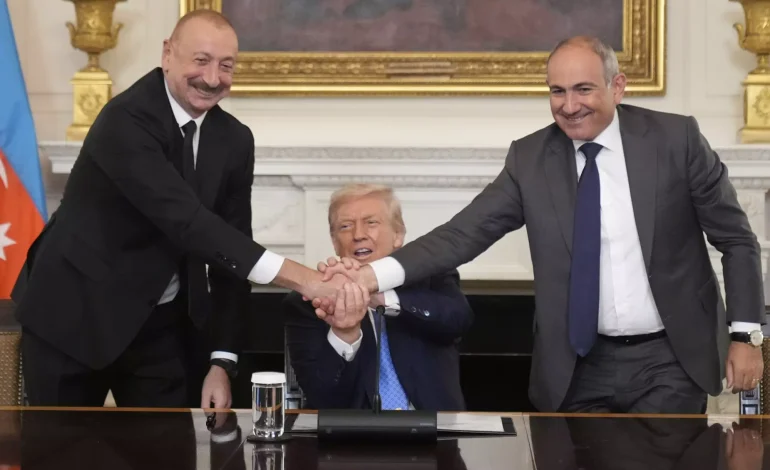
Before the bombs fell on Iran, the Trump administration was riding high on a diplomatic victory in the South Caucasus. On August 8, 2025, Armenian Prime Minister Nikol Pashinyan and Azerbaijani President Ilham Aliyev stood with Trump at the White House and signed a trilateral joint declaration. The document had two pillars. First, a political track: Armenia and Azerbaijan initialed the text of a peace agreement, formally ending decades of conflict over Nagorno-Karabakh. Second, a connectivity track: a transit route across southern Armenia linking Azerbaijan proper to its Nakhchivan exclave, named the Trump Route for International Peace and Prosperity – TRIPP.
TRIPP was a geopolitical instrument. The US would hold exclusive development rights for an initial period of 49 years, with a controlling 74% stake in the development company. The route would run through the town of Meghri, along the Arax River and the Armenia-Iran border. For Washington, the strategic payoff was clear: a reliable east-west link connecting the Caspian Basin to European markets while bypassing both Russia and Iran. For Armenia, it meant transit fees, jobs, and integration into Western trade networks. For Azerbaijan, it meant long-sought direct access to Nakhchivan without relying on Iranian territory.
The deal was classic Trump transactional diplomacy: US companies get the contract, the region gets connectivity, and Moscow gets sidelined. Russia’s Federal Security Service had previously overseen the prospective transit route under the 2020 ceasefire agreement. Now Washington was taking that role, effectively excluding Russia from a strategically vital project. The Carnegie Endowment’s Thomas de Waal and Zaur Shiriyev noted that TRIPP was designed to create “a new dynamic of Armenia-Azerbaijan economic cooperation, replacing one of antagonism and closed borders” while reducing dependence on Russian and Chinese infrastructure.
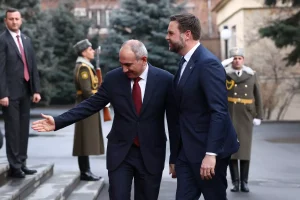
Vice President JD Vance’s visit to Yerevan and Baku in February 2026 cemented the new alignment. It was the highest-level American visit to the South Caucasus in nearly a decade. Vance announced the sale of $11 million in US reconnaissance drone technology to Armenia, signed an agreement on civilian nuclear cooperation, and formalized a Charter on Strategic Partnership with Azerbaijan. The message was unmistakable: Washington was putting real money and political capital into a region that Moscow had long considered its backyard.
But Iran saw the corridor differently. Tehran viewed TRIPP as a strategic pincer closing in from the north. Alex Vatanka, Senior Fellow at the Middle East Institute, explained:
“Iran has voiced strong opposition to the proposed Zangezur Corridor… Tehran views the project as more than a trade initiative, casting it instead as a geopolitical maneuver backed by the United States and Israel to diminish Iran’s influence in the South Caucasus.”
Iranian officials warned that the corridor would cut Iran off from Armenia, undermine its access to vital transit routes, and increase its isolation in regional trade. Dr. Ehsan Movahedian, a Caucasus expert at Tehran’s ATU University, put it in stark terms:
“Iran opposes US intervention in the affairs of the Caucasus… The purpose of this move … is to economically and geopolitically encircle Iran… Iran’s only safe border in the South Caucasus is the border with Armenia, which the US wants to make insecure…”
Then the war came. And all those carefully laid plans began to crack.
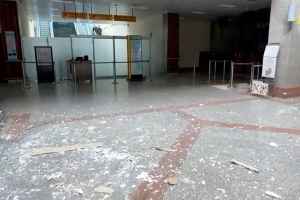
On March 5, 2026, two drones, reportedly of Iranian origin, struck the passenger terminal of Nakhchivan International Airport. Another fell near a school. Four civilians were injured. Azerbaijan’s President Aliyev called it an “act of terror” and ordered the military to full combat readiness. The US State Department condemned the “unprovoked drone attack” and declared “full solidarity with Azerbaijan.” But the incident exposed a deeper vulnerability: Nakhchivan’s air and land links depend heavily on transit through Iran. Civil aviation was briefly suspended. An alternative route via Turkey’s Iğdır province exists but is limited. The exclave, already isolated, suddenly became a chokepoint.
The American University of Armenia in Yerevan also felt the heat. Iran’s Revolutionary Guard issued a warning on March 29: US and Israeli universities “in the West Asia region” were “legitimate targets” in retaliation for Iranian universities damaged in coalition strikes. The AUA switched to online learning as a precaution, though it had received no direct threats. The university resumed in-person classes after receiving assurances from Armenia’s Education Ministry, but the message was clear: US-affiliated institutions in the region were now in the crosshairs.
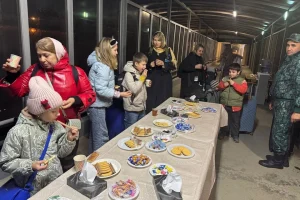
Meanwhile, a refugee crisis began to take shape. By mid-March, up to 3.2 million Iranians had been internally displaced. Armenia and Azerbaijan together received around 1,500 evacuees from Iran, including hundreds of foreign nationals, during the first days of the war.
Tigran Grigoryan, head of the Yerevan-based Regional Centre for Democracy and Security, warned of broader economic disruption:
“Iran and Armenia have a gas-swap deal, which is likely to be disrupted. Armenia’s trade with the Gulf states and China also largely flows through Bandar Abbas, in south Iran.”
The war was no longer a distant spectacle.
Carnegie’s Zaur Shiriyev noted the economic paradox: Azerbaijan stood to gain substantially from higher oil prices – a sustained $20–$25 rise in Brent crude would generate an annual export windfall of roughly $6 billion to $7.5 billion. But the benefits came with costs: higher energy prices would feed imported inflation, and a potential refugee flow from Iran posed an additional risk. For Baku, the deeper long-term concern lay across its roughly 700-kilometer border with Iran: the fate of Iran’s ethnic Azerbaijanis, numbering more than 20 million. Aliyev’s public comments about Iranian Azerbaijanis being “a place of hope” represented a calculated warning: any attempt to pressure Baku could affect Iran’s internal stability.
The war placed Armenia in an impossible position. Yerevan has historically maintained close ties with Iran – the two share a border, a gas-swap deal, and significant trade flows. Yet Armenia was simultaneously deepening its strategic partnership with the United States, which was now bombing Iran. Prime Minister Pashinyan walked a tightrope: he expressed condolences after Khamenei’s killing, sent humanitarian aid to Iran, but refrained from criticizing the US-Israeli military campaign. On April 8, after the ceasefire was announced, Pashinyan welcomed the truce while noting that the war would likely delay work on TRIPP, which he said was “not a priority for the US administration today.”
Sergei Melkonian of the Applied Policy Research Institute of Armenia described the balancing act:
“Neither Armenia nor Azerbaijan has officially condemned the US and Israeli strikes against Iran. This delicate balancing act underscores the increasing relevance of the United States in the South Caucasus, but also the need for the two small republics to balance their ambitions against the interests of their large neighbor Iran.”
Can the US salvage its strategic position in the South Caucasus? The answer hinges on whether TRIPP can survive the war.
Jeremy Tasch, Eurasian & Global Studies Research Professor with the Department of Geography & Environmental Planning at Towson University, put the stakes clearly:
“The current conflict with Iran has turned the South Caucasus into a critical test of Washington’s regional ambitions. The shift of the American University of Armenia to online learning and the targeting of Nakhchivan are clear signals that Tehran views US- and Israeli-linked interests in the region as vulnerable to retaliation. These are the types of institutions and corridors Washington has recently highlighted as symbols of a new regional order, which means disruptions now carry a reputational weight they did not in earlier phases of US regional engagement.
Whether Washington can “salvage” its reputation depends on its ability to move from diplomatic architect to credible security guarantor. The Trump Route for International Peace and Prosperity (TRIPP) is more than a transit project: it is the flagship initiative in a broader US effort to reduce the region’s reliance on Russian and Iranian routes. It signals major political commitment, but symbolism alone cannot protect infrastructure. If the US can provide the necessary security frameworks, it may cement its reputation as the only power capable of offering a stable alternative to the status quo. If these efforts stall, the region may pivot back toward more restrictive powers that can offer immediate security.”
Matthew Evangelista, President White Professor of History and Political Science Emeritus at Cornell University, highlighted another layer of risk:
“The Trump administration’s foreign policy is sometimes described as a return to great-power spheres of influence, with US intervention in Venezuela and threats against Cuba, Mexico, Greenland, and Canada and a seeming acceptance that Vladimir Putin’s Russia gets to dictate the terms of its relationship with Ukraine. Yet Trump doesn’t limit his ambitions to the Americas. Aside from wanting to abandon NATO in Europe, he has continued his predecessors’ claims to a US role in the Middle East, with the war against Iran and support for Israel, and planning for a war against China over Taiwan. Despite taking Russia’s side in its war against Ukraine, however, Trump has also intervened in what Russia considers its own sphere of influence, the “near abroad” – namely, in promoting the economic, energy, and territorial agreement between Armenia and Azerbaijan, modestly named the Trump Route for International Peace and Prosperity (TRIPP). As often happens with Trump, some of his impulsive moves – such as launching the war against Iran without any notion of its consequences – undermine his other goals, such as serving as a peacemaker in the South Caucasus.
As Iran retaliates against US and Israeli targets in the ongoing war, would the TRIPP agreement become collateral damage? The first point to remember is that the project is still in its early stages. The details of the rail links between Azerbaijan and its enclave of Nakhchivan, within Armenian territory, have still not been decided – nor has the funding for TRIPP’s ambitious infrastructure been secured. Given the vulnerability of a rail line that runs so close to the Iranian border, an intensification of Iranian military action could spook potential investors.
A further possible consequence of the US effort to weaken Iran is to enflame ethnic tensions in border areas. The Trump administration has sought to recruit Kurdish militia forces in its campaign against Tehran. If the goal is to use ethnic identities to divide Iran, the question of Iran’s Azerbaijani population (estimated at anywhere between 14 and 22 million) could complicate Iran’s relations with Azerbaijan. Even if there are no realistic prospects of a secessionist movement in the Iranian provinces of Ardebil, East Azerbaijan, and West Azerbaijan, the suspicion that the Americans are encouraging such efforts could make Iran more hostile to the TRIPP project and the improvement of Azerbaijan’s relations with the United States.”
Ronald Grigor Suny, William H. Sewell, Jr. Distinguished University Professor Emeritus of History and Emeritus Professor of Political Science at The University of Michigan, Emeritus Professor of Political Science and History at The University of Chicago, in his recent series of lectures ‘Forging the Nation: The Making and Faking of Nationalisms,’ offered a sober assessment:
“In the many years I have been studying, traveling to, and writing about the South Caucasus, a notable observation is that the peoples and even governments of this region are interested much more in their own persistent problems than in the world outside. Their concern with Great Powers and world politics rises when it directly affects their own country or the region. At the moment South Caucasia is in a transitional period marked by the retreat of Russia because of its war in Ukraine, Armenia’s desperate position attempting to stabilize after the defeat in the war, Azerbaijan’s triumphalist eagerness to emerge as the most powerful state in the region, and Georgia’s internal political divisions. The war in Iran is geographically close but distant in all other ways. There are not great effects on Georgia, which receives its energy from Azerbaijan and Russia. Armenia is friendly with Iran, despite its desperate attempts to cultivate closer relations with the United States and Europe and to keep Azerbaijan from any further aggressions. Azerbaijan is most vulnerable to the war in Iran. Its ally Israel is a participant, if not the principal initiator, of the war, having dragged the confused Trump into a war from which he now wants to exit as quickly as possible. Iran and Azerbaijan have been hostile to one another since Baku looks hungrily at the two-thirds of the world’s Azerbaijans who live across the border in Iran. And Azerbaijan has been hit by Iran in the war.
Azerbaijan, as an oil and gas supplier, will in the short run benefit materially from the war.
No country in the South Caucasus wants to become involved in the Israeli-American war against Iran, but the precarity of war, the impossibility of predicting what might happen should it continue for a long time, must trouble the ruling clan in Baku most of all.
Immigrants from Iran are more likely to move to Turkey than to Armenia or Azerbaijan. But it is possible that compatriots of people in those two countries may wish to emigrate to a place willing to accept them. Right now the immigrants seem to be emigrating for safety reasons and will wait to see how the situation in Iran works out, particularly after the war ends.”
The Carnegie Endowment’s Thomas de Waal and Zaur Shiriyev, writing just before the ceasefire, identified the immediate threat:
“…A continuation of the war in Iran could make it too dangerous for the US-led company entrusted with implementing the project on the Armenia-Iran border to begin its work.”
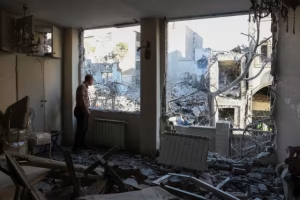
That threat has not disappeared with the ceasefire. The two-week truce is conditional, fragile, and seemingly excludes Lebanon. Iran retains control of the strait and continues to collect transit fees. The underlying grievances – sanctions, nuclear program, and regional influence – remain unresolved.
The ceasefire may buy time, but it does not solve the structural problem. The US launched a war of choice against Iran, expecting a quick collapse. Instead, it got a grinding confrontation that exposed American vulnerabilities, boosted Russian oil revenues, and handed Tehran a diplomatic victory. The same administration that brokered the historic Armenia-Azerbaijan peace deal and unveiled TRIPP as a flagship connectivity project now finds itself unable to guarantee the security of that very corridor. The rail line runs along the Iran-Armenia border – a border that is now a frontline. The US-led company that was supposed to build and operate TRIPP cannot begin work if Iranian drones are flying overhead.
Parsi’s conclusion about the broader war applies equally to the South Caucasus:
“This elective war was not only a strategic blunder. Rather than precipitating regime change, it has likely granted Iran’s theocracy a renewed lease on life. The magnitude of this miscalculation may well puzzle historians for decades to come.”


The latest news in your social feeds
Subscribe to our social media platforms to stay tuned