
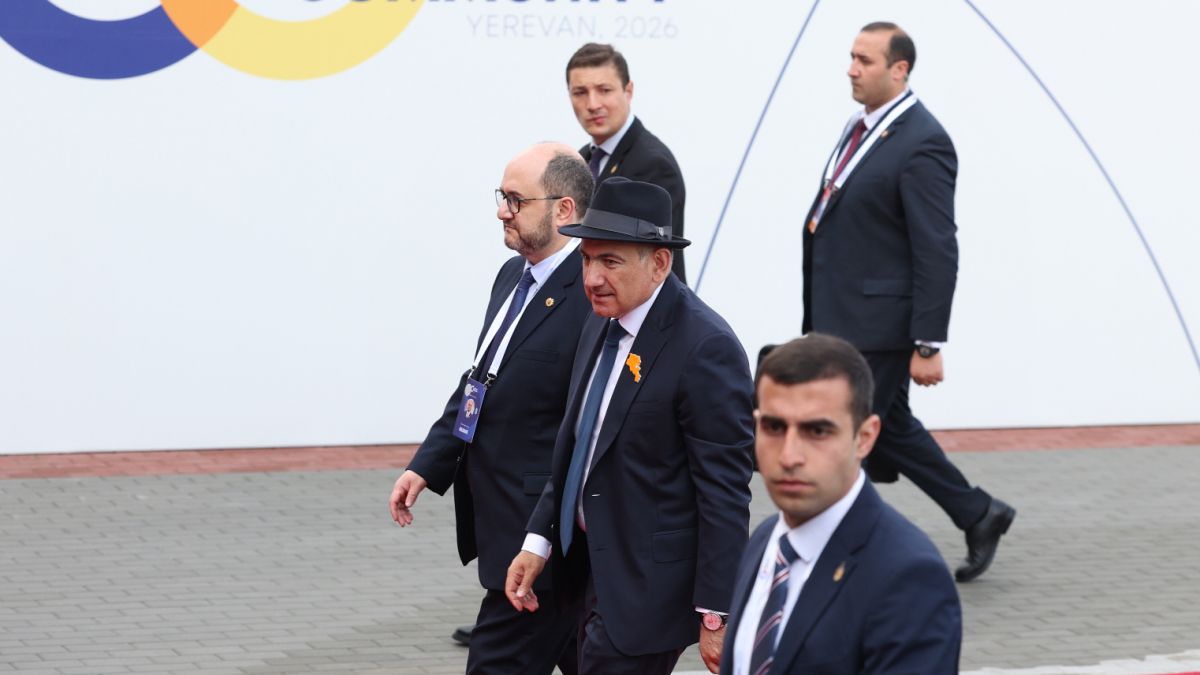

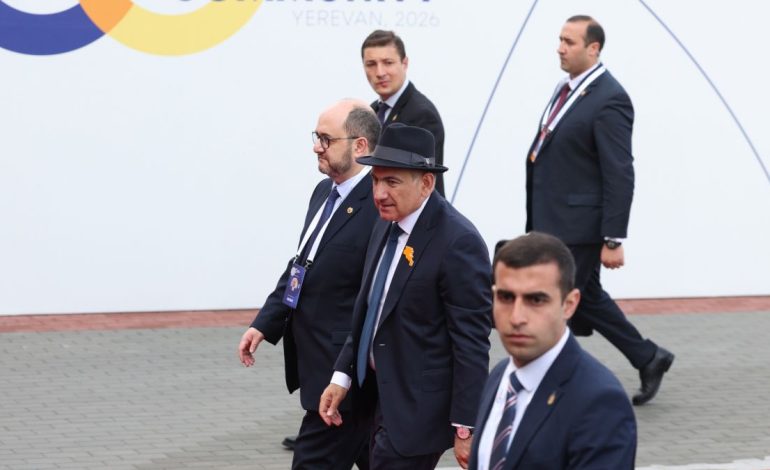

For two days, Armenian Prime Minister Nikol Pashinyan got everything he wanted: the world’s political elite in his capital, praising his peace agenda, and hosting a summit designed to pivot his country away from Moscow and towards Brussels. But as European leaders bid farewell on Tuesday, the fundamental question remains unanswered: what, exactly, did Armenia get in return for its dramatic geopolitical leap of faith? For Brussels and its allies, the answer was much clearer. The Yerevan gathering was about showing a wounded, fractious Europe that it could still project power and relevance in a world increasingly defined by transactional superpowers.
The decision to hold the eighth European Political Community (EPC) meeting in Armenia was a deliberate “red rag to Moscow,” underscoring Europe’s determination to court a former Russian ally. Baku, for its part, saw the event as undermining the peace process. Nearly 50 delegations poured into the city, with Canadian Prime Minister Mark Carney attending – the first non-European leader to join the informal talks. With Washington pulling 5,000 troops out of Germany and US President Donald Trump publicly sparring with European leaders, the gathering took on a defiant tone of European “strategic autonomy” in the face of an unreliable ally.
The summit’s primary goal was to demonstrate that the EU bloc can “scramble support for Ukraine” on its own, even as Washington’s attention is consumed by the Iran war. On the sidelines, Ukrainian President Volodymyr Zelenskyy held a flurry of bilateral meetings, outlining his key objectives with European leaders. British Prime Minister Keir Starmer used the platform to pursue the UK’s participation in an EU-backed loan scheme for Ukraine. For Canada, this was a chance to forge new alliances away from its increasingly erratic southern neighbor. Carney’s presence was a powerful signal:
We don’t think that we’re destined to submit to a more transactional, insular, and brutal world.
NATO chief Mark Rutte even admitted that Europe had “gotten the message” from Trump and was now prepared to help clear the Strait of Hormuz. In every sense, the summit was as much about soothing transatlantic tensions as it was about Armenia.
For Armenia, the embrace was warm, but the commitments were less concrete than the symbolism. The summit formally launched an “EU-Armenia Connectivity Partnership,” covering transport, energy, and digital infrastructure. Officials also initialed a working arrangement for the EU border agency Frontex to cooperate with Armenia’s Ministry of Internal Affairs. But for all the talk of deepening ties, the EU kept its strongest card – the prospect of membership – firmly in its pocket. High Representative Kaja Kallas only affirmed that the “European perspective is on the table, and Armenia will decide for itself.” It was a diplomatic way of saying “not yet” without closing the door entirely. The summit produced tangible deliverables, but not the strategic guarantee Pashinyan desperately needs.
This wariness is justified. Armenia is still trapped in a difficult geography. It remains a member of the Russian-led Eurasian Economic Union (EAEU), a reality that limits Brussels’ ability to integrate it fully. As Russian President Vladimir Putin reminded Pashinyan at a Kremlin meeting just before the summit, being “simultaneously in a customs union with both the European Union and the Eurasian Economic Union is simply impossible by definition.” While the EPC summit was a diplomatic triumph, it cannot erase the fact that Armenia remains deeply dependent on Russia for subsidized gas and security. The country continues to pay a “preferential rate” of 177.50 per 1,000 cubic meters, compared to 600 in Europe, a fact Moscow is unlikely to let Yerevan forget.
Back home, the warm glow of the European spotlight failed to mask the tense atmosphere on the streets of Yerevan. A heavy police presence cordoned off the city center, and critics accused the government of stage-managing the event to hide its domestic troubles. An open letter signed by 40 public organizations warned that Armenia’s democratic indicators are deteriorating, citing political repression and a shrinking space for free expression. The coalition of opposition parties that signed the letter argued that a glitzy photo op with EU leaders risked “sending a dangerous political signal: that democratic backsliding can be overlooked when it is politically convenient.”
Ultimately, the Yerevan summit was a masterclass in political theater. Europe got to demonstrate its relevance and unity in a world fractured by the wars in Ukraine and Iran. And Pashinyan gambled to cement his “Peace Agenda” on an international stage. The partnership between the EU and Armenia is now deeper than ever, but in the rough neighborhood of the South Caucasus, symbolism is rarely a substitute for security.

The latest news in your social feeds
Subscribe to our social media platforms to stay tuned