



Yellowstone’s 19-Mile-Wide, Chicago-Sized Bulge Near Volcano Has Stopped Growing
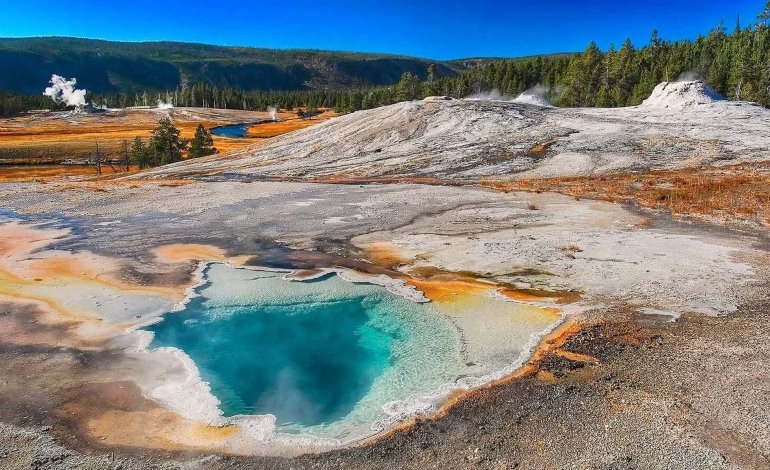

Scientists are still monitoring a Chicago-sized bulge in Yellowstone National Park, but the ground has stopped rising. The 19-mile stretch of the northern rim of the volcano’s caldera started inflating in July 2025 and continued growing into 2026. “The inflation abruptly stopped in January,” said Mike Poland, scientist in charge of the Yellowstone Volcano Observatory. “It’s there. It’s just not growing.”
The bulge is the latest episode of what is called the Norris Uplift Anomaly (NUA), a well-documented phenomenon between the Norris Geyser Basin and Gibbon Falls. The same spot has been rising and falling for decades. The first observed NUA event spanned from 1996 to 2004, rising almost 5 inches before subsiding. Another event between 2013 and 2020 rose about 3 inches. This latest uplift, detected by continuous GPS stations in July 2025, was accompanied by an increase in nearby earthquakes. The total rise remained less than an inch.
Poland said the NUA reflects dynamic processes happening about 10 miles deep, likely the movement of fluids—possibly magma. “That’s quite a bit deeper than we might expect the hydrothermal system to be acting, so the accumulation and withdrawal of magma is a likely source,” he said. Nearly all the hot springs in the northwest corner of Yellowstone, from Terrace Spring to Mammoth Hot Springs, occur along the same corridor.
Poland was quick to reassure that the bulge is not an indication of an imminent, apocalyptic eruption of the Yellowstone supervolcano. A 2025 study determined that Yellowstone’s magma chamber is mostly solid rather than melt. There is still enough liquid melt to cause a stir, but not enough to breach the surface with explosive energy. “If there was actually a chance that this was a magmatic system that was about to erupt, the deformation would be much shallower and accompanied by other huge changes,” Poland said.
The bulge may already be subsiding, but that would be happening so slowly that scientists haven’t yet observed it. Poland said the NUA has been doing this for a very long time, but now scientists have the technology—both radar satellites and ground-based GPS—to see it in real time. “It allows us to see how these things change over time in really subtle ways,” he said.
Poland emphasized that the public should not be worried. “We’re not worried about much in the way of eruption because the signs aren’t there,” he said. “The NUA is big, but the uplift is very, very small, and we can see all these subtle features that might otherwise be missed.”


The latest news in your social feeds
Subscribe to our social media platforms to stay tuned