

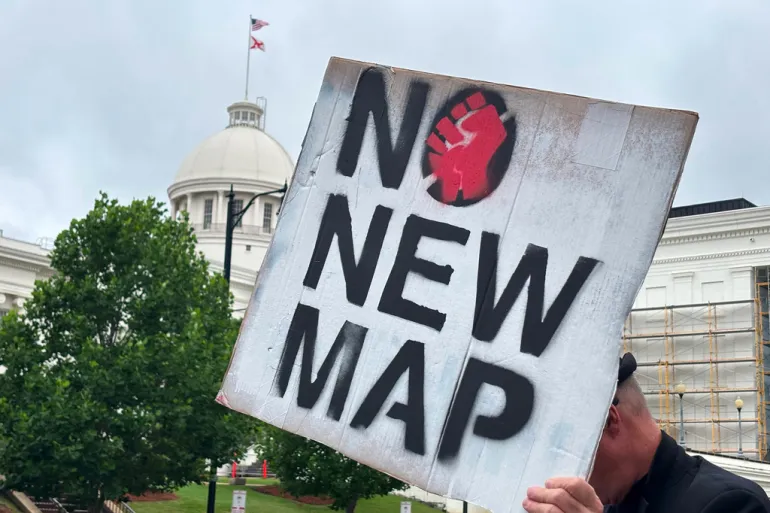



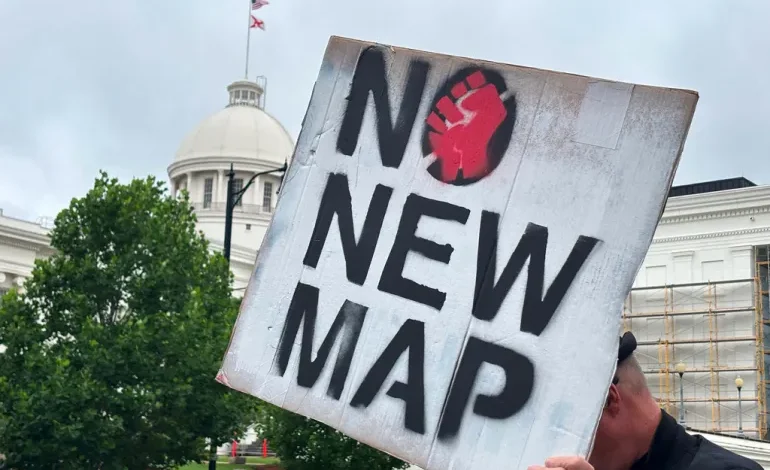

Efforts backed by Donald Trump to redraw congressional maps ahead of the 2026 midterm elections have hit significant obstacles in Alabama and South Carolina, complicating Republican attempts to strengthen their hold on Congress.
In Alabama, a three-judge federal panel blocked a Republican-backed district map that would have removed one of the state’s two majority-Black congressional districts.
“Ultimately, we cannot see our way clear to requiring Alabamians to cast their votes in the 2026 elections under a districting plan tainted by intentional race-based discrimination,” the panel wrote in its ruling.
Republican officials in the state said they plan to appeal the decision to the US Supreme Court. Alabama had already delayed primary elections in four congressional districts while lawmakers worked to redraw the maps.
The ruling represents another major legal fight over voting rights in the Deep South, where congressional district boundaries have long been tied to battles over racial representation and political power.
Meanwhile, in South Carolina, Republicans faced resistance from within their own party. Several GOP lawmakers joined Democrats in blocking a proposed map that would have reshaped the district represented by longtime Democratic Congressman James Clyburn, one of the most influential Black lawmakers in Washington.
The debate unfolded even as early voting for the June 9 primary election was already underway.
“Neither my conscience nor my common sense will allow me to stop an election that is already underway,” Republican state Senator Richard Cash said, according to local media reports.
The setbacks come as Republicans across several states move aggressively to redraw congressional districts following a recent Supreme Court ruling that loosened some protections against partisan mapmaking.
Trump celebrated the ruling as a “big win” and has openly encouraged Republican-led states to redraw district boundaries in ways that could help the party preserve control of the House and Senate during next year’s elections.
Redistricting — the process of redrawing electoral boundaries after census changes or political challenges — has long been a contentious feature of US politics. Both Democrats and Republicans have used gerrymandering to create maps favorable to their candidates.
But critics argue the latest efforts are especially aggressive because they are unfolding in direct response to concerns about Trump’s political standing and Republican vulnerabilities heading into the midterms.
Democrats have responded with their own redistricting efforts in states they control. In California, voters recently approved a map expected to give Democrats between three and five additional congressional seats.
Still, Democratic efforts have also faced legal setbacks. Earlier this month, Virginia’s highest court struck down a Democratic-backed map in that state.
The broader battle reflects how congressional control in the United States is increasingly being shaped not only through campaigning and voter turnout, but through legal and political fights over the structure of the electoral map itself.
Voting rights groups warn that aggressive redistricting risks weakening public confidence in elections, particularly in states with long histories of racial discrimination in voting. Republicans, meanwhile, argue they are operating within constitutional authority granted to states over election administration.



The latest news in your social feeds
Subscribe to our social media platforms to stay tuned