





Waffle House’s Role in Assessing Storm Impact for Southerners and FEMA
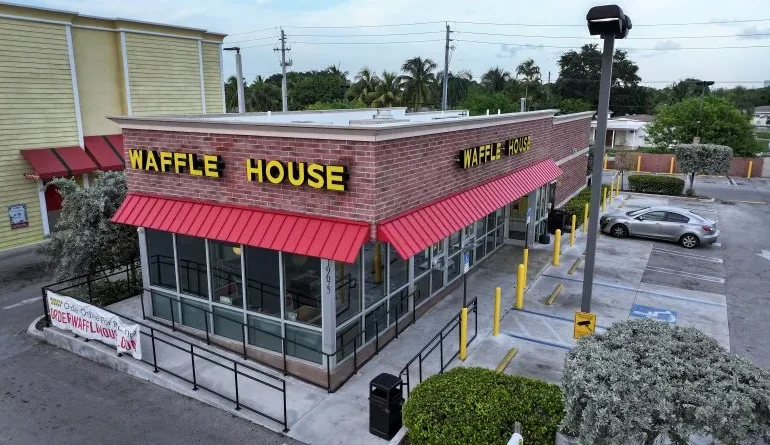

Waffle House has long been a beloved institution in the South, known for its golden hash browns, gravy-smothered biscuits, and crispy waffles drenched in maple syrup.
However, during hurricane season, the chain takes on an additional role, serving as a unique indicator of a storm’s severity. The sight of open Waffle House locations brings comfort to residents in storm-prone areas, signaling that a hurricane is less likely to cause significant destruction.
This informal measure, referred to as the “Waffle House Index,” has gained traction among Southerners and federal officials alike as a reliable way to assess storm impact and identify communities in need of urgent assistance. When Waffle House remains operational, even with a limited menu, it reassures locals that their town has escaped serious damage. Conversely, a closed Waffle House often signals impending disaster.
Following Hurricane Helene’s impact on the Carolinas and Georgia, approximately two dozen Waffle House locations remained closed, nearly two weeks after the storm hit. As Hurricane Milton approaches Florida, several Waffle House outlets along the Gulf Coast, including those in Tampa and St. Petersburg, have closed in anticipation of the storm.
The Waffle House Index functions as a color-coded system to indicate restaurant status in storm-affected areas. Green signifies a full menu and operational status, indicating minimal damage nearby. Yellow means the restaurant is serving a limited menu, often relying on generator power, while red indicates the establishment is closed due to unsafe conditions or significant destruction.
The concept of the Waffle House Index originated in 2004 when former FEMA administrator Craig Fugate noticed that Waffle Houses were often the only businesses remaining open after storms. This observation led to the inclusion of Waffle House locations on color-coded maps used to assess storm damage. This strategy was employed during Fugate’s tenure with FEMA under President Obama and has continued to be a key tool for gauging recovery efforts.
Waffle House has taken steps to ensure its disaster readiness, investing in portable generators and training staff on how to serve customers even without electricity. This proactive approach stems from the chain’s experiences during Hurricane Katrina in 2005, when many locations were destroyed but others that quickly reopened saw business thrive.
As Hurricane Milton strengthens to a Category 5 storm, Waffle House’s preemptive closures in Florida suggest that communities may face severe damage. The National Hurricane Center has reported Milton’s sustained winds at 165 mph, with expected landfall near Tampa Bay.
In anticipation of Milton, evacuation orders have been issued for numerous Florida counties, with schools and emergency shelters closing to prepare for the storm’s arrival. The Florida Department of Transportation has implemented measures to assist with evacuations, including suspending tolls and opening emergency lanes on major highways.
A Waffle House spokesperson reiterated the company’s commitment to keeping employees safe, stating that they would close locations in areas predicted to be hardest hit but aim to reopen as soon as possible to serve affected communities.
The Waffle House Index continues to be a valuable tool for residents and officials, offering a straightforward indicator of storm severity and recovery potential. As Hurricane Milton approaches, the chain remains a critical resource for those affected by severe weather in the South.
FOX Weather, the Associated Press, Newsweek contributed to this report.


The latest news in your social feeds
Subscribe to our social media platforms to stay tuned