




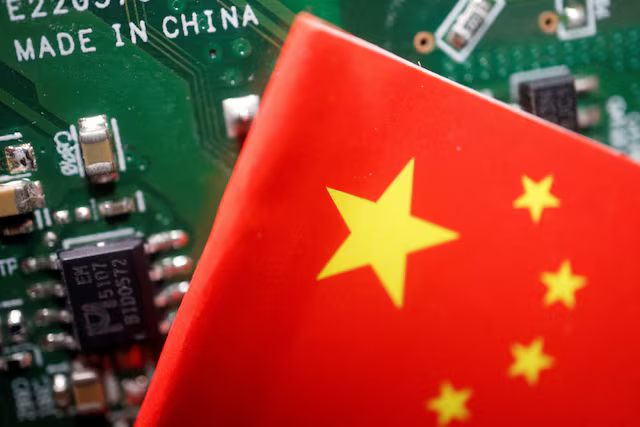

China’s semiconductor sector saw a significant boost on Monday, with the CSI Semiconductor Index nearing a three-year high, as investors speculated that the US government’s recent export restrictions on Taiwan Semiconductor Manufacturing Co. (TSMC) could accelerate China’s push for self-reliance in chip production, Reuters reports.
The US Department of Commerce ordered TSMC to halt shipments of certain advanced chips to Chinese customers, a move that is expected to have both short- and long-term implications for the global semiconductor market. Analysts believe that while Chinese firms involved in designing chips for artificial intelligence and graphics processing units may experience immediate disruptions, the longer-term effects could benefit China’s domestic chipmaking industry, which is increasingly focused on reducing dependence on foreign suppliers.
The CSI Semiconductor Index jumped by over 6% during Monday’s trading session, reaching its highest level since December 2021. Additionally, the CSI Integrated Circuits Index rose by 5%, and shares in SMIC (Semiconductor Manufacturing International Corporation), China’s largest foundry and a key player in the country’s chip production efforts, climbed more than 4%.
Cinda Securities, a Chinese brokerage, noted that the US restrictions could lead to a reorganization of the global semiconductor supply chain, creating greater demand for domestic chip production and spurring technological breakthroughs in semiconductor manufacturing equipment and materials. As a result, China’s push to develop its own advanced semiconductor capabilities may gain momentum.
In recent years, Chinese tech companies and chip designers have made concerted efforts to develop their own advanced processors in response to US sanctions, particularly after restrictions were imposed on Huawei Technologies and several other Chinese companies. These sanctions prevented firms like Nvidia and AMD from selling their most advanced chips to China, pushing Chinese companies to seek alternatives.
While many Chinese firms have relied on TSMC for the production of their advanced chips, including those for AI and smartphones, the halt in shipments could have lasting effects on the industry. In the third quarter of 2024, approximately 11% of TSMC’s revenue came from Chinese clients, highlighting the importance of the Chinese market to the Taiwanese company.
The US restrictions specifically target chips with 7-nanometer or more advanced designs, a category in which TSMC has been a global leader. The only Chinese foundry capable of producing chips at this level is SMIC, which has been using equipment from suppliers like ASML (Netherlands) and Applied Materials (US) to produce advanced chips, including those for Huawei’s latest smartphones.
However, SMIC has faced challenges in scaling up its production of advanced chips due to US export controls, which have restricted its access to key manufacturing equipment. While SMIC has made progress, it has had to prioritize the production of AI chips over smartphone chips, as the former is considered more strategically important for China’s long-term technological goals.



The latest news in your social feeds
Subscribe to our social media platforms to stay tuned