





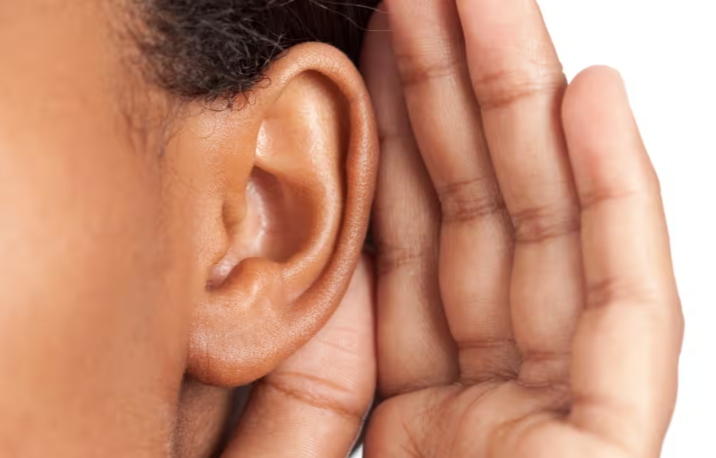

New research suggests that human ears may attempt to move subtly when people focus on listening, despite losing their ear-orienting ability millions of years ago, the Guardian reports.
Researchers from Saarland University in Germany have found that vestigial ear muscles are still activated in response to sound, highlighting what they describe as a “neural fossil” from evolutionary history.
The ability to move ears is crucial for many animals, helping them pinpoint the source and direction of sounds. While human ears remain largely immobile, traces of this ancestral system persist, according to Andreas Schröer, the lead author of the study.
“Our ancestors lost their ability to move their ears about 25 million years ago. Why, exactly, is difficult to say,” Schröer explained. “However, we have demonstrated that the neural circuits still seem to be present in some state, even though they apparently are not useful anymore.”
The study, published in Frontiers in Neuroscience, involved 20 adults without hearing problems. Participants were asked to listen to an audiobook played through a speaker while a competing podcast was also played from the same location. Scenarios ranged from easy (with clear differences in pitch and volume between the audiobook and podcast) to difficult (with louder and more similar audio sources).
Participants wore electrodes to measure the electrical activity of the muscles responsible for ear movement. After each session, they rated their listening effort and reported how often they lost focus on the audiobook.
The findings revealed that the more challenging the listening scenario, the greater the perceived effort reported by participants. Researchers observed increased activity in the superior auricular muscles, which lift the ear upwards and outwards, during the most difficult conditions. Additionally, the posterior auricular muscles, which pull the ear backward, were more active when sounds came from behind the participant.
Schröer noted that the results were unrelated to a person’s ability to voluntarily wiggle their ears, as almost no participant had this capability.
“The ear movements that could be generated by the signals we recorded are so minuscule—or even absent—that there is probably no perceivable benefit,” he added. “This vestigial auriculomotor system is ‘trying its best’ but probably doesn’t achieve much.”



The latest news in your social feeds
Subscribe to our social media platforms to stay tuned