



EXCLUSIVE: The South Caucasus. Collateral Damage of the Iran War.




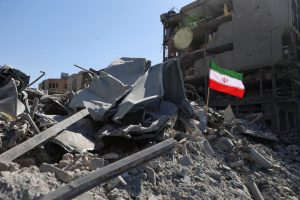
The war arrived before dawn on February 28, 2026. Israeli jets and long‑range missiles streaked across Iranian skies in what Jerusalem christened Operation Lion’s Roar; within hours Washington joined under a separate banner – Operation Epic Fury. The stated goal was to cripple Iran’s nuclear and military infrastructure and usher in a regime change. The opening salvo killed Supreme Leader Ali Khamenei, took out top IRGC commanders, and struck nuclear facilities at Natanz and Isfahan. The Trump administration expected the theocracy to implode.
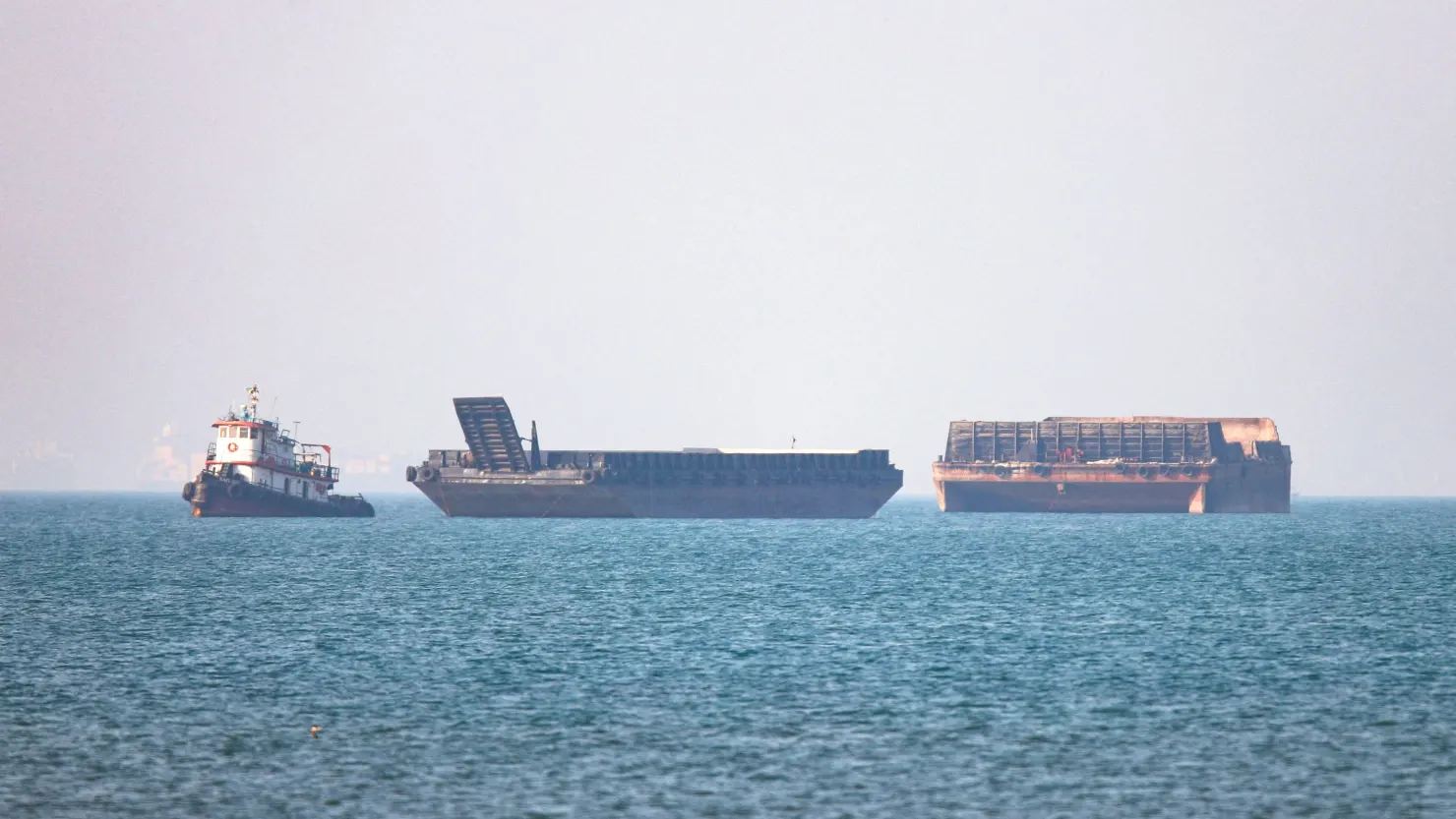
It didn’t. Iranian retaliation came fast – missiles hit US bases across the Gulf, a drone struck near a US diplomatic facility in Dubai, and the Strait of Hormuz was effectively shut. By April, more than 3,500 Iranians were dead, including 1,600 civilians, and 3.2 million were internally displaced. An endlessly prolonged ceasefire on April 7 paused the bombs, but the strait stays closed, and a naval blockade is locked in a grinding standoff, still unresolved today.
That is the war’s center of gravity. But its shockwaves are far-reaching, and few places feel them more acutely than the three small republics perched on Iran’s northern rim: Armenia, Azerbaijan, and Georgia.
Armenia
Armenia is uniquely vulnerable. Zareh Asatryan, Professor of Economics at University of Münster and Deputy Head of Department at ZEW – Leibniz-Centre for European Economic Research, says:
The 2026 Iran war is having negative economic impacts on the South Caucasus countries, although they have been limited so far, not leading into a crisis situation. The longer-term impacts will depend crucially on how the situation in Iran evolves. Immediate effects are driven primarily by disruptions to trade and transport costs feeding into inflation, especially in more exposed economies and sectors. Armenia is the most exposed, as its southern border with Iran is one of only two open land borders the country has. It is a key trade lifeline responsible for about 9% of its trade, and the disruptions are already having effects such as on the input prices of the country’s construction sector. Azerbaijan is comparatively better positioned, benefiting from higher revenues from its oil and gas production due to elevated international prices, although this comes with higher security risks. Georgia sits in between, it potentially gains from increased transit flows via its ports, but remains vulnerable to imported inflation and shifts in investor sentiment typical of small open economies. Over the longer run, outcomes depend critically on how the situation in Iran evolves. A prolonged or escalating conflict or instability in Iran would raise uncertainty and risk premia, discouraging investment and slowing growth across the region. It would also certainly derail infrastructure and connectivity projects, such as the TRIPP initiative, which is a US-backed transport link through Armenia’s Syunik province, which was concluded after Armenia’s loss in the 2020 war against Azerbaijan and the forced displacement of ethnic Armenians from Nagorno-Karabakh in 2023. More fundamentally, persistent instability risks spilling over into regional geopolitics, – particularly the fragile Armenia–Azerbaijan balance, amplifying economic risks beyond trade.
The numbers tell the story. In 2025, Armenia imported goods worth $680 million from Iran – everything from Iranian gas to Chinese cars that transship through Iranian ports. That flow is now choked. Freight companies report ships carrying Armenian cargo stuck idle in Iranian ports since hostilities began, and delivery times for goods from China have stretched from 45‑60 days to three months. The Meghri border checkpoint – through which 89 % of Armenia’s iron bars and nearly all of its petroleum bitumen pass – remains open but under constant pressure. Transport costs have risen, and the threat of outright closure hangs over an economy that imports roughly 40 % of its food and consumer goods from Iran.
David A. Grigorian, Research Fellow at the Mossavar-Rahmani Center for Business and Government at Harvard’s Kennedy School of Government and a 22-year veteran of the International Monetary Fund, is blunt about the risks:
Armenia’s exposure to Iran and the ongoing war is significant. While it is too early to draw a final account of the economic impact, a few predictions can be made at this point. An estimated 40 percent of Armenia’s imports of food and consumer goods originate from Iran. A prolonged conflict that forces the authorities in Iran to limit export for domestic use will likely create shortages in Armenia and lead to higher prices. This, along with already higher prices of gasoline at the pump, will deal a blow to Armenia’s poor, who account for up to a third of the population, and its fragile middle class. Should the security situation inside Iran worsen due to further escalation of the war, an outflow of refugees to Armenia could further strain its public services and infrastructure.
Grigorian pulls no punches on the government’s readiness.
Unfortunately, Armenia is not ready for any serious eventuality. The incompetence of the current government will – this time again – prevent it from drawing up, much less implementing, any contingency plans and rolling out any meaningful social safety programs, leaving the population to face the brunt of the shock. An appropriate policy response should ideally include Armenia’s international partners, who could provide financial assistance to the most vulnerable, in addition to funds that the Armenian budget itself should earmark to soften the blow.
More of Dr. Grigorian’s analysis can be found in his recent pieces with the Washington Times and the Hill.
The state budget has earmarked little for the kind of social safety programs that a sudden oil‑and‑grain shock would demand.
Yet the economic pain is not uniform. The war has created a strange, hidden inflow. Aghasi Tavadyan, ‘Economic Uncertainty Modelling’ Laboratory Head at the Armenian State University of Economics, Director of Convert LLC, and Founder & CEO of Data Deltum, points to a 7.2 % GDP growth figure that he traces partly to capital flight from Iran during the crisis. Wartime instability has pushed Iranian money – and sometimes people – across the border, providing a temporary financial jolt even as real trade disintegrates. It is a sugar‑high dynamic: welcome in the short term, but utterly unsustainable if the conflict grinds on.
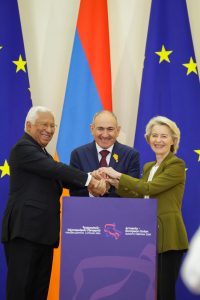
Politically, the war is pulling Yerevan in two directions at once. Prime Minister Nikol Pashinyan has staked his government on two horses: a US‑backed peace deal with Azerbaijan and a deepening embrace of the European Union. The EU–Armenia summit in Yerevan on May 4-5 showcased that ambition, with Commission President Ursula von der Leyen declaring the two sides “closer than ever.” Meanwhile, the Trump Route for International Peace and Prosperity – TRIPP – a 26‑mile rail‑and‑road corridor through Armenian territory, anchors Washington’s vision for regional connectivity.
But the Iran war muddies both bets. Thomas de Waal of Carnegie Europe warns that “it will be difficult to have Americans on the ground near the Iranian border… That’s simply too dangerous as long as there is a conflict.” TRIPP was supposed to be a backbone of post‑conflict prosperity. Now, with the Iranian shore visible from the planned route, the project looks more like a geopolitical target. Hard‑line voices in Tehran have always seen TRIPP as a US encirclement play; a few rockets near Nakhchivan Airport in March demonstrated how quickly that unease can turn kinetic.
The Armenia–Azerbaijan peace process itself is wobbling. Officials in both capitals concede that Washington’s attention has shifted from the Caucasus to the Strait of Hormuz. Without sustained US pressure, the two sides are slipping back into familiar patterns: procedural haggling, constitutional disputes, and a thickening linkage between TRIPP’s fate and the broader peace settlement. The window for a transformative accord, never wide, is narrowing.
Azerbaija
Azerbaijan wears the war differently. It has a southern border that stretches roughly 435 miles along Iran, and that frontier has already been singed. On March 5, Iranian drones struck the Nakhchivan airport and a school in the exclave, injuring civilians but causing no confirmed deaths. Baku’s response was a masterclass in crisis management: a direct phone call between the Iranian and Azerbaijani presidents, a flood of humanitarian aid, and a deliberate decision not to escalate.
Rusif Huseynov, Co-founder and Director of the Topchubashov Center, a Baku-based think tank , says:
The war involving Iran has had a direct impact on the neighboring region of the South Caucasus region. This is not a distant conflict for us; rather, it is one whose consequences have been felt immediately by Azerbaijan through a clear spillover effect when several Iranian drones attacked Azerbaijan’s Nakhchivan province in early March. Nevertheless, further escalation was avoided.
Nakhchivan’s land links depend heavily on transit through Iran, and an open breach would have isolated the exclave. So Baku chose pragmatism: protect the corridor, send aid, and pocket the windfall that the war was already delivering.

That windfall is substantial. A sustained $20–$25 rise in Brent crude translates into roughly $6-$7.5 billion a year in extra export revenue for Azerbaijan. Oil prices have spiked past $100 a barrel at multiple points since February, and Baku’s state budget is swimming in petrodollars even as the global economy chokes. At the same time, the closure of Hormuz has turbo-charged the Trans-Caspian corridor. Demand for container transport along the route has surged by 450–500%, and Azerbaijan is suddenly the indispensable bridge between China and Europe. Italian Prime Minister Giorgia Meloni flew to Baku in early May to deepen energy and defense ties, calling Azerbaijani oil and gas supplies “crucial.”
But the cash comes with complications. Higher energy prices feed imported inflation, and roughly half of Azerbaijan’s imports originate from countries also hit by rising fuel costs. More existentially, the war has reopened the question of Iran’s ethnic Azerbaijanis – some 20 million people living just across the border. Any further destabilization of the Islamic Republic could send ethnic‑kin refugees streaming north, a scenario Baku’s border‑control apparatus is not designed to handle.
Politically, the war has stiffened Baku’s bargaining position. With Western capitals desperate for alternative energy sources, Azerbaijan’s gas reserves and pipeline infrastructure have become strategic prizes. The US–Azerbaijan Charter on Strategic Partnership, signed in February during Vice President JD Vance’s visit, is now translating into concrete infrastructure and technology projects. Baku is leveraging the moment to deepen ties with Italy, Turkey, and the Gulf states while keeping a wary eye on Iran’s internal fractures. The Council on Foreign Relations has even floated the idea that the US should exploit Iran’s ethnic fault lines, including its Azerbaijani minority, as a pressure point. That is a game Baku can neither openly endorse nor fully ignore.
On the peace process, Azerbaijan’s posture has grown less accommodating. President Ilham Aliyev used the European Political Community summit in Yerevan to lambast the European Parliament for “sabotaging the peace process,” suspending cooperation with the EU assembly and threatening to pull out of the Euronest Parliamentary Assembly altogether. The message was clear: Baku will not be lectured while holding the cards.
The TRIPP project sits at the center of this calculation. Huseynov warns:
It is undeniable that the outcome of the war, and more importantly, the manner in which Iran emerges from it, will directly shape Tehran’s future policy toward the South Caucasus, as well as the interests and engagement of the United States in the region. At present, Iran appears to be strengthening its image as a resilient and difficult-to-defeat power in the eyes of many, while simultaneously targeting core US interests and military facilities in the Gulf. Under these circumstances, concerns are growing over the future of the American-initiated TRIPP project in the South Caucasus. The initiative, into which the Trump administration invested considerable political energy and resources, is also believed to have the potential to significantly influence the Azerbaijan–Armenia peace process. Iran opposed US participation in the TRIPP project from the outset, viewing a quasi-military American presence along its northern border as a threat to its strategic interests. As a result, speculation is increasing that Iran may seek to obstruct the development of TRIPP infrastructure either during the continuation of the war or in its aftermath.
If TRIPP stalls, Baku will likely revert to what it calls the “Zangezur corridor” – a route through Armenian territory that Yerevan has long resisted. That would bring the fragile peace process straight back to its most flammable issue.
Georgia
Georgia’s position is the most paradoxical. It shares no border with Iran – a geographic fact that has shielded it from the direct spillover that hit Nakhchivan – but it sits astride the main alternative transit routes for goods that can no longer pass through Hormuz or Iran. The result is a mixed bag: a ballooning trade role, a tourism slump, and a political balancing act that gets harder by the week.
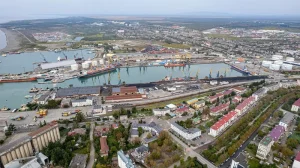
The war has effectively paralyzed the traditional maritime route through Iran. Cargo that once moved through Bandar Abbas or Chabahar is now being rerouted through Georgia’s Black Sea ports of Poti and Batumi. For Armenia in particular, Georgia has become a lifeline: transit via Iran has “practically stopped,” and freight is flowing overland from Poti to Yerevan instead. Demand for the Trans‑Caspian corridor – Azerbaijan‑Georgia‑Turkey – has rocketed, turning Tbilisi into a logistics hub overnight. The country’s GDP grew 10.7% year‑on‑year in March, even as regional tourism took a direct blow from cancelled flights and consumer anxiety.
But the same conflict that fills Georgia’s transit coffers is hollowing out its tourist industry. Airspace closures over Iran have forced longer, more expensive routes to Tbilisi and Batumi, and the knock‑on effect on visitor arrivals is severe. In a country where tourism accounts for roughly 8 % of GDP, that is not a footnote.
Politically, the Georgia Dream government is walking a tightrope of its own making. The party has been drifting away from Western institutions for years, and the Iran war is accelerating that pivot. Analysts at the Hudson Institute argue that the conflict is accelerating Tbilisi’s reorientation and greater distancing from the West. Official rhetoric has grown increasingly critical of US and European policy, and the government has quietly maintained economic ties with Iran even as Western sanctions tighten. The EU’s frustration with Tbilisi’s democratic backsliding was already palpable; now, with the bloc’s energy calculus scrambled by Hormuz, Georgia’s ambivalence has become a direct irritant.
For ordinary Georgians, the war is felt most directly in prices. Inflation has crept up, driven by higher transport costs and the global fuel shock. The IMF has warned that continued economic growth depends on the conflict not escalating further. Energy security is another quiet worry: Georgia is heavily dependent on imported energy, and any disruption to the Caspian‑Black Sea corridor would hit hard.
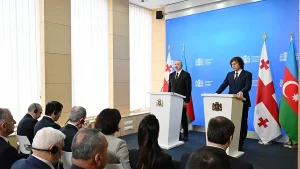
The Tbilisi‑Yerevan axis is also being tested. Armenia’s deputy prime minister recently framed the Brussels‑Tbilisi rift as the “biggest problem” for Armenia’s EU accession ambitions. The more Georgia drifts from Europe, the harder it becomes for Yerevan to use Georgian territory as a bridge to the West – a bridge that Armenia desperately needs as its Iranian lifeline narrows.
For all three countries, the Iran war is a crisis that does not respect borders. Armenia’s economic vulnerability, Azerbaijan’s energy windfall, and Georgia’s transit boom are threads in a single fabric. A prolonged war or a chaotic Iranian collapse would unsettle all of them at once – through refugee flows, severed trade routes, and a security vacuum that other powers would rush to fill.
The US‑backed TRIPP project was supposed to be the thread that bound the region together in a shared interest of connectivity. Instead, it is becoming the fault line along which Iranian, American, Turkish, and Russian ambitions strain against each other. Huseynov puts it plainly:
The realization of the TRIPP project, which represents a new geopolitical reality in the South Caucasus, will largely depend on the consistency and long-term commitment of US interests and engagement in the region.
Right now, that commitment looks wavering, tugged to the Gulf and the strait and the grinding diplomatic theater in Islamabad. The South Caucasus has learned, over decades of war and blockade, that it cannot choose its geography. Iran sits next door, and the whole neighborhood is still burning.



The latest news in your social feeds
Subscribe to our social media platforms to stay tuned