

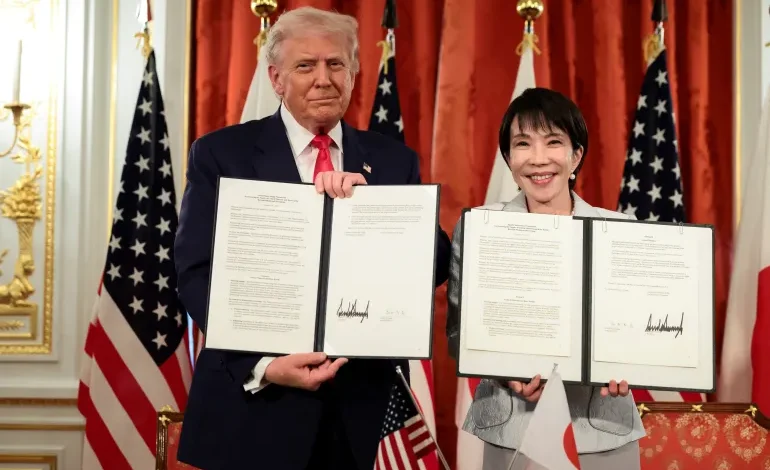

United States President Donald Trump wrapped up his visit to Tokyo on Tuesday by signing a slate of trade and security agreements with Japan’s first female prime minister, Sanae Takaichi, capping a day that underscored both countries’ intent to deepen military and economic coordination amid rising tensions with China.
Meeting at the Akasaka Palace, Trump praised Takaichi as a “great leader” and “a strong partner,” while the new prime minister pledged to accelerate Japan’s military buildup and to expand US investments under a $550 billion package agreed earlier this year. According to Japanese officials, the deal covers shipbuilding contracts and increased purchases of American soya beans, natural gas, and pickup trucks — a familiar mix of agriculture, energy, and automotive trade designed to satisfy Trump’s domestic base.
“It’s a very strong handshake,” Trump said with a grin as the two leaders posed for photographs. “Everything I know from Shinzo and others, you will be one of the great prime ministers.”
For Takaichi, a protégé of the late Shinzo Abe, the meeting was a symbolic continuation of the security-first doctrine that has defined Japan’s relationship with Washington since World War II. Ahead of the summit, she vowed to fast-track Japan’s plan to raise defence spending to 2 percent of GDP, a target long encouraged by the United States as part of its strategy to counterbalance China’s regional influence.
The gestures of goodwill went both ways. Takaichi presented Trump with a set of golf memorabilia, including Abe’s personal putter, a gold-leaf golf ball, and a bag signed by major champion Hideki Matsuyama, in a nostalgic nod to Abe’s “golf diplomacy” with Trump during his first presidency.
Trump, in turn, showered her with public flattery and confirmed that Tokyo had agreed to join a new bilateral agreement on critical minerals and rare earths. The White House described the deal as a step toward “resilience and security of supply chains,” targeting China’s dominance over essential resources used in electronics, renewable energy, and defense technologies.
The agreement commits both nations to identify and co-invest in projects addressing gaps in rare-earth processing, batteries, catalysts, and optical materials. Analysts say it complements Japan’s broader efforts to “de-risk” its economy from China, a policy accelerated after Beijing imposed export controls on key minerals earlier this year.
Takaichi, who has built her political reputation on conservative values and a hard line toward Beijing, hailed Trump’s global diplomatic record, pointing to ceasefires he helped broker between Cambodia and Thailand, and between Israel and Palestinian groups. “In such a short period of time, the world started to enjoy more peace,” she said, calling Trump’s actions “unprecedented achievements.”
Trump will visit the US naval base in Yokosuka, before departing for South Korea, where he is scheduled to meet Chinese President Xi Jinping for talks aimed at defusing their trade war.


The latest news in your social feeds
Subscribe to our social media platforms to stay tuned