






If anyone still wondered whether nuclear energy is a political tripwire in Wyoming, Gov. Mark Gordon settled it. After Radiant Industries yanked its proposed nuclear microreactor manufacturing plant from Natrona County and rerouted to Oak Ridge, Tennessee, the governor blamed the Wyoming Freedom Caucus for poisoning the well, Gillette News Record reports.
“Members of the Freedom Caucus inspired ‘Club No’ convinced Radiant that Wyoming isn’t about leadership and problem solving,” Gordon said, adding that a reflexive opposition culture “is not the way Wyoming became the great state it is.”
Radiant’s plan hinged on a big ask: changing state law to allow storage of spent nuclear fuel. That proposal ran into a wall this summer when the Joint Minerals, Business and Economic Development Committee tabled it amid a statewide backlash. Freedom Caucus leaders called Radiant’s exit a win for common sense, not obstruction. Rep. John Bear of Gillette accused the governor of chasing industry-aligned donors and trying to sideline conservatives at the ballot box. As emeritus chair of the caucus, he pointed to their July statement: Wyoming should lead in proven energy, not “settle as a dumping ground for nuclear waste from other states.”
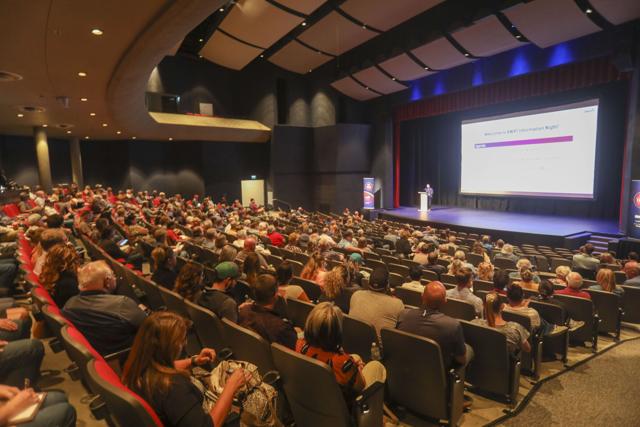
Strip away the political elbows and you hear something more basic in Natrona and Campbell counties: people are uneasy, curious, and starving for answers they can trust. In back-to-back public meetings — Sept. 29 at Casper College and Sept. 30 in Gillette — residents said they’re stuck between a high-stakes technology they don’t know well and a chorus of boosters and bashers who seem to speak past them.
In Natrona County, about 100 people turned up for “Nuclear 101,” a Q&A led by a retired uranium mining engineer. Radiant was still in the mix then, and so were the jitters. Bar Nunn’s Chris Hermel said the company’s assurances on moving radioactive materials in and out of town felt thin.
“It needs to come with proof, not just somebody saying, ‘It’s safe,’ and ‘Trust me,'” he said, adding that with no federal repository open, he doubted the waste would leave as promised.
Even kitchen tables are divided. Bar Nunn couple Lisa and Wayne Kasparek sparred over whether spent fuel could or should be stored near their community. She’s more comfortable with modern safety systems; he worries that Wyoming’s open space and sparse population make it a soft target for becoming the federal fallback.
Others bristled at being told to pick a team. Bar Nunn resident Lee-Ann Newquist said the forced “for or against” dynamic — amplified by political actors on both sides — left many shut out. She wants a citizens committee and roundtable discussions long before ground is broken and money is committed.
“We’d like fair information, unbiased information that isn’t coming from people who stand to gain,” she said. “It’s not a for-or-against issue. There are people in the middle who are not being represented.”
In Gillette, BWXT — the defense and nuclear firm exploring a fuel manufacturing facility — hosted an open house that drew close to 300 people. The format was breezier than a formal hearing: a short presentation, then stations where engineers and executives fielded questions. Residents came prepared. DJ Towne carried a notebook and asked bluntly about worst-case transport accidents in bad weather. She was told packaging standards are designed to prevent radioactive release. She kept moving, hunting for clarity on what tax breaks BWXT might seek.
“I just wanted more information before I made a decision,” she said. “That’s what a lot of people are here for.”
Not everyone was swept up by the sales pitch. Longtime resident Ronda Boller warned against boom fever. She remembers the coal-bed methane rush of the 2000s, when regulators and leaders embraced hundreds of newcomers, only for taxpayers to be left with more than 2,000 orphaned wells.
“Don’t get greedy. Don’t get in a hurry,” she said. “After watching what happened with coal-bed methane, you can’t do that with nuclear.”
Still, there’s genuine enthusiasm too. Twenty-five-year-old civil engineer Kyle Van Lant arrived as a self-described renewable-energy supporter. Nuclear, he argued, is a serious tool for cutting carbon. He’s been reading up on how a coal-and-uranium town like Gillette might pivot.
“I’m excited and optimistic,” he said. “I just hope people are receptive.”
The political scenery keeps shifting even as companies pitch. Radiant is out, but lawmakers say the waste-storage fight could resurface in the coming budget session. BWXT says spent-fuel storage isn’t part of its proposal, and the Campbell County Commission says it won’t allow any form of spent-fuel storage for now. Commissioners are also weighing whether to put the question to voters next year — an idea that, if nothing else, acknowledges just how consequential and contested this stuff is.
Underneath the headlines and the name-calling is the core dilemma of the energy transition, Western-style. Wyoming wants high-paying jobs, tax base, and long-term stability without repeating mistakes from past resource booms — or becoming a permanent parking lot for other states’ waste. It wants credible safety answers that come with evidence, not PR. And it wants that information before contracts are signed, not after.
That’s the center of gravity in these debates: not the loudest voices on either edge, but the uneasy middle, the folks who might say yes with guardrails or no until those guardrails exist. Until the state’s political class can meet that middle on its terms — with transparent risks, timelines, and who-pays-if-it-goes-wrong details — Wyoming’s nuclear future will keep colliding with Wyoming’s political present.



The latest news in your social feeds
Subscribe to our social media platforms to stay tuned