


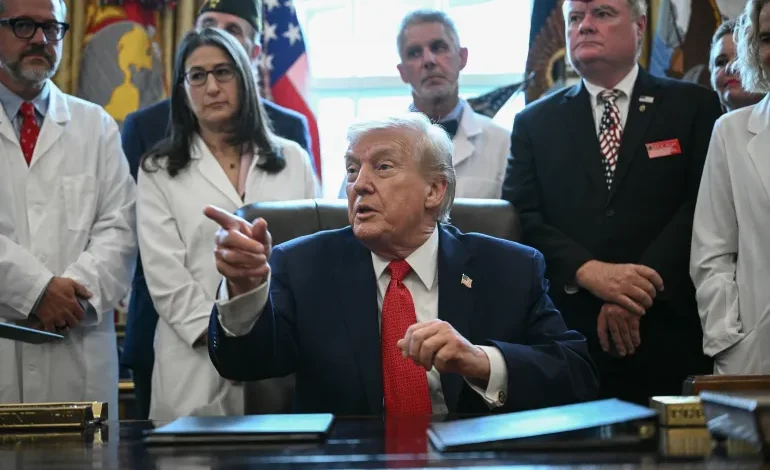

US President Donald Trump has signed an executive order directing federal agencies to move marijuana into a less restrictive category under US drug law, marking a significant shift in how the substance is treated at the federal level.
The order, signed on Thursday, instructs Attorney General Pam Bondi to fast-track the Drug Enforcement Administration’s process for reclassifying marijuana within the federal scheduling system.
Under US law, controlled substances are divided into five schedules, with Schedule I reserved for drugs considered the most dangerous and lacking accepted medical use, and Schedule V the least restricted. Marijuana has long been listed as a Schedule I substance alongside heroin and LSD.
Trump’s order would move marijuana to Schedule III, placing it in the same category as drugs such as ketamine and anabolic steroids.
The president was careful to frame the move as a regulatory adjustment rather than a policy endorsement.
“This is not the legalisation” of marijuana, Trump said, adding that the decision “in no way sanctions its use as a recreational drug”.
The reclassification would, however, significantly ease restrictions on scientific research. Studies involving Schedule III substances face far fewer regulatory hurdles than those applied to Schedule I drugs, opening the door to expanded medical and pharmacological research.
Speaking earlier in the week, Trump said the change had broad appeal.
“It’s popular because it leads to tremendous amounts of research that can’t be done unless you reclassify, so we are looking at that very strongly,” he told reporters.
The move aligns federal policy more closely with state-level trends. A growing number of US states have legalised marijuana for medical or recreational use, creating a patchwork system in which state laws increasingly clash with federal prohibition.
Trump’s action builds on steps taken by his predecessor, Joe Biden, who issued mass pardons for federal convictions related to simple marijuana possession and launched the initial effort to move the drug to Schedule III, a process that was not completed before he left office in January.
Those convictions had disproportionately affected minority communities and contributed to mass incarceration in the United States.
The decision has not been universally welcomed within Trump’s own party. Earlier this year, 20 Republican senators urged him to maintain stricter controls, arguing that marijuana remains dangerous and that reclassification would “undermine your strong efforts to Make America Great Again”.
Public opinion, however, has shifted sharply. Support for legalising recreational marijuana has nearly doubled over the past two decades, rising from 36 percent in 2005 to 68 percent in 2024, according to Gallup polling.



The latest news in your social feeds
Subscribe to our social media platforms to stay tuned