




The original story by Clair McFarland & David Madison for Cowboy State Daily.
Wyoming’s attorney general is taking a high-profile wind energy fight to the state Supreme Court — and he says the case is about far more than turbines on a ridgeline.
Attorney General Keith Kautz told Cowboy State Daily on Thursday that he’s appealing a Converse County judge’s ruling that voided a state land lease for the Pronghorn H2 wind project. The decision, he said, hinges on how courts interpret a single word that appears all over Wyoming law: “including.”
“This isn’t just about wind,” Kautz said. “It’s about how state statutes and rules are read across the board.”
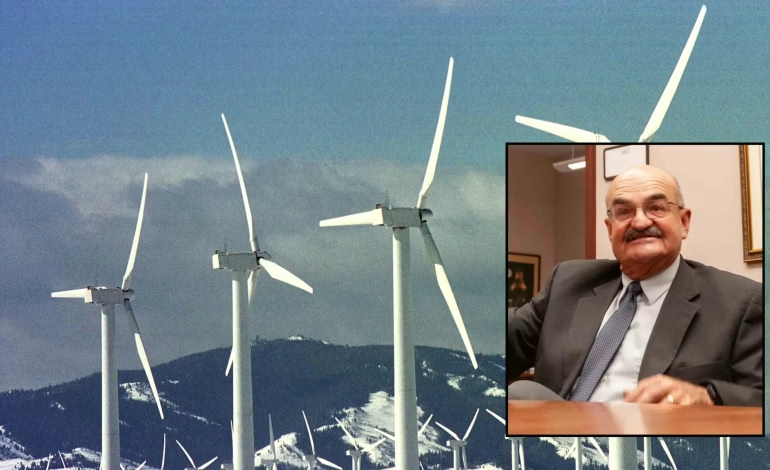
Earlier this month, Converse County District Court Judge Scott Peasley struck down the Wyoming Board of Land Commissioners’ approval of a lease allowing a 267-turbine wind project on about 15,500 acres of state trust land in the northern Laramie Range.
The project’s twist: the electricity generated wouldn’t necessarily go straight to the power grid. Instead, it would be used in part to help produce clean hydrogen.
Peasley zeroed in on a board rule that allows leases for wind projects “including collecting and transmitting the electrical energy … to the interconnection of the transmission grid.” He concluded that “including” limits leases to projects that actually feed power into the grid — and that the Pronghorn project doesn’t clearly do that.
A neighboring ranch successfully argued that this wording should restrict what the state can approve.
Kautz says the judge got it backward.
In legal usage, he argues, “including” expands a definition — it doesn’t narrow it. Reading it as a limiter, he said, would send shockwaves through Wyoming law.
“Every case I could find says ‘including’ expands the definition,” Kautz said. “If you flip that on its head, you suddenly call into question hundreds of statutes, contracts and regulations.”
That’s why, he said, an appeal wasn’t optional.
“I’ve got to appeal it.”
Gov. Mark Gordon, who voted with the land board majority to approve the lease earlier this year, threw his support behind Kautz’s appeal.
“This ruling was a novel interpretation of Wyoming law and needs to be clarified by the Wyoming Supreme Court,” Gordon said in a statement.
Gordon framed the issue as one that reaches well beyond a single wind project — touching on school funding, private property rights and future uses of state land.
“This is about whether a wind turbine could power stock watering or an oil and gas rig,” he said. “And it’s about meeting our constitutional duty to use state lands to fund Wyoming schools.”
Blocking the lease, Gordon argued, wouldn’t stop the project — most of it sits on private land — but it would cut schools out of revenue.
Secretary of State Chuck Gray, the lone land board member who voted against the lease, didn’t hold back.
Gray blasted the appeal as a “Gordon-engineered fiasco” and said he was disturbed by how the board handled a closed-door meeting this week. He also criticized Kautz for announcing the appeal without a formal board vote.
“I was prepared to vote against any motion to appeal,” Gray said. “This woke wind lease violates the board’s rules, and Judge Peasley got it right.”
Gray is calling for a new board meeting with public comment and a chance to reverse course.
Gordon shot back, saying the meeting was clearly noticed as an executive session for legal advice, where no public comment or action was allowed.
“To suggest otherwise is either a misunderstanding of the law or grandstanding,” Gordon said.
For the rancher who brought the lawsuit, Mike Stephens, the appeal is just the next chapter.
His attorney, Patrick Lewallen, said the district court’s decision wiped out the lease — leaving appeal as the main option for the state. He also noted that Focus Clean Energy, the Colorado-based developer behind Pronghorn, could file its own appeal.
Lewallen said one key victory in the ruling was the judge’s finding that Stephens had legal standing to challenge the lease. Stephens’ family ranch sits right next to the proposed project.
“If we’d lost that,” Lewallen said, “it would have shut the courthouse door to people affected by these kinds of leases.”
Focus Clean Energy says it’s pressing ahead. About 30% of the project sits on state land, and the company estimates the full development could bring $1.7 billion in private investment to Converse County, along with $471 million in taxes over 35 years.
Now, the fight over a single word — “including” — is headed for Wyoming’s highest court, where it could shape how the state leases its land for years to come.



The latest news in your social feeds
Subscribe to our social media platforms to stay tuned