

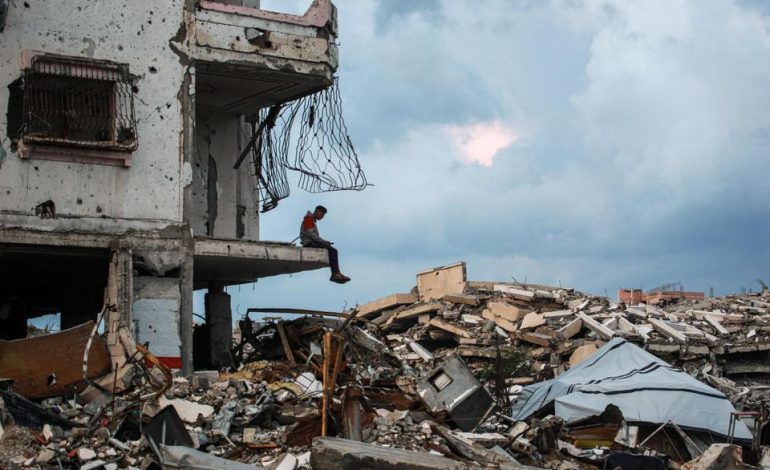

The ceasefire was supposed to be the moment the noise finally dropped – the point where diplomacy could outrun the blast radius. Instead, three months (or, more precisely, a little over ten weeks) after the October 10, 2025 truce took effect, Gaza still feels like a place stuck in the worst kind of limbo: not full-scale war, not real peace, just a “pause” where the headline is calm and the ground truth is chaos.
That gap – between what’s signed in capitals and what’s lived under canvas and concrete dust – is the story of this ceasefire. And it’s why so many people inside and outside Gaza have started describing the moment with a grim slogan: you cease, I fire.
Trump’s ceasefire didn’t arrive as a single neat document. It came as a “plan” –a political umbrella meant to cover a lot of moving parts: hostage releases, phased de-escalation, humanitarian access, and the architecture for a new governance and security regime in Gaza. The White House’s “Trump Declaration for Enduring Peace and Prosperity” sold the approach as a pathway toward stability, reconstruction, and a long-term settlement – heavy on confidence, light on the messy specifics of enforcement.
Our earlier reporting tracked the road to this moment with a blunt thesis: the Gaza assault and blockade were not isolated episodes but a long, grinding process that – in their framing – amounted to a “two-year road to genocide,” defined by near-total displacement, aid strangulation, hunger, and the collapse of basic systems. Their ceasefire-era pieces kept returning to the same tension: any “pause” that doesn’t unlock food, water, medicine, shelter, and freedom of movement risks becoming a PR veneer over a continuing catastrophe.
International institutions have used similarly severe language. In September 2025, the UN Human Rights Office published a press release summarizing findings by the UN Independent International Commission of Inquiry, which said Israel had “committed genocide” in Gaza, describing multiple genocidal acts under the Genocide Convention and pointing to intent as “the only reasonable inference,” in the commission’s view.
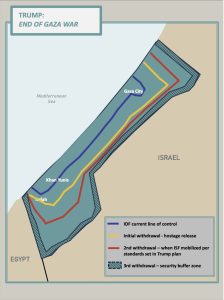
Amnesty International, writing after the ceasefire announcement, argued the ceasefire “risks creating a dangerous illusion” and claimed that conditions “calculated to bring about… physical destruction” continued, even if the scale of attacks had dropped. Amnesty also said Israeli forces remained deployed across roughly 54–58% of Gaza and that restrictions on critical supplies persisted.
And hovering behind all of this is the argument that Gaza isn’t just a humanitarian emergency – it’s also an economic and infrastructural collapse. UNDP’s “War in Gaza” materials describe development losses and the scale of recovery needs in ways that make “reconstruction” sound less like a policy plank and more like a multigenerational project.
So Trump’s ceasefire launched into a landscape where the word ‘genocide’ had already become part of the official vocabulary for major human-rights actors, while the practical reality remained: people needed a working system of aid, housing, health care, and security yesterday, not after a conference circuit and a phased implementation schedule.
If Phase One was about stopping the worst of the shooting and moving hostages and prisoners, Phase Two was always about power: Who controls Gaza? Who polices it? Who disarms Hamas? Who funds reconstruction? Who guarantees Israel’s withdrawal?
That’s where the “International Stabilization Force” (ISF) enters the script – and where the script starts to wobble.
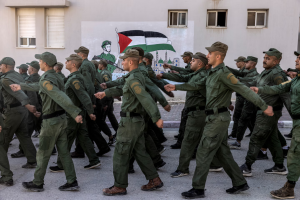
In November, the UN Security Council authorized an International Stabilization Force in Gaza and endorsed Trump’s broader framework (commonly referenced as a 20-point plan) via Resolution 2803, according to UN press listings and subsequent summaries. The ISF concept is presented as a multinational force meant to provide security, protect humanitarian operations, and help train a new Palestinian policing structure – while overseeing demilitarization and supporting redevelopment.
But “authorized” isn’t “deployed,” and “mandate” isn’t “mission.” By December, the international push looked like a scramble to fill in blanks that should have been inked before a ceasefire was sold as durable.
Reuters reported on December 19 that US Secretary of State Marco Rubio said new governance bodies for Gaza would be in place soon – followed by the international force – while acknowledging unresolved questions about the force’s mandate, funding, and the thorny issue of disarming Hamas. A US-hosted planning conference in Doha was part of that effort; Reuters described it as urgent but still full of “who pays, who goes, who commands” uncertainty.
Analysts aren’t exactly cheering. The Middle East Institute framed the ISF as a bundle of hard questions: legitimacy, rules of engagement, coordination with Palestinian actors, and the risk of becoming stuck between Israel’s security demands and Palestinian political realities. The Middle East Council on Global Affairs was even more direct, warning that peacekeepers and UN resolutions can become a substitute for solving root political problems – and can fail spectacularly when they’re asked to manage an occupation-shaped conflict without ending the occupation dynamic itself.
Meanwhile, other outlets have focused on what Palestinian factions think they’re being asked to swallow. Drop Site News coverage emphasized Hamas messaging that it had not “surrendered,” warning against foreign “guardianship” and framing the ceasefire’s second phase as a political struggle over who gets to claim representation and legitimacy.
And layered on top of security governance is the question we raised back in October: recognition of Palestine – symbolic breakthrough or empty gesture? The ceasefire didn’t erase that debate; it sharpened it. Recognition talk can look like a diplomatic win – until it’s paired with an on-the-ground reality where borders, movement, resources, and sovereignty remain controlled by someone else.
Even the UN’s own press listings framed the post-ceasefire period as a “fragile” moment that could be used either to entrench a new reality or to push toward something more durable.
Which brings us to the core political contradiction of the ceasefire: it tries to be a security plan, a governance plan, and a statehood-adjacent plan – without actually resolving the underlying conflict over land, rights, and sovereignty.
As Khalil Shikaki, Professor of Political Science, and Director of the Palestinian Center for Policy and Survey Research (Ramallah), one of the founders of the Arab Barometer, a member of its steering committee, and senior fellow at the Crown Center for Middle East Studies at Brandeis University, notes:
“In the mid-term, the ceasefire will likely hold, albeit precariously, despite Israeli violations. Key Arab and Muslim states, deferring to Washington on the Trump Plan’s implementation, are unwilling to challenge Israel. The US will continue to turn a blind eye to violations as long as they do not escalate into total war, while Hamas, fearing a devastating, US-backed Israeli response, will not retaliate. Consequently, the focus of all players, including Hamas, is shifting toward the plan’s “second phase,” which features the deployment of an “International Stabilization Force” they hope will constrain Israel’s ability to act with impunity. This phase, however, is fraught with its own intractable difficulties, namely finding a diplomatic way to disarm Hamas while persuading Israel to withdraw from Gaza. These challenges will likely stall any meaningful progress and prevent the launch of a reconstruction process. Ultimately, this reveals the plan’s fundamental flaw: it attempts to address the crisis in Gaza in a vacuum, detached from the broader context of the Palestinian-Israeli conflict, the end of the occupation, and the establishment of a Palestinian state. The Trump Administration, with its deep affinity for Israel’s right-wing government and anti-Palestinian policies, is structurally incapable of addressing this core issue, and therefore remains incapable of making a lasting peace.”
Wars don’t just end; they fade – especially when they become administratively inconvenient. One of the most striking features of the ceasefire period has been how quickly Gaza can disappear from daily front pages even as people continue to die, hunger, and freeze.
CPJ’s December report warned that Israel has escalated censorship and suppression of independent reporting, describing intensified pressure on journalists and constraints that push Gaza further “under the radar.”
The UN itself has repeatedly stressed that the Gaza conflict has been exceptionally lethal for journalists; a UN Secretary-General message described it as the deadliest for journalists in decades.
This matters because when foreign press access is limited, information ecosystems tilt: people rely more on local reporting under siege, fragmented video evidence, advocacy channels, and official statements – a mix that makes it easier for powerful actors to dismiss what they don’t like as “misinformation” and easier for audiences to tune out when the signal feels contested or overwhelming.
The political effect of silence is simple: if there’s no sustained spotlight, the incentive to comply with the spirit of a ceasefire drops. Ceasefires thrive on verification, pressure, and consequences. Silence is the opposite of consequences.
Here’s the blunt truth: whatever you call the ceasefire, it has not meant safety.
Amnesty said that at least 347 people, including 136 children, had been killed in Israeli attacks since the ceasefire was announced on October 9, while also describing ongoing restrictions on infrastructure repair and essential goods. Al Jazeera’s December 21 live updates described continued ceasefire violations and worsening medical supply pressures, underlining how often “ceasefire” can coexist with lethal force. The Guardian reported on December 20 that Israeli troops killed Palestinians sheltering in a Gaza school, according to hospital officials – the kind of incident that doesn’t fit neatly into the word “truce” but keeps happening anyway.
Humanitarian systems remain brittle. OCHA’s Situation Update #349 reflects the churn of constraints, displacement pressures, and the constant fragility of service delivery. ReliefWeb’s publication of “Gaza Humanitarian Response During Month 1 of the October 2025 Ceasefire” similarly frames the ceasefire period as a race to scale aid under restrictions and damaged infrastructure rather than a normal recovery phase.
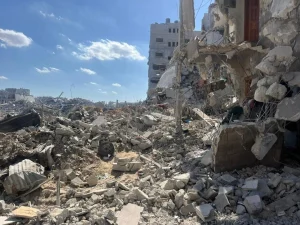
UNRWA’s situation reporting captures how much of Gaza’s basic survival depends on an aid architecture that’s perpetually at risk.
And then there’s the bureaucratic chokehold. Reuters reported on December 17 that the UN and more than 200 aid groups warned Gaza operations were at risk of collapse due to Israeli impediments, including a registration process that could de-register NGOs and force them to cease operations on a short fuse.
Food is a perfect example of “less bad” still being bad. Reuters reported that the IPC hunger monitor said Gaza was no longer in famine after improved aid access – but emphasized the situation remained dire, with ongoing “catastrophic” conditions for some and the risk of reversal if aid flows stall or fighting resumes.
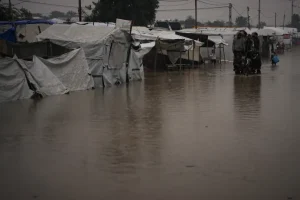
Winter has become its own weapon – not metaphorically, but materially. Flooding, cold, and inadequate shelter turn “humanitarian crisis” into a daily triage. The British Red Cross overview describes a desperate situation shaped by destroyed infrastructure and shortages of essentials.
In a comment to Wyoming Star Riham Jafari, ActionAid Palestine Communication & Advocacy coordinator, captures the ceasefire-as-illusion problem from the standpoint of people waiting for the promised aid surge:
“Gaza is still facing an ongoing unprecedented catastrophe with ongoing violations of the ceasefire. We expected that the ceasefire would bring more aid and Gaza would be flooded with aid, but this did not happen. ActionAid is deeply concerned by the catastrophic humanitarian situation in Gaza, where civilians, especially women and children, are facing unimaginable hardship. Ongoing hostilities, mass displacement, and severe restrictions on access have devastated livelihoods and overwhelmed already fragile systems. Families are struggling to access basic necessities, including food, clean water, shelter, and healthcare, while women and girls face heightened risks and carry the heaviest burden of this crisis. As winter sets in, the situation has become even more dire. Thousands of displaced families are exposed to cold temperatures, heavy rain, and flooding, living in damaged homes or makeshift shelters that offer little protection. The lack of warm clothing, blankets, heating, and safe shelter is putting lives at further risk, particularly for children, older people, and those with chronic illnesses. ActionAid urgently calls for lifting all restrictions imposed on humanitarian aid, opening all border crossings, and stopping all violations of ceasefire. All women, men, boys, elderly, girls, and people with disabilities are in urgent need of aid. Gaza lost everything, and it needs everything. Without full access to aid, shelter items, caravans, heavy machinery for clearing rubble, medical equipment, and medical staff, people will not survive winter. Winter and humanitarian catastrophe will become another tool for a death sentence for people of Gaza. This suffering is enabled by inaction and silence of world leaders and governments.”
And here is Stephen Zunes, Professor of Politics and International Studies at the University of San Francisco and longtime analyst of US policy and nonviolent movements, tying together the ceasefire violations, the restrictions on housing, and the media-access problem:
“Israel has been continuing to violate the ceasefire resolution with impunity, attacking both civilian and alleged Hamas targets as well as blocking adequate food, medical supplies, and rebuilding materials. In addition, the cold and rain have led to a number of children dying because Israel is preventing the shipment of mobile homes and other more secure housing as agreed to. Israel continues to deny access to journalists, human rights investigators, and others, while US politicians like Hillary Clinton blame social media, the main remaining alternative available for getting news from Gaza, for supposedly misrepresenting the situation. Over half of Gaza remains under Israeli occupation, giving Hamas the excuse to continue its repressive rule over the remaining part of the territory. The United States has refused to use its enormous leverage to get Israel to live up to its agreements. Meanwhile, the US has blocked the UN Security Council from addressing increasing settler violence in the occupied West Bank and has insisted that the required quarterly briefings on Resolution 2334, which underscored the illegality of Israeli settlements in occupied territory, are no longer necessary on the grounds that that resolution has somehow been supplanted by Resolution 2803 endorsing Trump’s Gaza plan, even though it does not address Israel’s illegal settlements or settler violence.”
Finally, Mehran Kamrava, Professor of Government at Georgetown University Qatar and Director of the Iranian Studies Unit at the Arab Center for Research and Policy Studies, points to the long tail: how unlivable conditions don’t just harm Palestinians; they corrode any future security for everyone:
“The tragedy that is life in Gaza continues, with no end in sight. Inclement weather, lack of basic services, inhumane and unsanitary living conditions, and the abject misery in which people live aren’t just crimes against humanity. It is a recipe for further violence and bloodshed. When people don’t have much to look forward to in this life, they will look for it in extremist solutions. The current predicament of Palestinians is highly detrimental to the long-term peace and security of everyone – Israelis, Palestinians, and everyone else in the region.”
This is the ground-level meaning of “You cease, I fire.” It’s not only about bullets and bombs. It’s about the slow violence: denial of materials, delayed repairs, restricted movement, and winter exposure – the stuff that doesn’t always trend, but kills.
If you zoom out, the ceasefire’s second phase is basically a high-stakes bet: that you can impose an international governance-and-security scaffold on Gaza and keep it standing long enough for reconstruction – without first resolving the deeper political conflict.
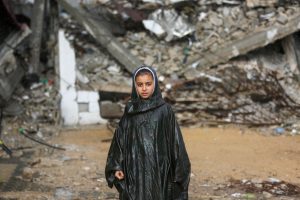
War on the Rocks called the UN move “historic” while warning the plan may be unworkable in practice – the kind of mandate that looks clean in a resolution but collapses when it meets the realities of armed groups, Israeli security doctrine, Palestinian legitimacy fights, and donor fatigue.
CNAS, in “After the Deal,” treats postwar Gaza as a policy engineering challenge – security arrangements, governance design, humanitarian stabilization, reconstruction sequencing – and implicitly acknowledges how many failure points exist even before you get to politics.
Carnegie’s critique is sharper: it argues that by endorsing the US plan, the Security Council risks elevating “rule by law” over rule of law – building a legalistic wrapper around a political project that may sidestep fundamental rights and accountability questions.
And while Gaza has (some) international pressure and visibility, the West Bank doesn’t necessarily get the same relief dividend. International Crisis Group’s Israel/Palestine page headlines that exact imbalance – “Why Some Relief for Gaza, but None for the West Bank?” – pointing toward a wider dynamic where a Gaza ceasefire can coexist with intensified repression and settlement expansion elsewhere.
So what awaits Gaza?
Probably not “peace” in the ordinary sense – not yet. More likely:
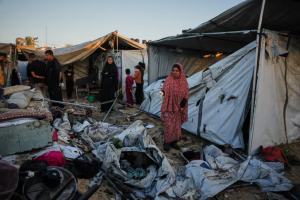
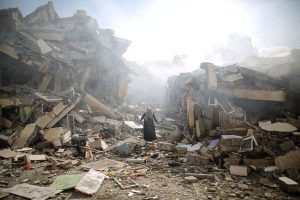
Displaced Palestinians inspect the damage after a post-ceasefire Israeli strike on a tent camp in Deir al-Balah, Gaza Strip, on October 29, 2025 (Abdel Kareem Hana / AP)
- A precarious lull where violence remains possible (and sometimes routine), but full-scale war is politically inconvenient.
- A contested international force plan that struggles to answer the two questions nobody can dodge: who disarms Hamas, and what compels Israel to withdraw?
- A humanitarian marathon where “no longer famine” doesn’t mean “fed,” and winter punishes delay.
- A legitimacy battle among Palestinian actors and external sponsors over who speaks for Gaza’s future.
- A media environment where restricted access and intensified censorship make it easier for the world to look away.
Trump’s ceasefire, in other words, may succeed at one thing: reducing the intensity of open warfare compared with the worst periods of the past two years. But the ceasefire’s deeper promise – that the shooting stops because life starts again – is still largely unmet.
And that’s why “You cease, I fire” lands as more than a slogan. It’s a description of a ceasefire that, so far, has been better at managing optics than guaranteeing protection – a truce measured in documents, while the reality is measured in funerals, empty pharmacies, and rain-soaked tents.

The latest news in your social feeds
Subscribe to our social media platforms to stay tuned