





Reuters, CNBC, CNN, the New York Times contributed to this report.
Warner Bros. Discovery shareholders are suddenly in a classic Wall Street tug-of-war: grab Paramount’s $30-per-share all-cash offer now, or stick with the board-backed Netflix deal and gamble that the leftover cable business — soon to be called Discovery Global — ends up worth more than skeptics think.
And this isn’t theoretical. Paramount executives have already started working the phones, talking directly to WBD shareholders to see who might tender their stock even though WBD’s board is telling them not to. The clock is ticking too: shareholders have until Jan. 21 to tender at $30, although Paramount can keep extending that deadline, potentially all the way to WBD’s annual meeting.
So what’s really going on? In short: Netflix says it’s done bidding. Paramount says it’s not. Shareholders get to decide who blinks first.
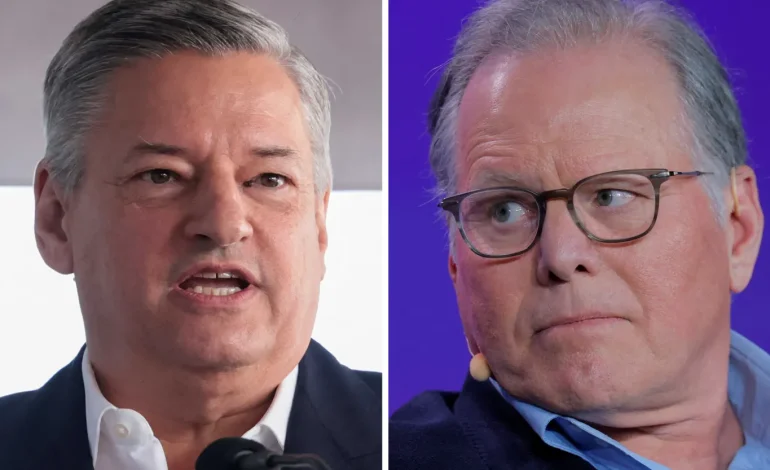
Hours before WBD agreed to sell its studio and streaming crown jewels to Netflix, Netflix co-CEO Ted Sarandos called WBD CEO David Zaslav with a message: don’t expect more money.
That’s the moment shareholders are now being asked to challenge.
Netflix’s deal values the Warner Bros. studio and HBO Max at $27.75 per share, and it includes a mix of cash and stock — with about 16% in Netflix equity under a “collar,” meaning the final value depends on where Netflix shares are when the deal closes.
Paramount’s bid, meanwhile, is blunt and simple: $30 per share, all cash, for all of WBD — including CNN and the rest of the cable networks.
That higher number is exactly why Paramount is trying to peel shareholders away from the board’s recommendation. And now Paramount has sweetened the credibility of its offer by adding a major confidence signal: Larry Ellison is personally backing the money.
On Monday, Paramount tweaked its offer in a way designed to hit WBD’s biggest criticism: financing risk.
Paramount added an “irrevocable personal guarantee” from Oracle co-founder Larry Ellison, backstopping $40.4 billion in equity financing tied to the transaction. It’s essentially a message to shareholders: this isn’t just some complicated spreadsheet of funding sources — one of the richest people alive is signing his name to it.
That matters because WBD’s board has been hammering Paramount on one theme: the original financing looked too reliant on outside partners and, in their view, too dependent on an “opaque” Ellison family trust structure. Paramount’s move tries to replace “trust us” with “Ellison guarantees it.”
And for shareholders, that change can tilt the risk calculation — even if it doesn’t answer every question about where all the money ultimately comes from.
Tendering your shares at $30 is basically saying one of two things:
“I like Paramount’s offer more than Netflix’s.”
“I want to force a bidding war.”
Let’s unpack both.
1) The all-cash appeal is real
Cash is clean. Paramount’s offer is straightforward: $30 in your hand (assuming the deal closes). Netflix’s bid is $27.75 for only part of WBD — and includes a stock component that won’t be precisely known until later.
If you’re the type of investor who hates uncertainty, Paramount’s pitch writes itself: higher price, all cash, and you don’t have to guess what Netflix stock will do.
2) Tendering can be a strategic shove
Even if you want the Netflix deal, tendering can be a pressure tactic.
Paramount has already signaled its $30 isn’t necessarily “best and final.” If enough shareholders tender, Netflix may have to decide whether Sarandos’ “we’re done” was real — or just a negotiating pose.
This is where the “game theory” comes in: plenty of shareholders don’t care who wins; they care about who pays more. Tendering can be less about loyalty to Paramount and more about turning the situation into an auction.
3) The regulatory argument
Paramount is also selling a narrative that its deal may be easier to approve than Netflix’s.
A Netflix + HBO Max combo would create an even bigger streaming monster — and Netflix already has more than 300 million global paying customers. That kind of dominance attracts political attention, and even President Donald Trump has publicly floated concerns about “market share” with a Netflix tie-up.
Paramount+ is much smaller (around 80 million subscribers), so Paramount can argue the competitive issues are less intense.
Whether regulators agree is another story — but to some shareholders, “less antitrust heat” equals “better odds of closing,” and better odds of closing equals real value.
Not tendering is also a rational move — and it sends a different message:
“I’m not convinced Paramount’s deal is safer or better.”
Here’s why.
1) Financing nerves don’t vanish overnight
Yes, Larry Ellison’s guarantee is a big deal. But some shareholders may still see Paramount’s structure as complicated — especially with a huge chunk of funding reportedly involving Middle Eastern sovereign wealth funds.
If you’re uncomfortable with the politics, the optics, or the possibility regulators scrutinize the funding sources more aggressively, you might prefer the Netflix route.
Even with Ellison stepping in, not everyone will be thrilled about the broader capital stack.
2) Discovery Global might be worth more than “a buck”
Paramount’s argument depends heavily on a brutal assumption: that Discovery Global — the cable portfolio that includes CNN, TNT, Discovery, HGTV, TBS, and others — will be close to worthless as a standalone public company.
Paramount’s CEO David Ellison has suggested it could be worth about $1 per share, based on the low multiples cable networks might get in today’s market.
But the counterpoint is simple: what if that’s wrong?
WBD disclosed that an unnamed “Company C” floated a proposal to acquire Discovery Global (and its stake in streaming/studios) for $25 billion in cash — and while WBD rejected it as “not actionable,” the mere existence of that interest hints there could be real value in the spin-off.
If Discovery Global ends up worth more than $1 per share — or if a buyer shows up once it’s separated — then Netflix’s offer suddenly looks a lot better than Paramount’s $30 headline number.
3) Not tendering can also spark a bidding war
Here’s the other chess move: some investors may believe Paramount will only raise its offer if it looks like it’s losing.
If tender results look weak as deadlines approach, Paramount may sweeten terms to win over hesitant holders. In that scenario, sitting tight isn’t passive — it’s leverage.
4) Optimism about the value of “the split”
There’s also a “safety-first” argument: if Paramount’s whole-company merger gets blocked, shareholders could be stuck holding declining cable assets without the benefits of the planned separation.
Some investors may prefer to let WBD execute its split into Discovery Global first, then see what the market assigns it — rather than risking a drawn-out regulatory fight that delays everything.
This is the part people underestimate: the tender process isn’t just a transaction — it’s a message board.
Tendering at $30 signals that shareholders either:
prefer Paramount’s cash bid,
think Paramount has a better chance of clearing regulators,
or want to force Netflix back to the table.
Not tendering signals that shareholders either:
still distrust Paramount’s financing,
think Discovery Global has upside,
or want Paramount to pay more before they move.
WBD shareholders are staring at two competing stories:
Paramount: “Take $30 cash now. Netflix is risky, and Discovery Global is basically dead weight.”
WBD + Netflix: “The Netflix deal is more valuable once you count the spin-off — and Paramount’s money comes with too many strings.”
And somewhere in the middle is the real dynamic: this may not be a clean “pick a winner” situation. For many shareholders, the best outcome is the messiest one — a bidding war where both sides keep raising the price until somebody taps out for real.


The latest news in your social feeds
Subscribe to our social media platforms to stay tuned