



What started as a casual rockhounding trip in southwest Wyoming last fall quickly turned into a once-in-a-lifetime discovery for 11-year-old Touren Pope, Oil City News reports.
While exploring public land managed by the Bureau of Land Management’s Rock Springs field office, Touren noticed something unusual on the ground. It turned out to be the fossilized remains of a soft-shelled turtle that lived nearly 48 million years ago, back when Wyoming looked more like a tropical floodplain than the high desert it is today.
At the time, the Greater Green River Basin was warm and lush, filled with rivers, streams and the remnants of ancient Lake Gosiute. The area supported crocodiles, fish, early mammals and plenty of turtles – including the one Touren unknowingly stumbled across.
That turtle, a member of the trionychid (soft-shelled) family, lived, died and was eventually buried by sediment. Over millions of years, natural processes fossilized its remains. Recently, erosion exposed the fossil at the surface – and Touren happened to be in the right place at the right time.
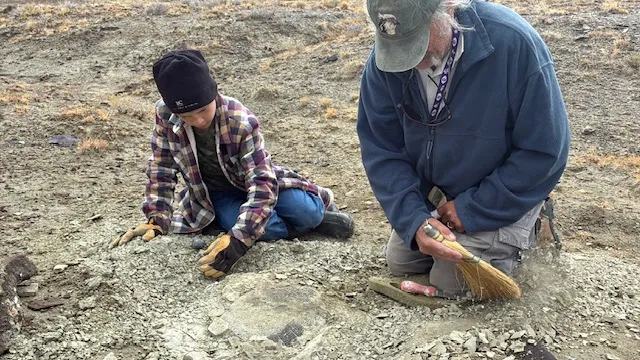
Touren was rockhounding with his grandparents, Patti and Tom Patterson, when he spotted the fossil and did exactly what land managers hope people will do: he reported it to the BLM. Paleontology staff at the Rock Springs field office were notified, and Touren’s grandparents later guided them to the site so the fossil could be documented and stabilized.
Once confirmed to be on BLM-managed land, officials moved quickly to protect it. Museum collections specialist J.P. Cavigelli from the Tate Geological Museum at Casper College volunteered to help excavate the specimen before further erosion could damage it.
In September, Cavigelli and his team returned to the site with Touren and his grandparents. The excavation revealed a nearly complete and remarkably well-preserved turtle shell, known as a carapace. While no other bones were found, the shell alone made the fossil an exceptional find.
The fossil was transported to the Tate Geological Museum, where it will be cleaned, prepared and potentially displayed for the public in the future.
Touren’s sharp eye – and his decision to report the fossil – not only helped preserve a rare piece of Wyoming’s ancient history, but also earned him a front-row seat in real-world paleontology. As a final honor, he was given permission to name the fossil.
From here on out, the ancient turtle will be known as “Little Timmy.”

The latest news in your social feeds
Subscribe to our social media platforms to stay tuned