

Wyoming’s Mega-Dinosaurs Steal the Show at Abu Dhabi’s New Natural History Museum

The original story by Andrew Rossi for Cowboy State Daily.
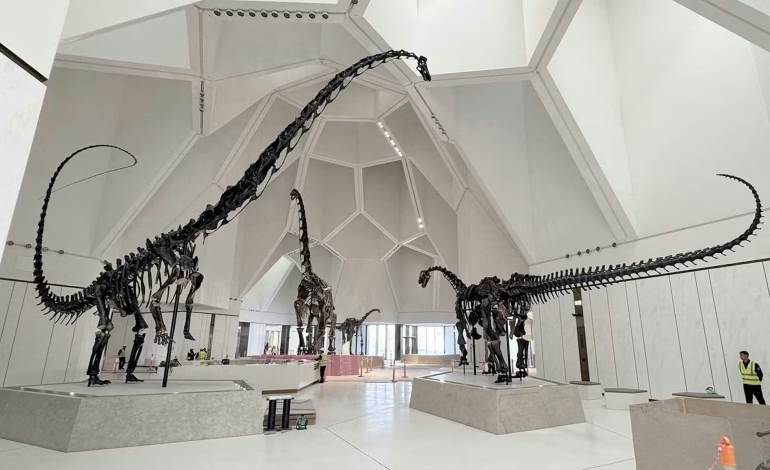
The very first thing visitors notice when they walk into the brand-new Natural History Museum Abu Dhabi isn’t subtle. Towering over the lobby are four massive, long-necked dinosaurs — and at least three of them came straight out of Wyoming’s fossil-rich ground.
The museum, which opened with plenty of fanfare in November, is the largest natural history museum in the Middle East and aims to rank among the world’s elite. To pull that off, curators had a clear wish list: jaw-dropping specimens, scientific credibility, and dinosaurs that could stop people in their tracks. Wyoming delivered.
Front and center in the 35,000-square-foot facility are four sauropods — Barosaurus, Brachiosaurus, Camarasaurus, and Diplodocus — some of the biggest animals ever to walk the Earth. Three of those giants, and possibly all four, were excavated from Wyoming’s Late Jurassic Morrison Formation, one of the most famous dinosaur-producing rock layers on the planet.
Once again, museums across the globe came knocking for Wyoming bones.
Much of the Wyoming material came from the Black Hills Institute of Geological Research (BHIGR) in Hill City, South Dakota, led by veteran fossil hunter Pete Larson. If his name sounds familiar, it’s because his team excavated “Stan,” the Tyrannosaurus rex that sold for more than $31 million in 2020 and now serves as another Abu Dhabi showpiece.
After landing Stan, museum officials wanted more — and bigger.
Larson had exactly that: several enormous sauropods from the Waugh Quarry near Hulett in Crook County, a site BHIGR has been working since 1999. Until recently, many of those dinosaurs had been sitting on the shelf, impressive but homeless.
“It’s a floodplain deposit in the Morrison Formation, about 145 to 150 million years old,” Larson said. “It’s one of the youngest Morrison sites we know of.”
The museum selected three sauropods from the quarry, each at different stages of completeness. BHIGR committed to delivering fully mounted skeletons for the museum’s opening — no small task when one dinosaur stretches more than 90 feet long and another stands over 30 feet tall.
“Our lab isn’t big enough to mount them,” Larson said. “We didn’t even see them fully assembled until they were up in the museum.”
The smallest of the trio, a Camarasaurus that’s still over 60 feet long, may actually represent a new species. Ongoing research on that specimen — and another from the same quarry — suggests subtle but important differences from known Camarasaurus fossils.
The largest challenge was the Brachiosaurus. The Abu Dhabi museum wanted visitors to walk underneath it, so BHIGR mounted the front and rear halves on separate bases. The original Wyoming material was fragmentary, which meant blending real bones with casts from the most complete Brachiosaurus known, housed at Chicago’s Field Museum, and sculpting the rest.
Even the skull is special — a replica of a nearly complete, yet-to-be-described specimen found 35 miles away.
“It’s a bit of a chimerasaurus,” Larson admitted, “but it’s the only real Brachiosaurus mounted anywhere in the world — and it’s probably a new species.”
If one dinosaur steals the spotlight, it’s the Barosaurus.
Mounted rearing up on its hind legs, the 90-foot-long giant dominates the lobby. It was found about 50 miles from the site where Barosaurus was first discovered in 1889, and it’s far more complete than the original.
Larson says this is the first, best, and most accurate Barosaurus mount anywhere — and the only original skeleton of Barosaurus lentus on display in the world.
“All three of these sauropods have never been mounted before,” he said. “That’s a pretty big deal.”
The Wyoming connection doesn’t stop in the lobby. The museum also featured a traveling exhibit of five Triceratops skeletons excavated from a single site in the Powder River Basin, along with Jurassic and Cretaceous dinosaurs like Stegosaurus, Camptosaurus, Denversaurus, and Torosaurus — many of them best known from Wyoming finds.
Larson is already working on another project for the museum using fossils from Wyoming’s Lance Formation, involving three dinosaurs preserved together.
“They’re not new species,” he said, “but they tell a really interesting story.”
Back at the Waugh Quarry, digging continues. More sauropods, a partial Apatosaurus, a Stegosaurus, smaller dinosaurs, and piles of Allosaurus teeth are still coming out of the ground. Many of those fossils will eventually be displayed in BHIGR’s expanded museum in Hill City, set to open in 2027.
And while Abu Dhabi’s dinosaurs may look like finished masterpieces, Larson stresses they’re far from static displays.
“This is meant to be a research institution,” he said. “These fossils will keep contributing to science.”
For Wyoming, it’s another reminder that some of the world’s most spectacular dinosaurs didn’t just roam the American West — they’re now wowing visitors half a world away.


The latest news in your social feeds
Subscribe to our social media platforms to stay tuned