

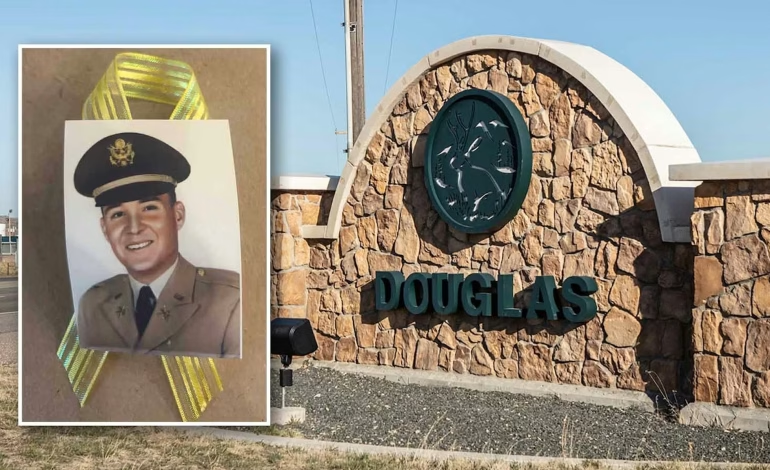

Nearly 50 years after a Wyoming man died in Vietnam, his family discovered reel-to-reel recordings he sent home. “Just hearing daddy’s voice was overwhelming,” said a daughter about a new perspective of her dad she could never have appreciated as a child.
Rhonda Jo McLean was 5 years old the last time she saw her father in 1967. She remembers watching out the window of the family station wagon as an airplane carried him to a faraway place called Vietnam. Her father died three months later while flying a reconnaissance mission for the U.S. Army.
What followed for her was a childhood with little room for the past. McLean lived in nine cities and towns across Washington, Colorado and Wyoming as her mother remarried several times. Her father’s death was rarely discussed. The memory of her father faded, and so did her understanding of what his death stood for.
Then an old leather suitcase surfaced in a storage unit in Riverton in 2014. Inside were reel-to-reel tapes the family had sent back and forth during her father’s time in Vietnam — voices recorded by her mother Ruthie, her siblings Bill and Shawn, herself, and her father, Capt. William Graves, then 27.
Soon after, Rhonda sat with her sister Shawn in Shawn’s living room, a digitized copy of the tapes queued up on a home stereo. But they hesitated. “We just sat and waited there for a while. It was really hard to hit the ‘play’ button,” said McLean. She was frozen by a sudden memory. It was the night she woke to the sound of her sister sobbing beside her in bed and learned that her father was gone. Now, 47 years later, she was crying beside her sister again.
“Her and I both had tears. I’m really glad we were together when we listened to it,” she said. “Just hearing daddy’s voice was overwhelming, because I didn’t remember it. Then I said, ‘How cute my sweet little voice is!'” The recordings stirred old memories, but for McLean, they also felt like discovery. It was a chance to understand her family’s story in a way she couldn’t have as a child.
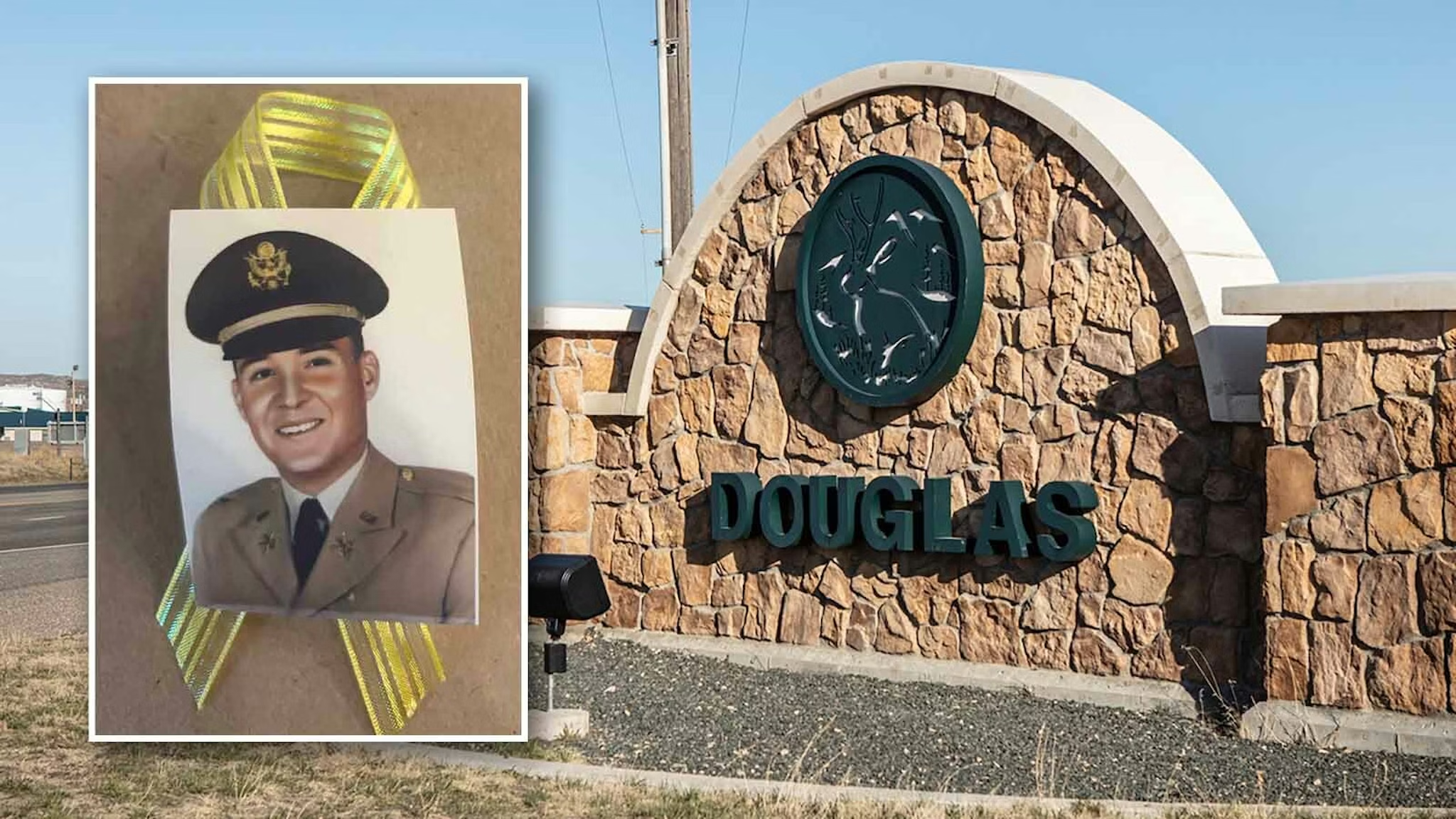
Before he was Capt. William Graves, U.S. Army, he was Bill from Douglas — a popular football player with handsome dark eyes and charming confidence, according to his youngest sister, Linda Fabian. He’d always wanted to fly airplanes. As a teenager, he liked to pretend his 1940s-era Ford coupe was an airplane, revving the engine as though it were preparing for takeoff. He lied about his age to join the National Guard at 17. He married his high school sweetheart Ruthie a year later. By 22, they had three children. He enlisted and went to Officer Candidate School and learned to fly.
Even in war, Graves held on to humor and assurance. By the time his youngest daughter could hear those qualities, she was older than he ever lived to be. “Rhonda … you’d really be a prize over here, young lady, cuz all the people over in this part of the world have very dark, black hair,” said Graves in one of the recordings. “If I brought you over here with your blond hair and that long ponytail, I bet I could sell you for … oh, I’ll bet I could get at least 5 or 10 dollars for you. What do you think about that?”
The tapes do not document the war so much as capture a family’s best efforts to preserve normalcy and connection in the face of uncertainty and separation. What matters most is often not what is said, but how it is said, as well as what is deliberately left out.
“You know kids, a long, long time ago, the American people … fought wars too because they wanted to be free — they wanted to be democratic,” he said, explaining the meaning of his absence in a soft and fatherly tone. “They had wars with England and different people and they established a real nice government — and that’s what we have now. But the South Vietnamese people don’t have this kind of freedom and that’s what we’re trying to help them get.”
He makes only one admission of danger. “We have a lot of bugs over here. It’s worse than Fort Rucker,” he said. “Daddy stands around here half the time with his spray can, but the Army spray isn’t too good. Shawn, you and Billy and Rhonda go down and you can get Daddy a can of Black Flag bug spray.”
The children respond in kind. “I’ve been trying to be good, but I said naughty words,” said an 8-year-old Shawn. “I’m trying not to say ’em anymore.”
The tapes also capture exchanges between Graves and his wife. “I don’t like making tapes, but I sure like playing yours,” Ruthie said. He jokes about reaching out for her in the night, but finding the wall of his bunk instead. “Keep the bed warm and Daddy will be home one of these days,” he tells her. “Maybe when we go to Hawaii, I’ll show you that little trick I learned over here in the Orient.”
Ruthie scolds him for getting too familiar with other women. “What do you mean teaching some girl to shine your boots?” she asks. “I’m so mad I could chew up nails and spit out tacks. I’m the only one that’s supposed to get to shine those beside you.”
Despite his confidence, Graves’ vulnerability also surfaces. “I’m starting to get worried the other way,” he said. “You’re getting so darn good at doing things by yourself you won’t want me to come back.” A moment later, the tone softens again. “I love you very, very much and I miss you … gobs! And I think I probably love you more than you love me.”
Linda Fabian, Graves’ youngest sister, was the first to rediscover the recordings after a fire damaged a relative’s storage unit. She remembers sitting with her sister in the office of Wyoming historian Sue Castaneda when she heard her brother’s voice play back for the first time. “It really took our breath away. It seemed surreal,” Fabian said. “I thought, ‘Wow, are we lucky to get to hear the voice one more time!'”
Though they thought of him often, they rarely spoke of him, as though acknowledging the loss outwardly would make it harder to bear. Hearing her brother’s voice decades later made her wonder if the pain might have been eased if they’d talked more openly. “If I could go back, I would have that talk in a minute,” she said.
Not everyone in the family has wanted to hear the tapes again, including Ruthie and Graves’ son Bill. “My mom never listened to it. My brother still will not listen to it,” said McLean.
Whatever Capt. William Graves’ expectations for his son, the tapes show his deep affection. “Tell that son of mine that I’ll be real glad to get back and do things with him too,” Graves said on the last tape he ever sent home. “I always carry that little ‘wishnik’ that he gave me. I never fly anyplace without it. I carry it in my pocket anytime we fly.”


The latest news in your social feeds
Subscribe to our social media platforms to stay tuned