

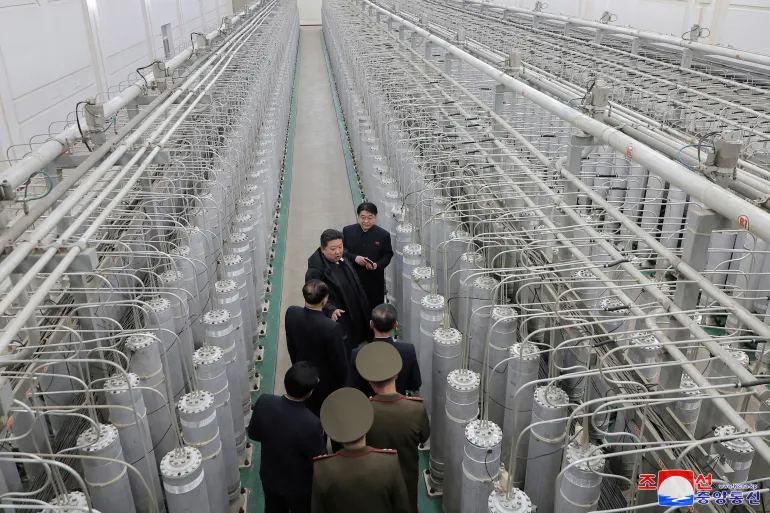


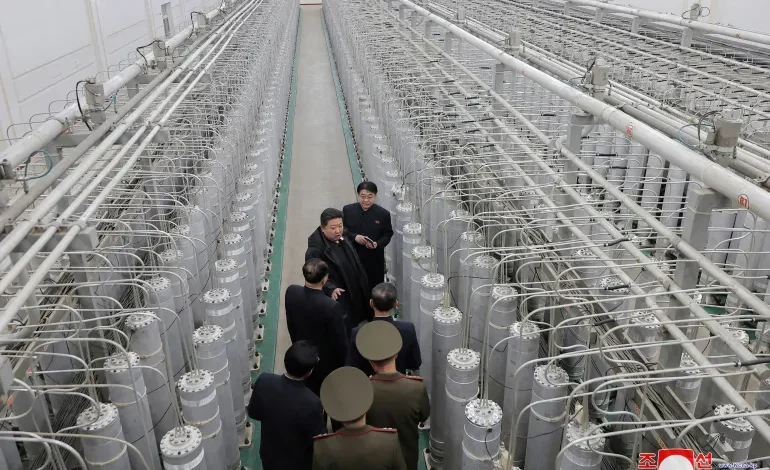

North Korea has doubled down on its nuclear stance, telling the United Nations it will not be bound by any agreement aimed at limiting atomic weapons and that its status as a nuclear-armed state is not up for negotiation.
Kim Song made the remarks in a statement carried by state media on Thursday, as delegates gathered for the latest review conference of the Nuclear Non-Proliferation Treaty. The comments were framed as a direct response to criticism from the United States and its allies over Pyongyang’s nuclear programme.
“At the 11th NPT Review Conference currently under way at UN headquarters, the United States and certain countries following its lead are groundlessly calling into question the current status and exercise of sovereign rights,” Kim said, according to the Korean Central News Agency.
“The status of the Democratic People’s Republic of Korea as a nuclear-armed state will not change based on external rhetorical claims or unilateral desires,” he added. “To make it clear once again, the Democratic People’s Republic of Korea will not be bound by the Non-Proliferation Treaty under any circumstances whatsoever.”
The position is consistent with North Korea’s trajectory since it withdrew from the NPT in 2003. Since then, it has conducted six nuclear tests, accumulated what is widely believed to be dozens of warheads, and faced multiple rounds of UN Security Council sanctions.
Kim said the country’s nuclear status has been “enshrined in the constitution, transparently declaring the principles of nuclear weapons use,” reinforcing Pyongyang’s long-standing claim that its programme is both permanent and non-negotiable.
The statement lands at a moment when nuclear issues are back at the centre of global politics. Tensions tied to the US-Israel war on Iran have revived debates over non-proliferation, with Donald Trump insisting that Tehran — itself an NPT signatory — must never acquire a nuclear weapon. Iran denies pursuing one and has argued for its right to enrich uranium.
Beyond the Korean Peninsula, the broader nuclear balance remains heavily concentrated. According to the Stockholm International Peace Research Institute, the world’s nine nuclear-armed states — Russia, the US, France, the United Kingdom, China, India, Pakistan, Israel and North Korea — held a combined 12,241 warheads as of January 2025. The US and Russia account for nearly 90 percent of that total and are both engaged in ongoing modernisation programmes.


The latest news in your social feeds
Subscribe to our social media platforms to stay tuned