
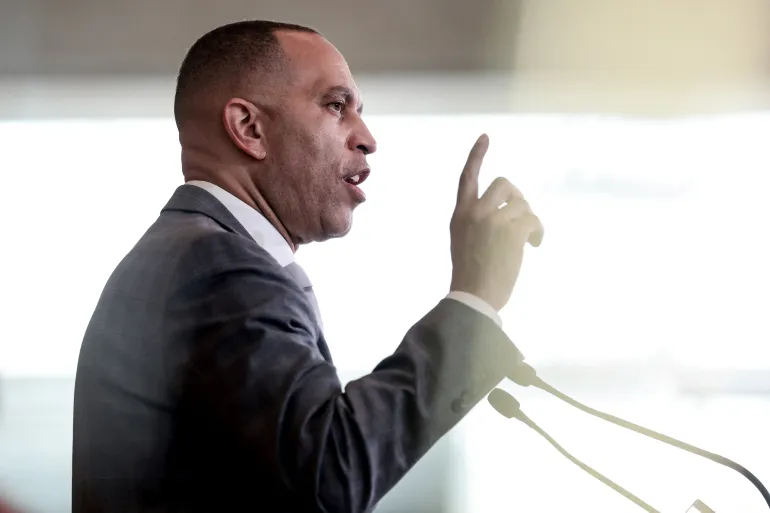



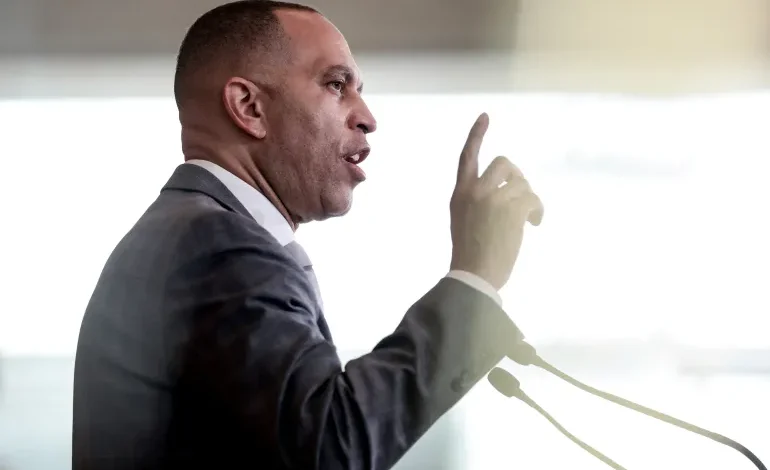


A fight over congressional maps in Virginia has turned into a broader confrontation over race and political rhetoric after the office of Hakeem Jeffries accused Republican lawmaker Jen Kiggans of endorsing racist language on live radio.
The dispute began during an appearance on a conservative talk show hosted by Rich Herrera, where the conversation focused on redistricting and Democratic efforts to reshape Virginia’s congressional map ahead of the November midterm elections.
Criticizing Jeffries, who represents a district in New York City, Herrera said he should either move to Virginia or “get your cotton-picking hands off of Virginia”.
“That’s right. Ditto,” Kiggans replied. “Yes. Yes to that.”
The phrase “cotton-picking” carries a well-known historical association in the United States, rooted in the forced labor of enslaved Black Americans on Southern plantations.
Kiggans later sought to distance herself from the remark.
“The radio host should not have used that language and I do not — and did not — condone it,” she said.
“It was obvious to anyone listening that I was agreeing Hakeem Jefferies should stay out of Virginia.”
Jeffries’s office was not persuaded.
His spokesperson, Christie Stephenson, issued a statement that left little room for ambiguity.
“Extremists who endorse disgusting, vile and racist language are pathetic,” Stephenson said.
“Jen Kiggans has no interest in our nation’s progress toward a multiracial democracy and apparently craves a return to the days of Jim Crow racial oppression in the South.”
The response quickly drew support from leading Democrats, including Katherine Clark and Gavin Newsom, both of whom called for Kiggans to resign.
The Congressional Black Caucus amplified the controversy by posting the exchange online and adding:
“Did she agree with him? Yes. Is this racist? Yes. Should she resign? Yes to that, too.”
The incident lands at a politically charged moment.
Redistricting has become one of the most contentious issues in US politics as both parties search for advantages ahead of the midterm elections. Although electoral maps are usually redrawn once every decade after the census, several states have reopened the process after renewed pressure from Donald Trump and his allies.
Virginia has emerged as one of the central battlegrounds. Voters approved a revised congressional map in April that would have created more Democratic-leaning districts, but the Supreme Court of Virginia later invalidated it. Democrats are now asking the Supreme Court of the United States to intervene.
The larger legal backdrop has only intensified the stakes.
A recent Supreme Court ruling weakened a key provision of the Voting Rights Act of 1965, making it harder to challenge maps that dilute minority voting power unless explicit racist intent can be shown.
Civil rights advocates argue that proving such intent is extraordinarily difficult, raising concerns that the decision will accelerate efforts to redraw districts in ways that reduce Black political representation.
Against that backdrop, language that might once have been dismissed as a radio gaffe is being treated as part of a deeper struggle over who holds power and how race continues to shape American politics.


The latest news in your social feeds
Subscribe to our social media platforms to stay tuned