




The Financial Times and CNN contributed to this report.
For decades, China has been a country of homeowners. Buying a place was not just a milestone; it was practically a rite of passage, one that helped fuel the world’s second-largest economy and shaped the lives of millions.
That model is now looking shakier.
When China’s old welfare housing system faded out in the 1990s, the country moved toward private ownership fast. Government policy and deep cultural expectations lined up neatly, creating a homeownership rate that would look almost absurd in much of the West. In China, plenty of people start thinking about their first apartment soon after graduation. In the United States, many are still paying off student debt well into their 30s and renting because there is little other option.
But the property market is no longer the unstoppable force it once was.
Last year, new home sales fell to their lowest value since 2014, according to official figures, dropping to 7.3 trillion yuan, or about $1.06 trillion. At the peak of the boom in 2021, that figure had been 16.2 trillion yuan, roughly $2.3 trillion. By volume, sales slipped 8.7% last year, and economists at Macquarie said in January they saw “no end in sight” for the slide.
That slowdown is changing how people think. A mortgage used to look like a ticket to security and status. Now, for many, it looks like a risk.
Take Cai Youcheng, a 36-year-old graphic designer in Beijing. He has put off buying for now. Renting, he says, can feel temporary and a little rootless. He does not love the idea of living somewhere he cannot fully make his own. Still, the math has him leaning toward renting, at least for the moment.
“For me personally, if you really do the math, renting actually makes more sense,” he said. “But deep down, I still really want to own a place of my own.”
That tension runs through Chinese society. Home ownership is tied to far more than wealth. It can signal adulthood, responsibility, family duty and social standing all at once. As Eric Fong, chair professor in sociology at the University of Hong Kong, put it, Chinese cultural values place huge weight on family, and home sits right at the center of that.
The modern homeownership boom really took off in the 1980s, when China opened up its economy and began stepping away from employer-provided housing. Then came the 1990s, when subsidies made buying a home far more accessible. Overnight, millions who had once been renters became owners.
“A lot of people, overnight, became homeowners at a very cheap price,” said Huang Youqin, professor of geography and planning at the University at Albany. “That converted a lot of people who used to be renters, into homeowners.”
China’s other deep habit – saving – fed the property frenzy too. As home prices climbed, apartments became the go-to place for household wealth. There were few other obvious options, and for many families, real estate felt safer than anything else.
There were also social reasons. Rural migrants often felt more accepted in cities if they owned a home. Parents bought apartments for their children to help them look more settled, and in some cases, more marriageable. In that kind of environment, buying property was not just about investing. It was about belonging.
The result was a country with one of the highest homeownership rates in the world. Surveys and academic research have repeatedly put the figure at about nine in 10 households.
That stands in sharp contrast with the West. In the US, homeownership is around 65%, according to the OECD Affordable Housing Database. Many younger adults are juggling rents, loans and high prices, with little hope of buying soon.
China’s property market, though, grew so big that it could not stay healthy forever.
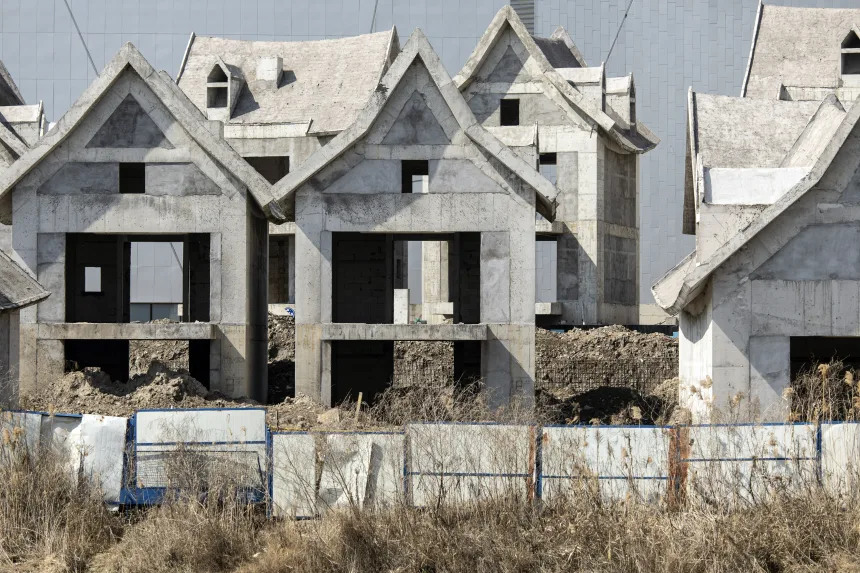
During the boom years, developers loaded up on debt. Cities ended up with oversupply, empty towers and half-finished districts. Local governments, eager to keep growth numbers looking strong, made the problem worse in some places. By 2020, Beijing moved to clamp down on the sector, which at one point accounted for about 30% of economic activity.
The cleanup was necessary. It also hit homeowners hard.
Prices fell. Buyers were left with delayed or unfinished apartments. Big developers stumbled or collapsed. Evergrande, once the country’s largest developer, was ordered to wind up by a Hong Kong court in 2024. Country Garden narrowly escaped a similar fate. Vanke is still waiting on an $11.6 billion rescue package from a local government.
Now the pain from that crash is feeding into the wider economy. Domestic demand is weak. Trade tensions with the U.S. keep hanging over the outlook. Even with the government trying to steady the market, confidence is thin.
Cushman & Wakefield’s Zhang Xiaoduan says the gap between official hopes and real buyer sentiment remains obvious.
“There’s still a gap between these signals and a real pickup in actual buying power across the market, or a rapid recovery driven by that demand,” she said.
That caution is easy to hear on the ground.
Mandy Feng, a 30-year-old photographer in Kunming, said the government’s stimulus measures have not done much to erase people’s anxiety. She uses a pseudonym because she does not want to be seen as criticizing the authorities. Property prices may be lower, she said, but that does not matter much when incomes feel shaky and the outlook is cloudy.
“It isn’t the case that people aren’t unwilling to buy,” she said. “But when everyone is struck by unstable income and isn’t making a lot of money, no one dares to get a mortgage.”
That fear is spreading. Five years after the first big wave of defaults, the sector still looks bruised. New home prices fell again nationwide in March, even though some big cities saw a slight monthly improvement.
The government still wants the market to stabilize, but analysts say Beijing is not eager to restore property to the giant role it once played in driving growth. The political focus has shifted toward technology and industrial upgrades, not another debt-fueled housing surge.
That leaves people like Cai waiting. He says he still wants to own a home one day, just not soon.
“I do plan to buy a home at some point, but probably not in the next few years,” he said. “I don’t see myself buying anytime soon.”
The shift is more than economic. It is cultural too. A younger generation is starting to look at housing differently from their parents, and even their grandparents. Owning a home still matters. It just does not feel as automatic as it once did.
Zoe Zhang, a 35-year-old public relations director and mother, says she is unlikely to buy homes for her own children, even though her current apartment in Beijing was bought with help from her parents.
“China’s market is gradually becoming more similar to Western countries, where renting might become more mainstream in the future,” she said.
That may be the clearest sign yet that the old script is changing.


The latest news in your social feeds
Subscribe to our social media platforms to stay tuned