


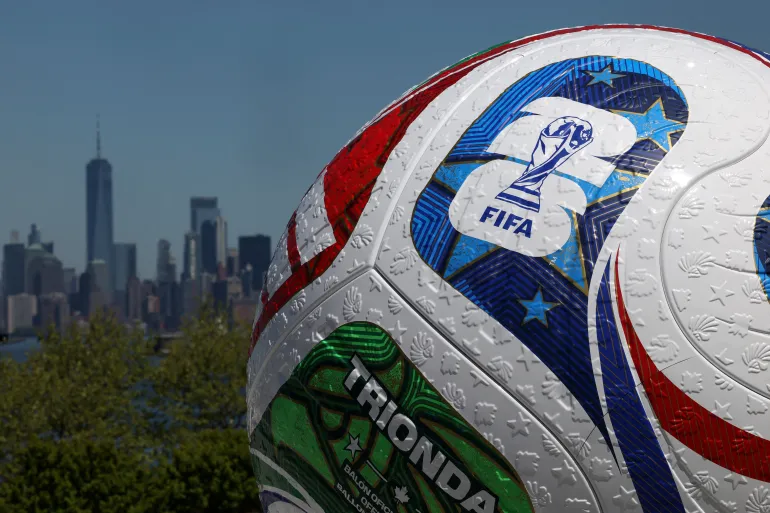



As the countdown to next month’s World Cup accelerates, football fans are flooding social media with AI-generated anthems supporting their national teams — and in many cases, the unofficial tracks are drawing more attention than FIFA’s official soundtrack.
Across TikTok, YouTube and Instagram, fan-made songs for countries like France, Brazil, Portugal and Argentina are collecting millions of plays. Built around repetitive chants, player name roll calls and high-energy phonk beats, the tracks are designed less as polished music and more as instantly shareable internet fuel.
The trend has emerged at an awkward moment for the music industry, which is still trying to define where artificial intelligence fits into questions of authorship, ownership and creative value.
FIFA itself commissioned an official World Cup anthem from musicians Jelly Roll and Carin León, while Shakira released a separate high-profile tournament track last week. But online attention has increasingly drifted toward songs made not in studios, but through AI-assisted production pipelines and viral templates.
The format became especially visible after the release of “Imbattables”, a France-themed track launched in February by Crystalo, who describes himself on Spotify as France’s “premier AI musical creator”. The song opens with a crowd-style chant naming stars including Kylian Mbappé before dropping into a heavy electronic rhythm clearly designed for short-form social media clips.
A Brazilian version followed soon after. Producer Guilherme Maia — known professionally as M4IA — said he used AI tools to help assemble parts of the production, layering generated elements into a final track rather than creating the entire song through a single text prompt.
But once the Brazilian song gained traction, dozens of near-identical versions appeared online. Portugal’s anthem crowned Cristiano Ronaldo as the squad’s “king”. Argentina’s version did the same for Lionel Messi. Many reused the same structure, the same pacing and even the same musical cues.
“What I see happening now is more about people following a trend or trying to recreate a feeling,” Maia told AFP, noting that imitation has always existed in music culture.
Still, he acknowledged that AI muddies already sensitive boundaries around creative ownership.
“In music, there are clear rules. You can’t just copy someone else’s work or use samples without permission, even if AI is involved.”
That legal and ethical uncertainty sits at the centre of the debate now unfolding around AI-generated music. Critics argue that many generative models are trained on copyrighted material without clear consent or compensation structures for artists.
“It had to come from somewhere,” said Jason Palamara, assistant professor of music technology at Indiana University, referring to the datasets used to train music-generation systems.
The technology also continues to expose its limitations in small but revealing ways. A Portugal fan anthem circulated online with a distinctly Brazilian vocal accent. Meanwhile, a Colombian World Cup track reportedly pronounced James Rodriguez’s name using English phonetics instead of Spanish pronunciation.
Palamara argued that AI-generated music can also feel flattened compared with traditional production.
“It’s one compact product, rather than a product where there are multiple tracks that have gone into it, where it has more texture.”
But the success of the songs may point to a more uncomfortable reality for the industry: many listeners simply do not care how the music was made.
“There seems to be a cohort of people who actually don’t care,” said Morgan Hayduk, co-CEO of music rights software company Beatdapp.
“They like the music, and they like the back story that it came from a large language model and not a songwriter or a group.”
That may explain why AI-generated football songs are proving particularly effective. They are simple, repetitive, instantly recognisable and built for chanting in crowds, remixing into memes or dropping into advertisements — exactly the kind of quick-turnaround content AI currently handles well.
For the music business, though, the viral World Cup tracks are becoming more than a novelty. They are an early test case for what happens when mass participation culture collides with generative AI at internet speed.
“Knowing what goes into a generative output, like a World Cup fan song, is the thorny Rubicon that the music industry has to cross now.”


The latest news in your social feeds
Subscribe to our social media platforms to stay tuned